UN commission report accuses Israel of genocide in Gaza conflict
Source:The Hindu ↗
Why It Matters
The accusation of genocide by a UN-appointed independent commission is a highly significant development in international law and global geopolitics. For UPSC aspirants, it is essential for understanding the mechanisms of international human rights law, the application of the 1948 Genocide Convention, the functioning of bodies like the UN and ICJ, and the broader geopolitical implications for the Middle East and international diplomatic relations.
Summary
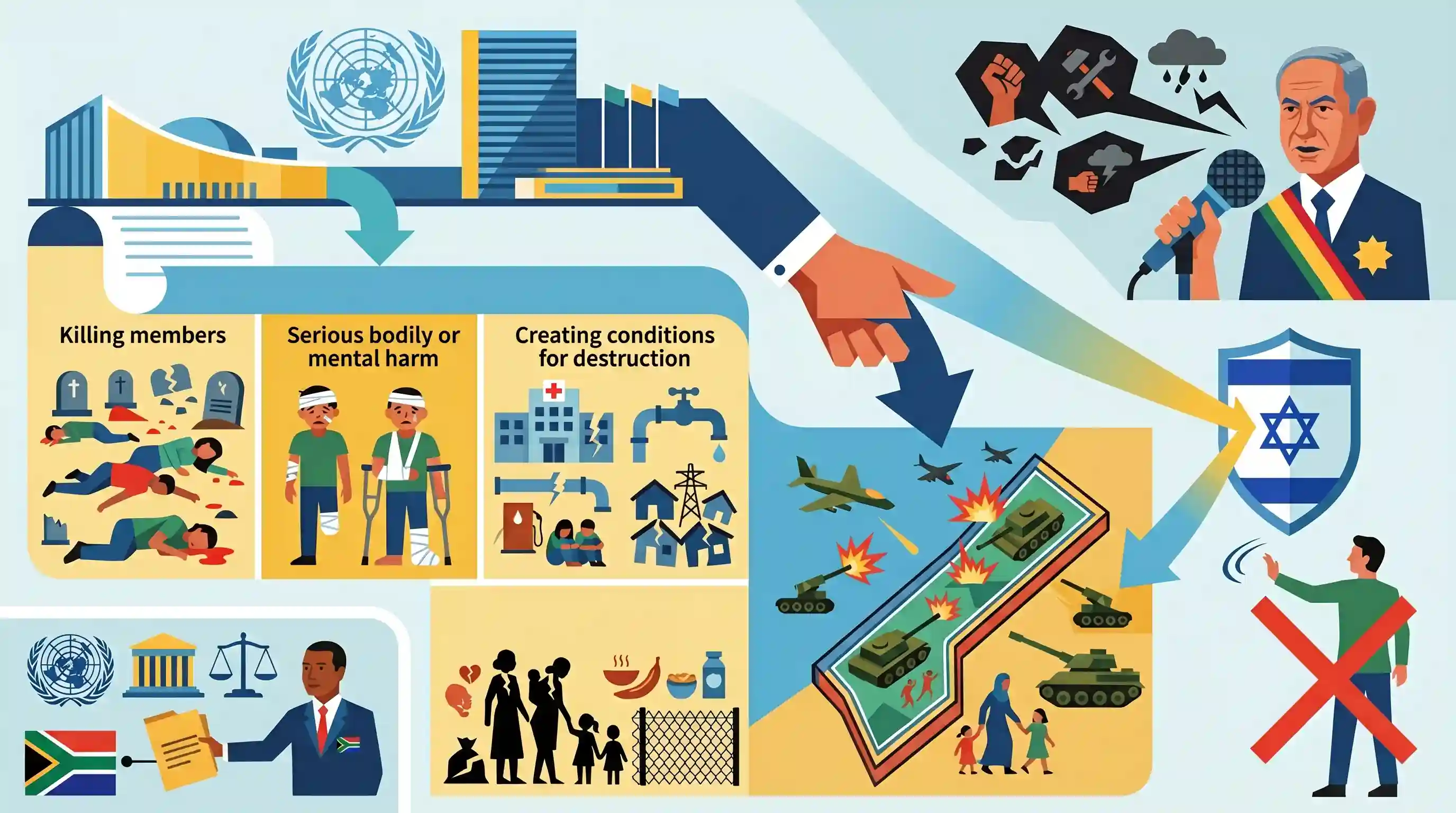
A United Nations Commission of Inquiry report has concluded that Israel is committing acts of genocide against Palestinians in the Gaza Strip. The investigation found that Israeli military operations fulfill four out of the five definitions of genocide outlined in the 1948 U.N. Genocide Convention. Crucially, the report accuses high-ranking Israeli officials, including Prime Minister Benjamin Netanyahu, of demonstrating "genocidal intent" by repeatedly employing dehumanizing language that encouraged and facilitated war crimes. The findings highlight a deliberate strategy to maximize civilian damage, severely impacting women, children, and vital infrastructure. Israel has fiercely rejected the report, labeling it "distorted and false," amid an ongoing genocide case brought by South Africa at the International Court of Justice.
Key Points
- A United Nations Commission of Inquiry report concluded that Israel is committing "genocide" against Palestinians in Gaza.
- The report stated that Israel's actions match four of the five acts defined in the 1948 U.N. Genocide Convention.
- High-ranking Israeli officials, including Prime Minister Benjamin Netanyahu, are accused of displaying "genocidal intent" through the repeated use of dehumanizing language.
- The commission found an intentional strategy to cause maximum damage to the civilian population, heavily impacting women, children, and infrastructure.
- Israel vehemently rejected the report as "distorted and false," while simultaneously fighting a separate genocide case brought by South Africa at the International Court of Justice (ICJ).
Important Terms
1948 U.N. Genocide Convention

The first human rights treaty adopted by the UN General Assembly, it criminalizes genocide and obligates signatories to prevent and punish acts intended to destroy protected groups.
UPSC context
GS Paper 2 (International Relations); tests knowledge of international legal frameworks and human rights treaties.
International Court of Justice (ICJ)
The principal judicial organ of the United Nations, based in The Hague, responsible for settling legal disputes between states and providing advisory opinions.
UPSC context
GS Paper 2 (International Institutions); crucial for understanding global governance and judicial mechanisms.
UN Commission of Inquiry (CoI)
An independent panel established by the UN Human Rights Council to investigate alleged human rights violations and international crimes in specific conflict zones.
UPSC context
GS Paper 2 (Important International Institutions); focuses on international monitoring and human rights accountability.
Hamas
A Palestinian Islamist politico-military organization that has governed the Gaza Strip since 2007 and is central to the ongoing conflict with Israel.
UPSC context
GS Paper 2 (International Relations); relevant for regional geopolitics and the role of non-state actors.
United Nations (UN)
An intergovernmental organization founded in 1945 to maintain international peace and security, develop friendly relations among nations, and promote social progress.
UPSC context
GS Paper 2 (International Organizations); foundational for topics on global governance and multilateralism.
Prelims Trap
"The International Court of Justice (ICJ) prosecutes individual political leaders for the crime of genocide."
The ICJ only adjudicates disputes between sovereign states. The International Criminal Court (ICC) is the body responsible for prosecuting individual political or military leaders.
Static Concepts Connected
What constitutes 'Genocide' under the 1948 UN Convention?
- Five Definitional Acts: Includes killing, causing serious harm, inflicting destructive living conditions, preventing births, and forcibly transferring children of a specific group.
- Genocidal Intent: Requires 'dolus specialis'—the specific intent to destroy a national, ethnic, racial, or religious group in whole or in part.
- State Obligation: All ratifying parties are legally bound to prevent and punish acts of genocide, establishing universal obligations.
How do the ICJ and ICC differ in jurisdiction and structure?
- Origin & Affiliation: The ICJ is the principal judicial organ of the UN. The ICC is an independent body established by the Rome Statute (not a UN organ).
- Subject Jurisdiction: The ICJ strictly resolves contentious legal disputes between sovereign States. The ICC investigates and prosecutes individual persons.
- Enforcement Mechanism: The ICJ relies on the UN Security Council for enforcement. The ICC relies entirely on the cooperation of its member states to arrest suspects.
Cross-Topic Patterns
ICJ enforcement + UNSC Veto power
The ICJ case brought by South Africa highlights how binding international rulings can be completely paralyzed by the veto power of permanent UNSC members during the enforcement stage.
Erga Omnes obligations + Universal Jurisdiction
The invocation of the Genocide Convention by a third-party state (South Africa) tests the principles of "erga omnes" obligations, where all states have a legal interest in protecting fundamental human rights.

Expect a 2026 prelims statement-based question contrasting the ICJ (state disputes) and ICC (individual prosecution) mandates and funding.
Linked PYQs · 3
Linked PYQs · 3
- 2025MainsGS2
"The reform process in the United Nations remains unresolved, because of the delicate imbalance of East and West and entanglement of the USA vs. Russo-Chinese alliance.” Examine and critically evaluate the East-West policy confrontations in this regard.
- 2018MainsGS2
“India’s relations with Israel have, of late, acquired a depth and diversity, which cannot be rolled back.” Discuss.
- 2021MainsGS4
“Refugees should not be turned back to the country where they would face persecution or human right violation.” Examine the statement with reference to ethical dimension being violated by the nation claiming to be democratic with open society.
