COP30 climate summit and global failure on emission targets
Source:Indian Express ↗
Why It Matters
Provides critical insights into the real-world bottlenecks of global climate negotiations, including the gap between climate commitments and actions (such as continued fossil fuel subsidies), climate finance challenges, and the lack of leadership from major emitters. This is highly relevant for GS-3 Environment and GS-2 International Relations topics on global groupings.
Summary
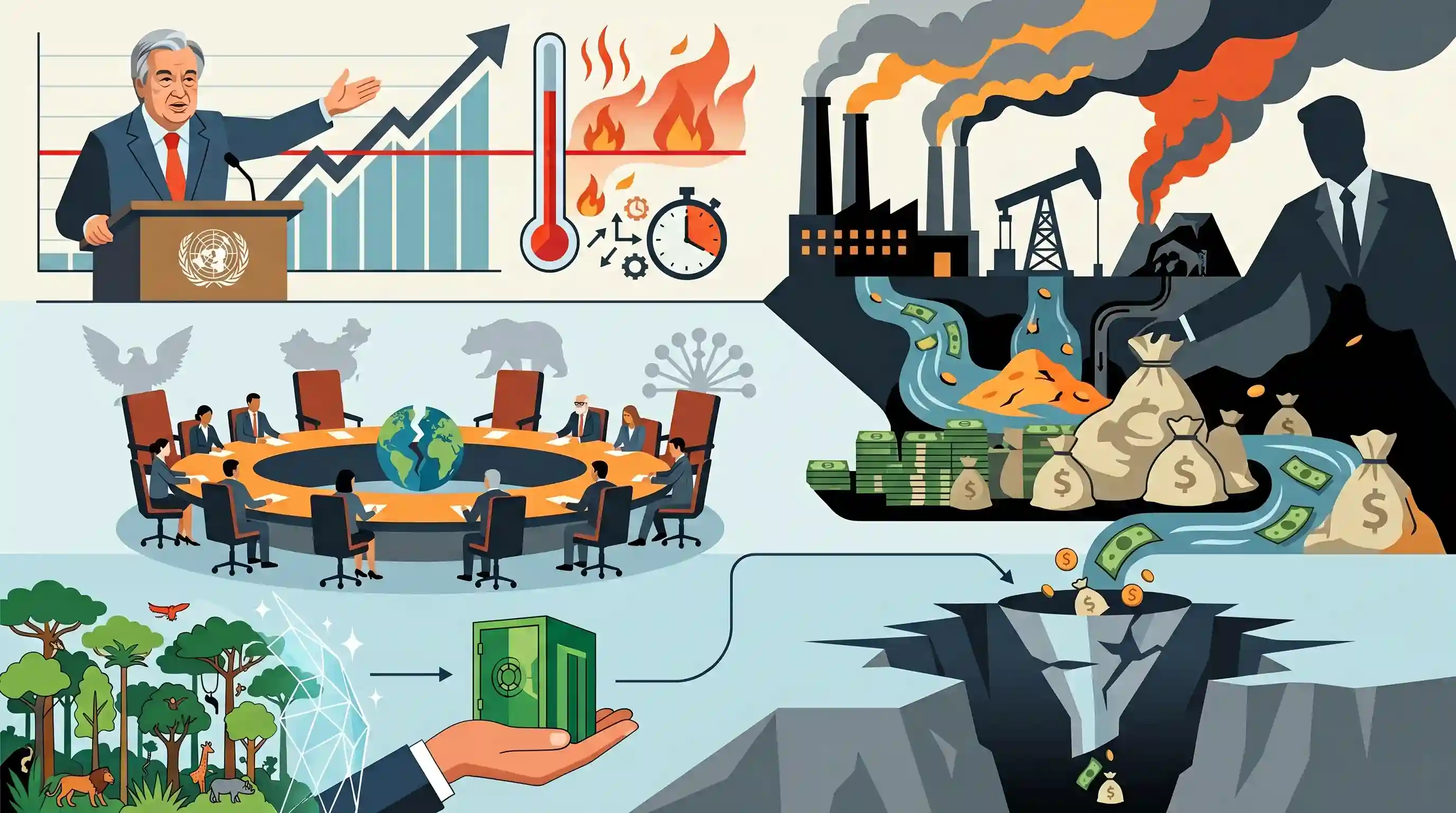
At the COP30 leaders' summit in Belem, Brazil, UN Secretary-General Antonio Guterres strongly criticized global powers for failing to implement measures necessary to limit global warming to the 1.5-degree Celsius target, warning the threshold could be breached by 2030. He highlighted the detrimental impact of ongoing fossil fuel subsidies, which amount to $1 trillion annually, and corporate lobbying by the fossil fuel industry. The summit's effectiveness was undermined by the absence of key leaders from major polluting nations—the US, China, India, and Russia—exposing severe challenges to multilateralism in global climate negotiations. Additionally, Brazil advocated for the 'Tropical Forest Forever Facility' to fund forest conservation, though financial commitments have significantly fallen short of expectations.
Key Points
- Global warming is on track to cross the critical 1.5-degree Celsius threshold around 2030, according to the UN Secretary-General.
- Governments continue to subsidize fossil fuels with approximately $1 trillion annually, severely undermining climate mitigation goals.
- The COP30 leaders' summit in Brazil saw the absence of heads of state from top polluting nations (US, China, India, Russia), highlighting challenges to multilateral climate cooperation.
- Brazil is pushing the 'Tropical Forest Forever Facility' to compensate countries for preserving tropical forests, though initial funding is expected to be around $10 billion, far short of the $125 billion target.
- Fossil fuel corporations face criticism for expanding production and lobbying against climate policies while reaping record profits from climate devastation.
Important Terms
Tropical Forest Forever Facility (TFFF)

A Brazil-led financing mechanism that pays tropical nations for conserving standing forests using returns from a proposed $125 billion trust fund, requiring 20% of funds to go to indigenous communities.
UPSC context
GS3: Environment. Tests knowledge of innovative climate finance models and 'results-based' conservation payments as alternatives to traditional grants.
Paris Agreement
The 2015 legally binding international treaty aiming to limit global warming to well below 2°C, preferably 1.5°C, through self-determined climate targets (NDCs).
UPSC context
GS2/GS3: International Treaties/Environment. A core syllabus topic; tests understanding of NDCs and global climate governance.
Climate Finance
Financial support—from public, private, or alternative sources—to assist developing countries in climate change mitigation and adaptation (e.g., the New Collective Quantified Goal).
UPSC context
GS3: Economy/Environment. Tests knowledge of the 'Common But Differentiated Responsibilities' (CBDR) principle and global funding gaps.
Multilateralism
Diplomatic cooperation between multiple nations to address global issues; at COP30, its effectiveness was challenged by the absence of major emitters like the US and China.
UPSC context
GS2: International Relations. Tests understanding of the 'crisis of multilateralism' in the face of geopolitical fragmentation.
Fossil Fuel Subsidies
Government incentives—both direct (cash/tax cuts) and indirect (failing to price pollution)—that reduce the cost of fossil fuels, currently estimated at $1.5 trillion to $7 trillion annually.
UPSC context
GS3: Economy/Environment. Relevant for 'Energy' and 'Government Budgeting' topics; highlights conflicts between economic subsidies and environmental goals.
1.5-Degree Celsius Target
The aspirational limit for global temperature rise above pre-industrial levels to avoid catastrophic climate tipping points, which UN reports warn could be breached by 2030.
UPSC context
GS3: Environment. Tests understanding of climate science and the urgency of mitigation efforts in the 'Critical Decade' (2021-2030).
Prelims Trap
"The Tropical Forest Forever Facility (TFFF) compensates nations solely based on their success in reducing annual deforestation rates."
TFFF uniquely compensates countries for preserving existing, standing tropical forests per hectare, whereas traditional REDD+ mechanisms focus on paying for reductions in the rate of deforestation.
Static Concepts Connected
What is the REDD+ mechanism under the UNFCCC?
- Core Objective: Emerged under the UNFCCC framework to mitigate climate change by reducing greenhouse gas emissions from deforestation and forest degradation in developing countries.
- The '+' Factor: The '+' represents the conservation of forest carbon stocks, sustainable management of forests, and enhancement of forest carbon stocks.
- Results-based Finance: It operates on results-based payments, meaning developing countries are financially rewarded only after verified emission reductions are achieved through forest protection.
How do Nationally Determined Contributions (NDCs) function under the Paris Agreement?
- Ratchet Mechanism: Countries must submit updated climate action plans every five years. Each new NDC must represent a progression (greater ambition) over the previous submission.
- Legal Nature: While the specific emission reduction targets are non-binding, the procedures for submitting, updating, and reporting on NDCs are legally binding.
- Global Stocktake: A five-yearly review assesses the world's collective progress toward achieving the Paris Agreement goals, which subsequently informs the next round of NDCs.
Cross-Topic Patterns
Climate Governance & Multilateral Apathy
The absence of top emitters at COP30 mirrors the structural paralysis seen in WTO negotiations, highlighting how domestic economic priorities consistently override binding global environmental agreements.
Fossil Subsidies vs. Fiscal Policy
Trillions in fossil fuel subsidies contradict global climate finance targets. UPSC often connects such conflicting economic policies to renewable energy transition hurdles and fiscal deficit issues in developing nations.

Expect a comparative Prelims question on the 'Tropical Forest Forever Facility' versus REDD+, focusing on standing forests vs reduced rates.
Linked PYQs · 5
Linked PYQs · 5
- 2025MainsGS3
Write a review on India's climate commitments under the Paris Agreement (2015) and mention how these have been further strengthened in COP26 (2021). In this direction, how has the first Nationally Determined Contribution intended by India been updated in 2022?
- 2022MainsGS3
Do you think India will meet 50 percent of its energy needs from renewable energy by 2030 ? Justify your answer. How will the shift of subsidies from fossil fuels to renewables help achieve the above objective ? Explain.
- 2022MainsGS3
Discuss global warming and mention its effects on the global climate. Explain the control measures to bring down the level of greenhouse gases which cause global warming, in the light of the Kyoto Protocol, 1997.
- 2025PrelimsGS1
Consider the following statements : Statement I: Article 6 of the Paris Agreement on climate change is frequently discussed in global discussions on sustainable development and climate change. Statement II: Article 6 of the Paris Agreement on climate change sets out the principles of carbon markets. Statement III : Article 6 of the Paris Agreement on climate change intends to promote inter-country non-market strategies to reach their climate targets. Which one of the following is correct in respect of the above statements?
- 2022PrelimsGS1
"Climate Action Tracker" which monitors the emission reduction pledges of different countries is a :
