United Nations Warning on Global Rule of Force
Source:The Hindu ↗
Why It Matters
This article is critical for understanding the contemporary crisis of multilateralism and the failure of international institutions. It provides excellent fodder for GS2 answers on UN reforms and geopolitics, as well as GS4 case studies involving ethics in international relations, humanitarian aid, and warfare.
Summary
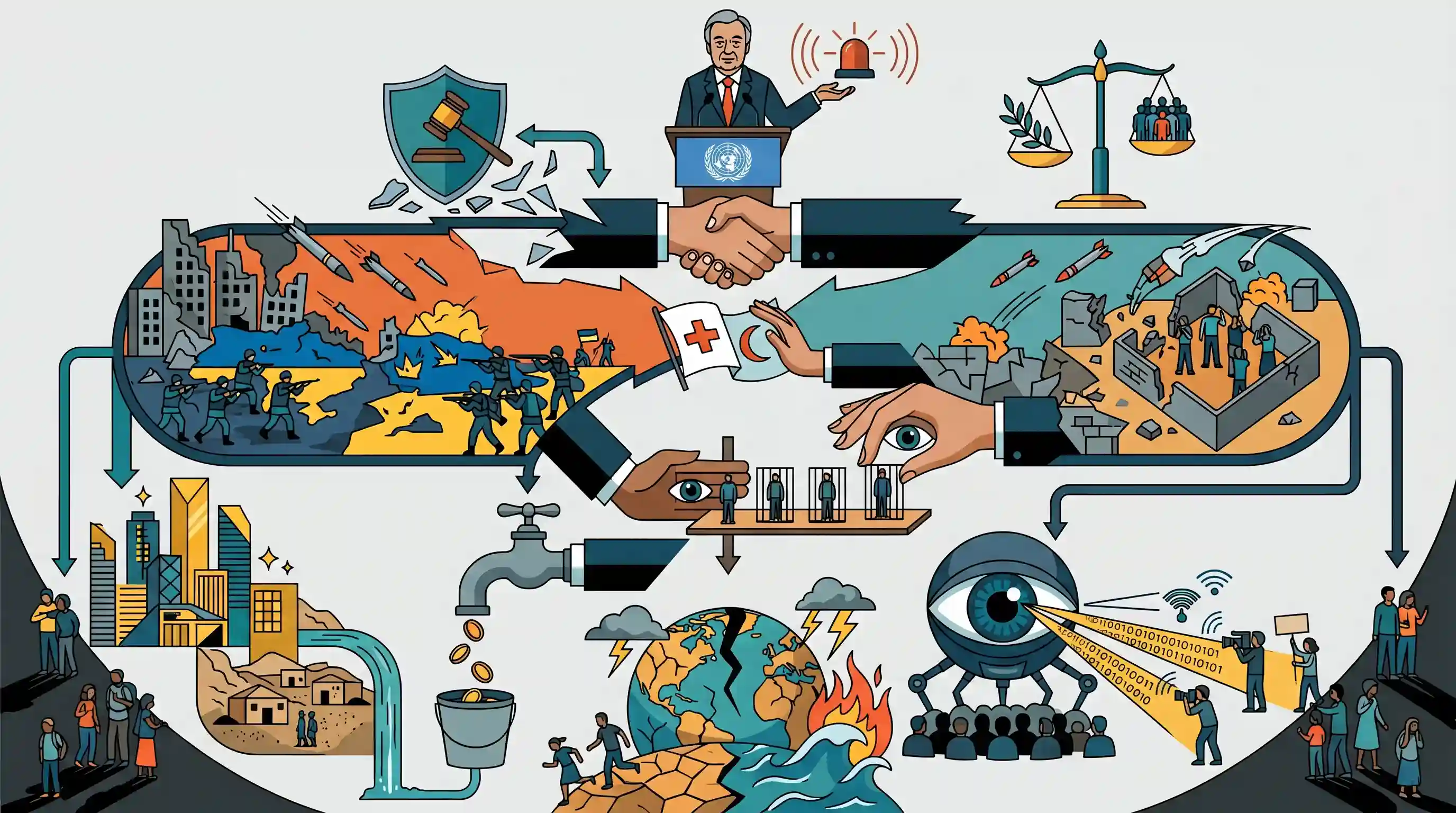
U.N. Secretary-General António Guterres has sounded the alarm on the global escalation of the 'rule of force', warning the U.N. Human Rights Council that international law and fundamental human rights are rapidly eroding. Highlighting ongoing conflicts such as the Russia-Ukraine war and the Israel-Palestine crisis, UN leaders condemned the use of civilians as 'bargaining chips' and the widespread disregard for international humanitarian law. Furthermore, deepening global inequalities, dramatic reductions in foreign aid, climate chaos, and the weaponization of Artificial Intelligence to suppress dissent are collectively pushing vulnerable groups further to the margins.
Key Points
- Global governance is facing a crisis as the 'rule of law' is increasingly being replaced by a 'rule of force', leading to unchecked domination and supremacy.
- Civilians in conflict zones (e.g., Ukraine, Israel-Palestine) are enduring immense suffering; international humanitarian law is being systematically ignored.
- New technologies, particularly Artificial Intelligence, are being increasingly weaponized to suppress human rights and silence defenders.
- Global inequalities are widening due to compounded crises, including climate change and dramatic cuts in international foreign aid, heavily impacting marginalized populations.
Important Terms
International Humanitarian Law (IHL)

A set of international rules, primarily the Geneva Conventions, designed to limit the effects of armed conflict by protecting non-combatants and restricting the means and methods of warfare.
UPSC context
GS Paper 2 (International Relations): Important for understanding global conflicts, war crimes, and India’s commitment to international treaties and conventions.
U.N. Human Rights Council (UNHRC)
An inter-governmental body within the United Nations consisting of 47 states, responsible for promoting and protecting human rights globally and addressing situations of human rights violations.
UPSC context
GS Paper 2 (International Relations): Essential for topics on important international institutions, their mandate, and India's role/re-election to such bodies.
Global Governance
The system of institutions, rules, and norms that facilitate international cooperation and collective decision-making to address transnational challenges like climate change, security, and global health.
UPSC context
GS Paper 2 (International Relations): A core concept for evaluating the effectiveness of multilateralism and the reform of international organizations.
Rule of Law
A principle of governance where all persons and institutions are accountable to laws that are publicly promulgated, equally enforced, and independently adjudicated, ensuring the absence of arbitrary power.
UPSC context
GS Paper 2 (Polity & Governance): Recognized as part of the 'Basic Structure' of the Indian Constitution and a standard for international stability.
Lethal Autonomous Weapons Systems (LAWS)
Artificial Intelligence-based military systems capable of identifying and engaging targets without meaningful human intervention, often raising critical ethical and legal (IHL) accountability concerns.
UPSC context
GS Paper 3 (S&T) and GS Paper 4 (Ethics): Relevant for discussions on AI ethics, internal security, and new-age warfare challenges.
Prelims Trap
The UN Human Rights Council (UNHRC) can impose binding economic sanctions on nations violating human rights.
The UNHRC can only make recommendations, adopt resolutions, and establish investigative mechanisms. Only the UN Security Council (under Chapter VII) can impose legally binding sanctions.
Static Concepts Connected
What are the core principles of International Humanitarian Law (IHL)?
- Distinction: Warring parties must clearly differentiate between combatants and civilians, and direct attacks only against military targets.
- Proportionality: Incidental harm to civilians or civilian property must not outweigh the direct and concrete military advantage anticipated.
- Military Necessity: The use of armed force must be strictly necessary to achieve legitimate military objectives, minimizing unnecessary suffering.
How is the UN Human Rights Council (UNHRC) structured and mandated?
- Membership: It consists of 47 Member States elected directly and individually by secret ballot by the UN General Assembly for three-year terms.
- UPR Mechanism: It employs the Universal Periodic Review (UPR) to assess and review the human rights records of all 193 UN Member States.
- Special Procedures: It uses Special Procedures (independent human rights experts) to investigate and report on specific country situations or thematic issues.
Cross-Topic Patterns
AI Weaponization + Human Rights
Links GS3 technology risks (AI and digital surveillance) directly with GS2 global governance, showing how unchecked tech disrupts established human rights frameworks and dissent mechanisms globally.
Climate Chaos + Foreign Aid Cuts
Intersects GS3 environment with GS2 international relations, highlighting how climate-induced disasters compound with shrinking foreign aid (ODA) to disproportionately damage the Global South.
Ethics in IR: Rule of Force
Connects GS2 UN Security Council paralysis with GS4 ethical imperatives in IR, illustrating the moral failure of using civilians as "bargaining chips" contrary to the Geneva Conventions.

The intersection of AI weaponization and International Humanitarian Law (IHL) is a highly probable Mains GS2/GS3 crossover question in 2026.
Linked PYQs · 5
Linked PYQs · 5
- 2025MainsGS2
"The reform process in the United Nations remains unresolved, because of the delicate imbalance of East and West and entanglement of the USA vs. Russo-Chinese alliance.” Examine and critically evaluate the East-West policy confrontations in this regard.
- 2020MainsGS4
‘The will to power exists, but it can be tamed and be guided by rationality and principles of moral duty.’ Examine this statement in the context of international relations.
- 2022MainsGS4
Russia and Ukraine war has been going on for the last seven months. Different countries have taken independent stands and actions keeping in view their own national interests. We are all aware that war has its own impact on the different aspects of society, including human tragedy. What are those ethical issues that are crucial to be considered while launching the war and its continuation so far? Illustrate with justification the ethical issues involved in the given state of affair.
- 2023MainsGS4
International aid' is an accepted form of helping 'resource-challenged' nations. Comment on 'ethics in contemporary international aid'. Support your answer with suitable examples.
- 2023MainsGS3
Introduce the concept of Artificial Intelligence (AI). How does Al help clinical diagnosis? Do you perceive any threat to privacy of the individual in the use of Al in healthcare?
