UN Chief Warnings on Global Conflicts and Institutional Crises
Source:The Hindu ↗
Why It Matters
The article underscores systemic challenges in global governance, highlighting the United Nations' struggle with enforcing international law (such as ICJ rulings) and securing consistent funding. These themes are highly relevant for GS-2 International Relations, concerning the effectiveness, democratization, and reform of international institutions.
Summary
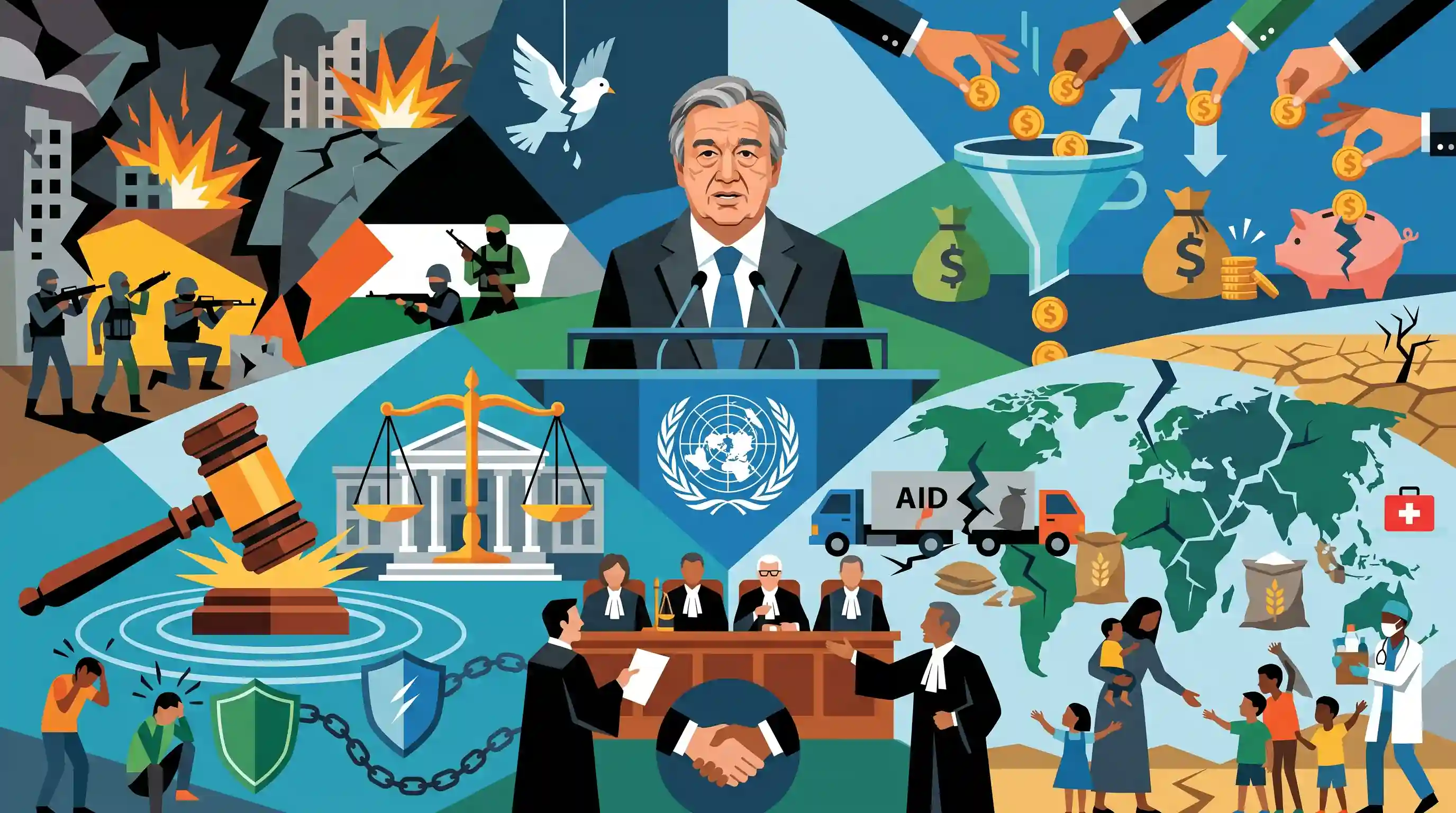
During the 80th session of the United Nations General Assembly, Secretary-General Antonio Guterres delivered a stark 'state of the world' address, cautioning leaders about the global decline in peace, law, and cooperation. He condemned the ongoing conflicts in Sudan and Gaza, specifically emphasizing the ICJ's legally binding provisional measures in South Africa's genocide case against Israel. Furthermore, Guterres criticized the severe financial constraints facing the U.N. due to withheld funding from member nations, warning that such aid cuts critically endanger lives across the globe.
Key Points
- U.N. Secretary-General Antonio Guterres addressed the 80th session of the UN General Assembly, warning of an age of 'reckless disruption and relentless human suffering.'
- He highlighted global impunity, calling out warring parties in Sudan and condemning the 'collective punishment' of Palestinians in Gaza.
- Guterres stressed the importance of South Africa's genocide case against Israel at the ICJ and demanded the full and immediate implementation of the court's provisional measures to protect civilians.
- He also raised alarms over U.N. financial cuts as member states, including the U.S., withhold funds, warning that aid cuts are a 'death sentence' for vulnerable populations.
Important Terms
International Court of Justice (ICJ)

The principal judicial organ of the United Nations, established in 1945 and based in The Hague. It settles legal disputes between states and provides advisory opinions on international legal questions.
UPSC context
GS Paper 2 (International Relations); key for understanding global dispute resolution, sovereignty, and the enforcement of international law.
UN General Assembly (UNGA)
The main deliberative, policymaking, and representative organ of the UN, comprising all 193 member states. It discusses global issues like peace and security, though its resolutions are generally non-binding.
UPSC context
GS Paper 2 (International Institutions); focuses on multilateral diplomacy, sovereign equality, and the "parliament of the world" concept.
Genocide Convention
The first human rights treaty adopted by the UN (1948). It codifies genocide as an international crime and obligates state parties to prevent and punish acts committed with intent to destroy specific groups.
UPSC context
GS Paper 2 (International Relations); critical for topics on human rights, international humanitarian law, and India's treaty obligations under Article 51.
Provisional Measures
Temporary remedies or interim orders issued by the ICJ to preserve the rights of parties and prevent "irreparable harm" while a final decision on the case's merits is pending.
UPSC context
GS Paper 2 (International Law); tests understanding of the ICJ's procedural powers and their binding nature in ongoing geopolitical conflicts.
United Nations (UN)
An intergovernmental organization founded in 1945 to maintain international peace and security, develop friendly relations among nations, and promote social progress and human rights.
UPSC context
GS Paper 2; foundational for understanding the post-WWII global order, multilateralism, and contemporary challenges like UN reform.
Prelims Trap
Provisional measures issued by the ICJ are advisory in nature and not legally binding on states.
While the ICJ lacks direct enforcement power (relying on the UNSC), its provisional measures under Article 41 of the ICJ Statute are strictly legally binding, not advisory.
Static Concepts Connected
How does the jurisdiction of the ICJ differ from the ICC?
- Subjects of Law: The ICJ settles legal disputes submitted by member states. The ICC prosecutes individuals for crimes against humanity, war crimes, and genocide.
- UN Affiliation: The ICJ is one of the six principal organs of the UN. The ICC is an independent treaty-based body established by the Rome Statute.
When does a UN member state lose its General Assembly voting rights?
- Arrears Threshold: Under UN Charter Article 19, a state loses its UNGA vote if financial arrears equal or exceed its mandatory contributions for the previous two full years.
- Exception Clause: The General Assembly may still permit the member to vote if it concludes that the failure to pay is due to conditions beyond the member's control.
Cross-Topic Patterns
Genocide Convention & Erga Omnes
South Africa invoking 'erga omnes partes' establishes that any state party can sue another for Genocide Convention violations at the ICJ, even without suffering direct injury.
Sudan Civil War & Regional Instability
The SAF vs. RSF power struggle in Sudan frequently appears as a 'places in news' match-the-following, linking with wider Sahel region coups and refugee crises.
Financial weaponization at the UN
Withholding assessed contributions ties into UN Charter Article 19, where chronic arrears can strip major powers of their voting rights, highlighting the financial weaponization of global bodies.

Expect a 2026 Prelims multi-statement question testing the legally binding nature of ICJ provisional measures alongside UN Charter Article 99.
Linked PYQs · 3
Linked PYQs · 3
- 2025MainsGS2
"The reform process in the United Nations remains unresolved, because of the delicate imbalance of East and West and entanglement of the USA vs. Russo-Chinese alliance.” Examine and critically evaluate the East-West policy confrontations in this regard.
- 2024MainsGS2
‘Terrorism has become a significant threat to global peace and security.’ Evaluate the effectiveness of the United Nations Security Council's Counter Terrorism Committee (CTC) and its associated bodies in addressing and mitigating this threat at the international level.
- 2018MainsGS2
“India’s relations with Israel have, of late, acquired a depth and diversity, which cannot be rolled back.” Discuss.
