UN General Assembly Address and Security Council Reforms
Source:The Hindu ↗
हे का महत्त्वाचे आहे
The article highlights the core challenges facing multilateralism and the United Nations Security Council, directly aligning with UPSC syllabus requirements regarding international institutions and India's pursuit of global governance reform.
सारांश
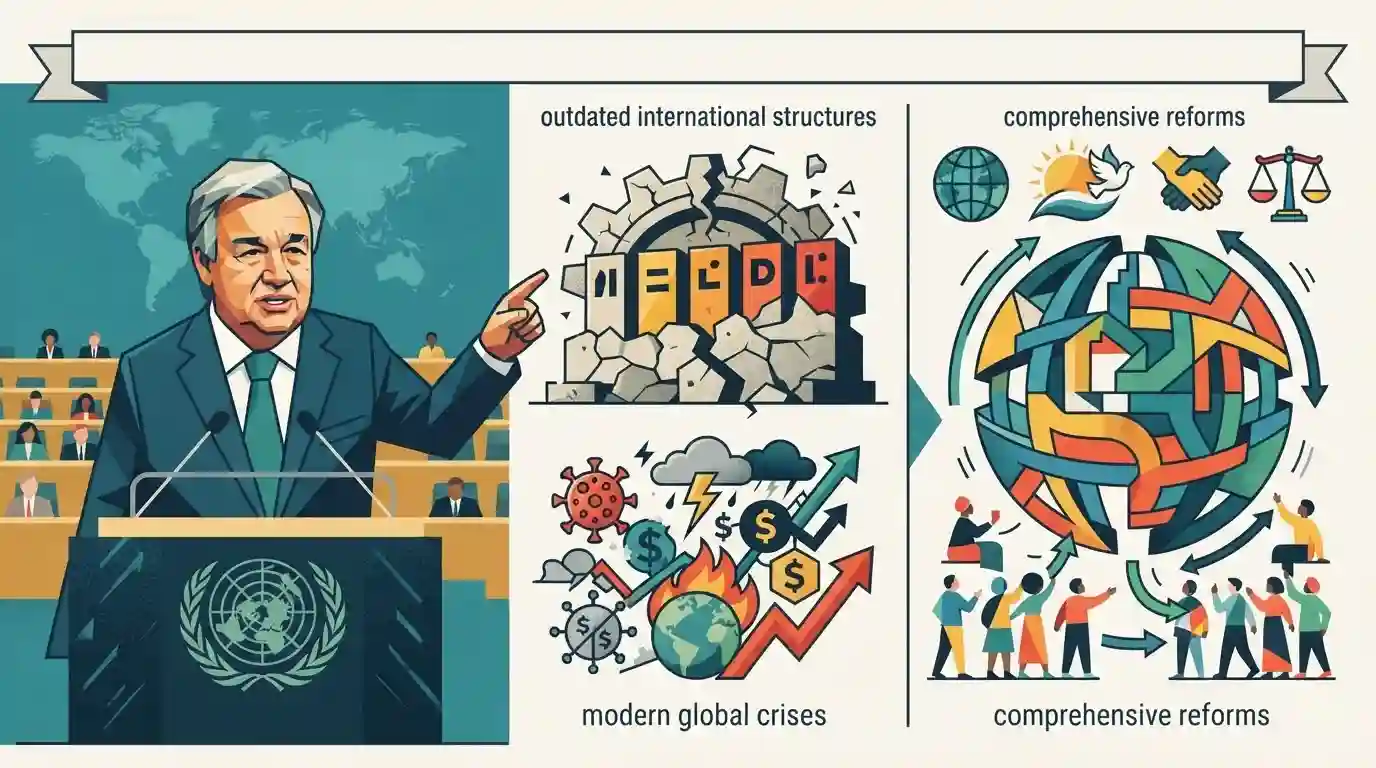
In his final address to the United Nations General Assembly (UNGA), UN Secretary-General António Guterres made a strong push for comprehensive reforms of the UN Security Council and global governance frameworks, stressing that outdated international structures cannot effectively handle modern global crises.
मुख्य मुद्दे
- UN Secretary-General António Guterres delivered his final UNGA address, emphasizing the urgent need to reform the UN Security Council and global multilateral institutions.
- Guterres highlighted that current global governance structures reflect post-WWII realities and fail to address contemporary geopolitical and economic imbalances.
- The address underscores the long-standing debate on reforming international bodies to make them more representative, accountable, and effective for the Global South.
महत्त्वाच्या संज्ञा
United Nations

An international organization founded in 1945, currently comprising 193 member states, tasked with promoting international peace, security, and cooperation based on international law and human rights.
UPSC context
GS Paper II (International Relations - Important International Institutions, Agencies and Fora). Tests understanding of multilateral governance and global order.
UN Security Council
The principal crisis-management body of the UN charged with maintaining international peace and security, featuring 15 members including five permanent veto-wielding nations (P5).
UPSC context
GS Paper II (International Relations - Structure, Mandate and Responding to Global Governance). Tests knowledge of UNSC reform debates and India's bid for permanent membership.
UN General Assembly (UNGA)
The main deliberative, policymaking, and representative organ of the United Nations, where all 193 member states have equal voting rights to discuss multilateral issues.
UPSC context
GS Paper II (International Institutions). Evaluates the role of global diplomacy, multilateral consensus building, and resolutions on international governance.
पूर्वपरीक्षा सापळा
A two-thirds majority in the General Assembly is sufficient to enact permanent structural changes to the UN Security Council.
Aspirants often confuse UNGA resolutions on UNSC expansion as legally binding; UNGA recommendations require P5 ratification to take effect.
संबंधित स्थिर संकल्पना
What is the exact legal procedure and amendment mechanism for reforming the UN Security Council under the UN Charter?
- UNGA Majority: Requires a vote of two-thirds of the members of the General Assembly (at least 129 out of 193).
- P5 Ratification: Must be ratified by two-thirds of the Members of the United Nations, including all the permanent members of the Security Council (P5).
- Charter Article 108: Governed strictly by Article 108 of the United Nations Charter, giving each P5 member an absolute veto over any structural reform.
आंतर-विषय नमुने
UNSC Reform + Global South Leadership
India's pursuit of a permanent UNSC seat is tied to securing critical mineral supply chains and leadership of the Global South via platforms like the Voice of Global South Summit.
Multilateralism Paralysis + Bretton Woods Reform
The UN Charter amendment hurdle (Article 108) mirrors debates on veto power abolition and democratization of Bretton Woods institutions.

UNSC reform mechanics (Article 108 ratification by P5) + G4 grouping composition frequently tested in Prelims.
संबंधित PYQ · 2
संबंधित PYQ · 2
- 2015MainsGS2
Discuss the impediments India is facing in its pursuit of a permanent seat in UN Security Council.
- 2025MainsGS2
"The reform process in the United Nations remains unresolved, because of the delicate imbalance of East and West and entanglement of the USA vs. Russo-Chinese alliance.” Examine and critically evaluate the East-West policy confrontations in this regard.
