UN Talks Consider Rules on Lethal Autonomous Weapons Systems
Source:The Hindu ↗
Why It Matters
This topic is critical for understanding the intersection of emerging technologies like Artificial Intelligence with national security, international humanitarian law, and global arms control governance.
Summary
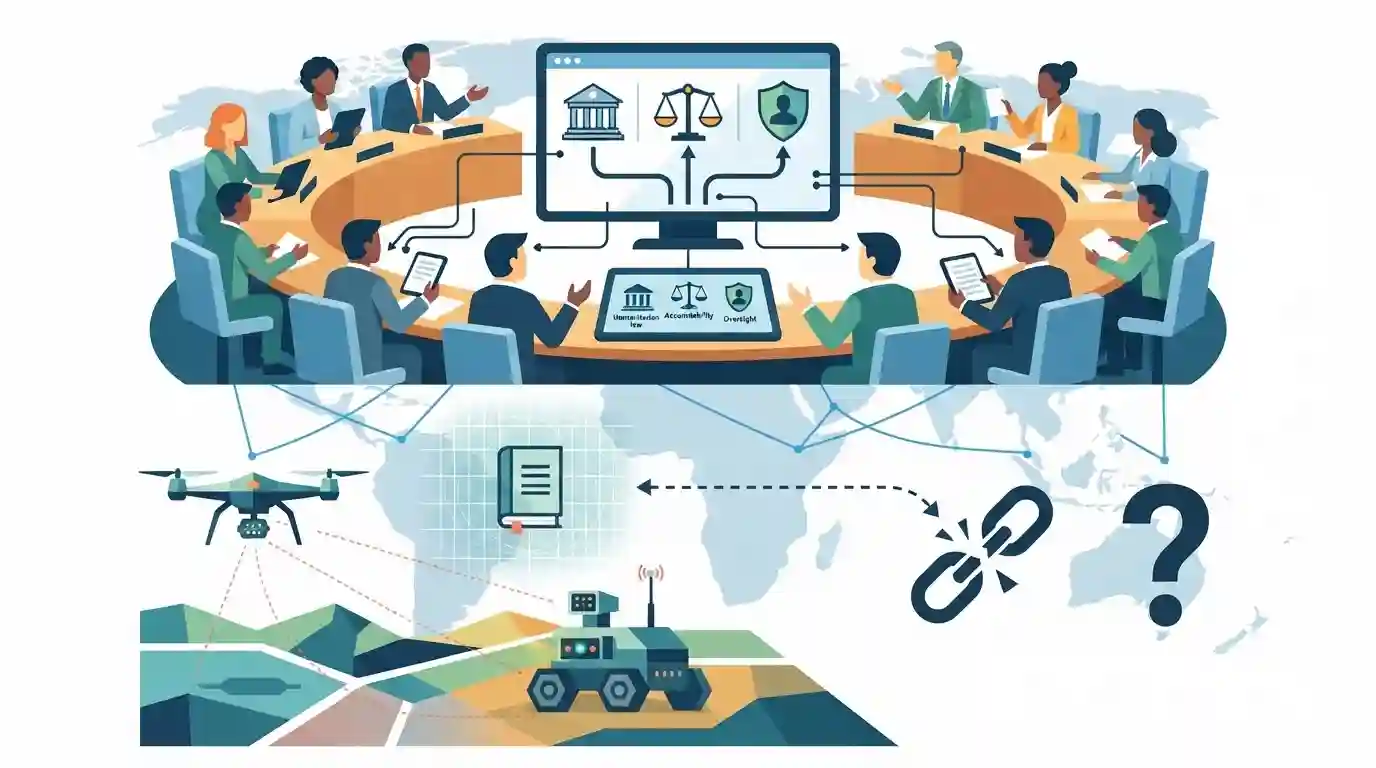
Delegates at UN-backed talks are exploring potential regulatory frameworks and rules governing lethal autonomous weapons systems (LAWS), highlighting global concerns over the use of artificial intelligence in military conflict, accountability, and international humanitarian law compliance.
Key Points
- UN-backed talks are considering regulatory frameworks and rules on lethal autonomous weapons systems (LAWS).
- Concerns exist over the ethical, legal, and humanitarian implications of delegating life-and-death decisions to artificial intelligence in warfare.
- Major nations have differing stances on whether a legally binding treaty or voluntary codes are required for autonomous weapons.
Important Terms
Lethal Autonomous Weapons Systems (LAWS)

Weapons systems that can independently search for, select, and engage targets based on generalized commands without further human intervention, raising complex ethical, legal, and accountability questions under international law.
UPSC context
GS Paper III (Internal Security / Science & Technology) and International Relations; tests awareness of AI ethics, military tech, and global governance.
Convention on Certain Conventional Weapons (CCW)
A key international arms control framework under the UN that aims to ban or restrict specific conventional weapons deemed excessively injurious or indiscriminately harmful to civilians.
UPSC context
GS Paper II (International Relations / Global Groupings) and GS Paper III; tests knowledge of multilateral disarmament and conventional arms treaties.
International Humanitarian Law (IHL)
The body of international rules—including the Geneva Conventions—that regulates the conduct of armed conflict and seeks to protect non-combatants, civilian objects, and limit the means of warfare.
UPSC context
GS Paper II (International Relations / Global Laws) and GS Paper IV (Ethics); tests understanding of laws of war and humanitarian principles.
United Nations (UN)
An international organization facilitating multilateral cooperation, global peace, security, and the regulation of emerging challenges such as military artificial intelligence and autonomous weaponry.
UPSC context
GS Paper II (International Relations & Global Organizations); evaluates the role of global multilateral bodies in setting norms and managing security challenges.
Static Concepts Connected
What is the institutional framework under the UN for regulating Lethal Autonomous Weapons Systems (LAWS)?
- CCW Framework: Convention on Certain Conventional Weapons (CCW) serves as the primary multilateral forum addressing LAWS through an open-ended Group of Governmental Experts (GGE).
- GGE Role: Group of Governmental Experts (GGE) on LAWS was established to examine proposals and make recommendations, though consensus requirements often slow progress.
- Human Control: Human-in-the-loop requirement is advocated by the UN Secretary-General to ensure accountability under International Humanitarian Law (IHL).
Cross-Topic Patterns
LAWS vs Cyber Norms at UN
LAWS discussions under the CCW parallel negotiations on cyber warfare norms, where major powers resist legally binding treaties in favor of voluntary confidence-building measures.

Expect a statement-based question linking CCW, human-in-the-loop requirements, and international humanitarian law violations in LAWS.
Linked PYQs · 2
Linked PYQs · 2
- 2023MainsGS3
The use of unmanned aerial vehicles (UAVs) by our adversaries across the borders to ferry arms/ammunitions, drugs, etc., is a serious threat to the internal security. Comment on the measures being taken to tackle this threat.
- 2023MainsGS3
Introduce the concept of Artificial Intelligence (AI). How does Al help clinical diagnosis? Do you perceive any threat to privacy of the individual in the use of Al in healthcare?
