Supreme Court Consideration of UAPA Bail Pleas and Personal Liberty
Source:Indian Express ↗
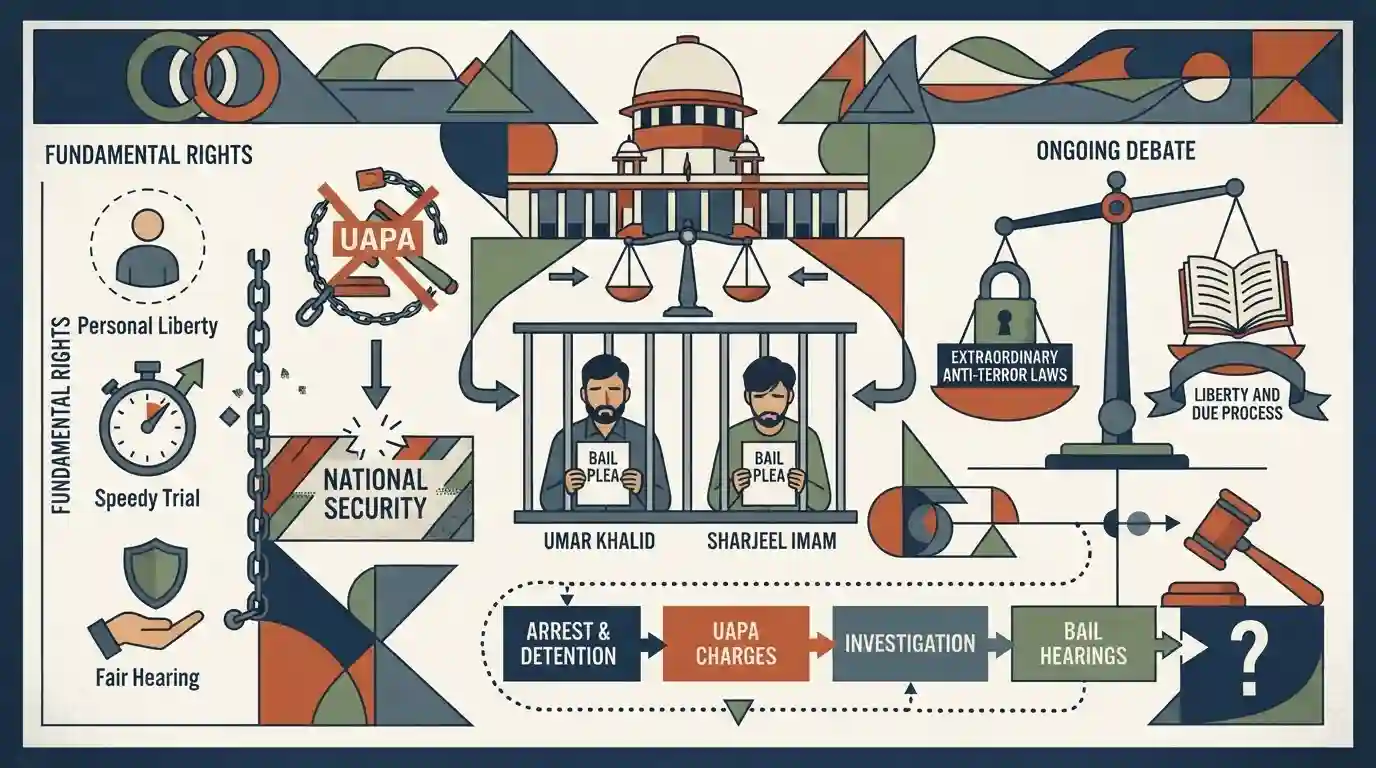
Why It Matters
It highlights the delicate constitutional balance between national security legislation like UAPA and the protection of fundamental rights under Article 21, particularly concerning prolonged pre-trial detention and the right to a speedy trial.
Summary
The Supreme Court is scheduled to hear bail pleas filed by student activists Umar Khalid and Sharjeel Imam under the stringent Unlawful Activities Prevention Act (UAPA). This legal proceeding highlights the ongoing debate between national security legislation and the protection of fundamental rights, specifically personal liberty, speedy trial, and the interpretation of bail jurisprudence under extraordinary anti-terror laws.
Key Points
- The Supreme Court of India is hearing bail pleas filed by Umar Khalid and Sharjeel Imam in connection with cases registered under the stringent Unlawful Activities Prevention Act (UAPA).
- The case brings to light ongoing judicial scrutiny over balancing stringent anti-terror statutory provisions with fundamental rights such as the right to speedy trial and personal liberty under Article 21.
- Extended pre-trial incarceration under anti-terror legislations continues to be a major constitutional and governance debate in India's criminal justice administration.
Important Terms
Unlawful Activities Prevention Act UAPA

India's primary anti-terror legislation designed for the effective prevention of unlawful activities associations, featuring stringent bail restrictions under Section 43D(5) where bail is typically denied if charges are prima facie true.
UPSC context
GS Paper II (Polity and Governance - Statutory Framework, Fundamental Rights, and Judicial Review of Special Laws).
Constitution of India
The supreme law of India that guarantees fundamental rights, including personal liberty under Article 21, balancing state security needs against individual constitutional freedoms.
UPSC context
GS Paper II (Indian Constitution - Historical Underpinnings, Evolution, Features, Amendments, Significant Provisions, and Basic Structure).
Supreme Court of India
The highest judicial forum and constitutional court of India, responsible for interpreting statutory laws like the UAPA against constitutional benchmarks and safeguarding fundamental rights.
UPSC context
GS Paper II (Structure, Organization, and Functioning of the Judiciary and Executive; Judicial Review).
Static Concepts Connected
How does Section 43D(5) of the UAPA alter standard criminal bail jurisprudence?
- Prima Facie Bar: If the court peruses the case diary and is of the opinion that there are reasonable grounds for believing the accusation is prima facie true, bail shall not be granted.
- Reversed Presumption: Unlike ordinary criminal law where bail is the rule and jail is the exception, UAPA reverses this presumption, making detention the norm.
- Article 21 Override: The Supreme Court held in K.A. Najib (2021) that Article 21 fundamental rights override statutory statutory bars against bail in cases of prolonged incarceration.
Cross-Topic Patterns
UAPA Bail vs. Article 21 Personal Liberty
The constitutional friction between state security measures and Article 21's right to speedy trial is a recurring theme across multiple law and governance papers.

UAPA bail jurisprudence and Article 21 interplay in extended pre-trial detention is a high-yield theme for Mains GS-2 Polity & Governance.
Linked PYQs · 1
Linked PYQs · 1
- 2017MainsGS2
Examine the scope of Fundamental Rights in the light of the latest judgement of the Supreme Court on Right to Privacy.
