Ukrainian Drones Target Russian Refineries and Infrastructure
Source:The Hindu ↗
Why It Matters
The events demonstrate the evolving nature of modern warfare, where low-cost, long-range drones bypass conventional frontlines to cripple critical national infrastructure (CNI) deep inside adversary territory. For India, this underscores the urgent need to bolster air defense and drone countermeasures around its own refineries, ports, and power grids, while also monitoring how such energy disruptions influence global crude oil markets and trade corridors.
Summary
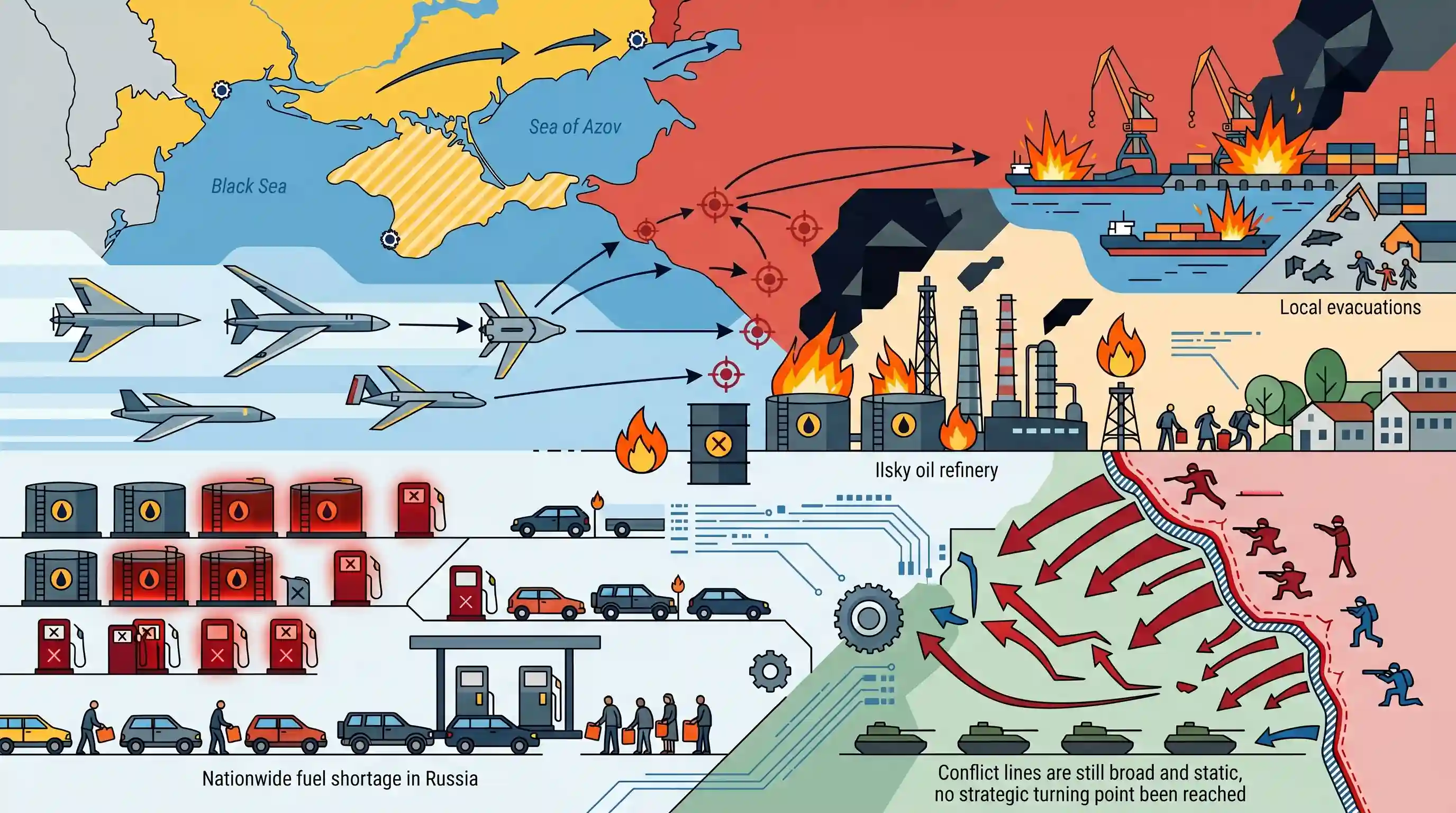
In July 2026, Ukrainian long-range drone strikes struck critical Russian energy and logistics nodes, including the Ilsky oil refinery and Taganrog seaport, causing petroleum fires, localized evacuations, and contributing to a nationwide fuel shortage in Russia. While Ukrainian forces have successfully slowed down the Russian land offensive and halved their frontline assaults, military leadership cautions that a strategic turning point in the conflict is still distant.
Key Points
- Ukrainian drone strikes on July 10, 2026, targeted southern Russian critical infrastructure, specifically hitting the Ilsky oil refinery in Krasnodar and the seaport of Taganrog on the Sea of Azov.
- In Taganrog, the attacks caused a major petroleum products fire, prompting authorities to declare a local emergency and evacuate residents.
- The Russian Defence Ministry reported downing over 370 Ukrainian drones, including over the Moscow region, indicating the unprecedented scale of the aerial offensive.
- Russian President Vladimir Putin acknowledged that the persistent Ukrainian strikes on energy infrastructure have led to a nationwide fuel shortage in Russia.
- Ukraine's Commander-in-Chief Oleksandr Syrsky stated that while Ukrainian troops have halted Russia's advance across much of the frontline—with active Russian assaults dropping by half in the first half of 2026—a definitive turning point in the war is still a long way off.
Important Terms
Asymmetric Warfare

A conflict where weaker actors use unconventional tactics, low-cost technologies (such as drones), and proxy strategies to exploit the vulnerabilities of a technologically or numerically superior adversary.
UPSC context
GS Paper III (Security): Evaluates irregular warfare tactics, modern internal security challenges, and unconventional defense planning.
Critical National Infrastructure (CNI)
Essential physical and digital assets, networks, and services—such as power grids, oil refineries, and transport systems—whose destruction would severely compromise national security, public safety, or economic stability.
UPSC context
GS Paper III (Internal Security & Infrastructure): Highlights vulnerability to cyber, physical, and hybrid attacks on key socio-economic assets.
Sea of Azov
The world's shallowest inland sea, located in Eastern Europe, bounded by Ukraine and Russia, and connected to the Black Sea via the strategic Kerch Strait.
UPSC context
GS Paper I (Geography) & GS Paper II (IR): Important for geopolitical mapping, trade corridors, and regional maritime conflicts.
Unmanned Aerial Vehicles (UAVs)
Aircraft operated without any onboard human pilot, controlled either autonomously by onboard computers or remotely by operators on the ground; commonly referred to as drones.
UPSC context
GS Paper III (Science & Technology / Security): Examines technology indigenisation, dual-use drone applications, and border defense threats.
Ukrainian Armed Forces
The state military organization of Ukraine, consisting of land, air, naval, and special forces, engaged in defending national sovereignty against foreign aggression.
UPSC context
GS Paper II (International Relations): Important for understanding regional conflict dynamics, international alliances, and global geopolitical shifts.
Russian Defence Ministry
The federal executive body of the Russian Federation responsible for implementing state military policy, overseeing the Armed Forces, and defending against external security threats.
UPSC context
GS Paper II (International Relations): Essential for assessing geopolitical strategies, defense capabilities, and state-level military operations in global conflicts.
Prelims Trap
The Sea of Azov is a deep, high-salinity water body directly connected to the Caspian Sea.
The Sea of Azov is the shallowest sea globally (max 14m), has low salinity due to river inflows, and connects to the Black Sea via the Kerch Strait.
Static Concepts Connected
What are the geographical features of the Sea of Azov?
- Depth Profile: It is the shallowest sea globally, with a maximum depth of approximately 14 meters.
- Freshwater Inflow: Receives major freshwater from the Don and Kuban rivers, leading to low salinity in the northeast.
- Kerch Strait: Functions as the sole narrow water passage connecting the Sea of Azov to the Black Sea.
What defines asymmetric warfare in modern defense?
- Tactical Imbalance: Weaker combatants leverage low-cost, high-impact technologies to exploit vulnerabilities of a conventionally superior adversary.
- Loitering Munitions: Cheap aerial systems that hover to identify and strike high-value assets, bypassing traditional defense systems.
Cross-Topic Patterns
Chokepoints and Global Energy Security
Tactical disruptions in the Black Sea-Azov region show how maritime chokepoint vulnerabilities directly destabilize global energy prices and supply routes.
Drone Swarms and India’s CNI
Cheap drone attrition highlights India’s urgent need to secure coastal critical national infrastructure, like Jamnagar refineries, using indigenous counter-UAV technology.

Mapping of Black Sea-Azov littoral ports and the definitions of asymmetric loitering munitions are highly likely 2026 Prelims targets.
Linked PYQs · 4
Linked PYQs · 4
- 2023MainsGS3
The use of unmanned aerial vehicles (UAVs) by our adversaries across the borders to ferry arms/ammunitions, drugs, etc., is a serious threat to the internal security. Comment on the measures being taken to tackle this threat.
- 2021MainsGS3
Analyse the multidimensional challenges posed by external state and non-state actors, to the internal security of India. Also discuss measures required to be taken to combat these threats.
- 2019PrelimsGS1
Consider the following pairs: Sea Bordering country 1. Adriatic Sea : Albania 2. Black Sea : Croatia 3. Caspian Sea : Kazakhstan 4. Mediterranean Sea : Morocco 5. Red Sea : Syria Which of the pairs given above are correctly matched?
- 2024PrelimsGS1
Consider the following countries : 1. Finland 2. Germany 3. Norway 4. Russia How many of the above countries have a border with the North Sea?
