Ukrainian Drones Target Russian Oil Infrastructure and Vessels
Source:The Hindu ↗
Why It Matters
This development underscores two critical UPSC themes: first, the shift in US strategic foreign policy under the Trump administration towards local co-production of state-of-the-art defense technology (the Patriot system) in active warzones; second, the rising efficacy of drone-driven economic attritional warfare targeting deep national energy infrastructure. This has direct security and strategic lessons for India concerning border drone threats, critical infrastructure protection, and the indigenization of air defense systems.
Summary
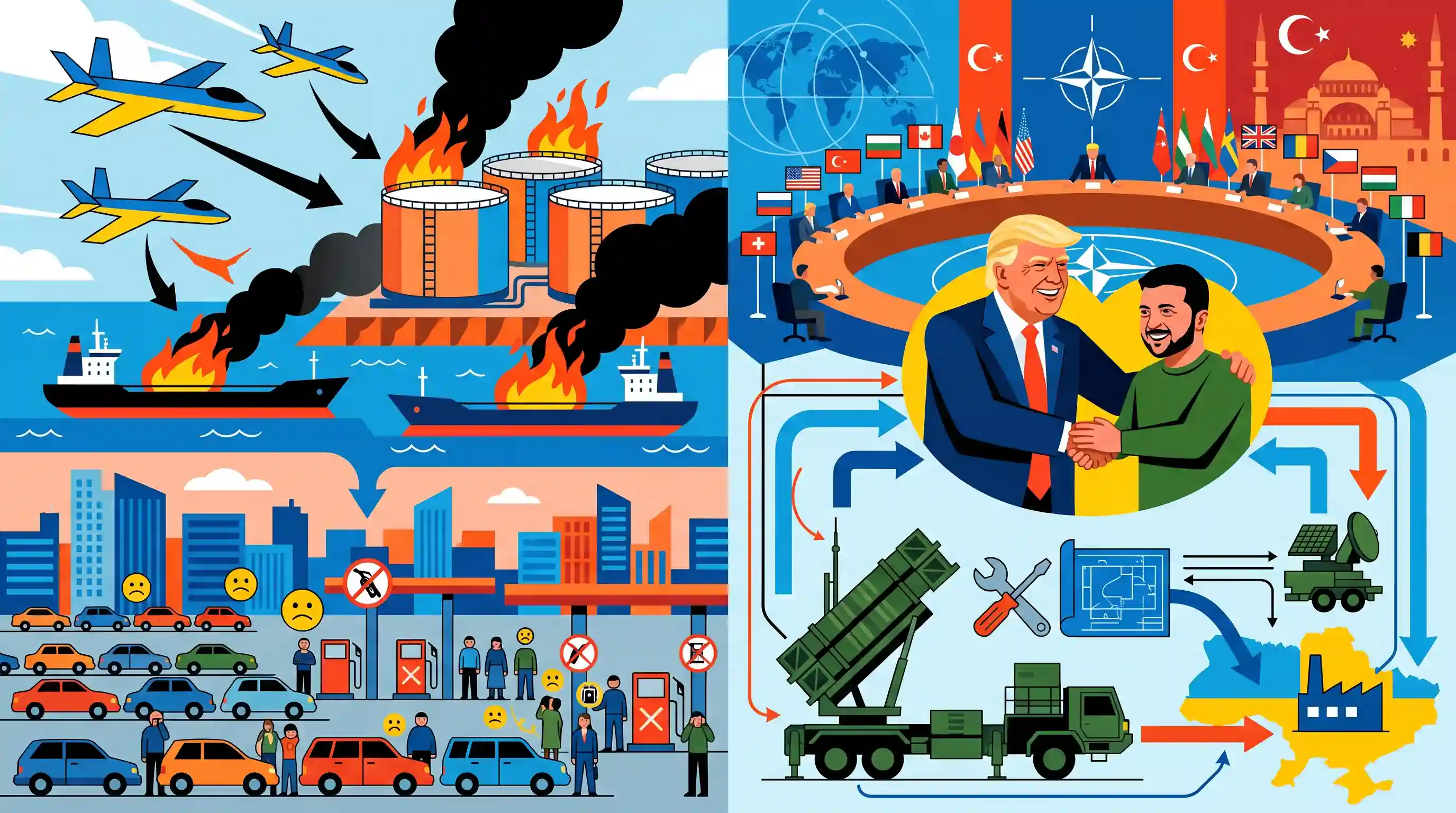
In a significant escalation of asymmetric conflict, Ukrainian drone strikes hit deep inside Russian territory, setting oil depots and tankers in the Sea of Azov ablaze and causing domestic fuel shortages inside Russia. Meanwhile, on the sidelines of the NATO summit in Turkey, US President Donald Trump announced a major policy shift by pledging to grant Ukraine a license to locally manufacture Patriot air defence systems. This development and Trump's warm praise of President Zelenskyy mark a key turning point in US-Ukraine relations and the broader strategic landscape of the ongoing war.
Key Points
- Ukrainian drone strikes successfully targeted multiple critical Russian oil infrastructure facilities, including depots in Tver, Vyazniki (Stavropol region), and Omsk, as well as oil tankers in the Sea of Azov aimed at cutting supplies to Crimea.
- The targeted strikes on refineries and transport vessels have triggered a widespread fuel crisis inside Russia, resulting in regional gasoline shortages, rationing, and lengthy driver queues at fuel stations.
- At the NATO summit in Turkey, US President Donald Trump committed to granting Ukraine a manufacturing license for the highly sought-after Patriot air defence system, representing a major strategic victory for Kyiv.
- The meeting marked a significant positive pivot in the Trump-Zelenskyy dynamic, contrasting sharply with their hostile February 2025 White House encounter, as Trump praised Zelenskyy's readiness to broker a peace deal.
- The conflict continues to feature high-intensity electronic warfare, with Russia actively attempting to jam Elon Musk's Starlink satellite systems to disrupt Ukrainian drone swarms, alongside massive, multi-front drone and missile interceptions on both sides.
Important Terms
Patriot air defence system

A highly advanced, mobile, all-weather, long-range surface-to-air missile defense system developed by the United States to detect, track, and intercept tactical ballistic missiles, cruise missiles, drones, and aircraft.
UPSC context
GS Paper 3 (Security & Defence Technology); tests knowledge of global advanced missile defense systems and technology.
NATO
An intergovernmental political and military alliance of 32 member states established in 1949 by the Washington Treaty, functioning on the core principle of collective defense under Article 5.
UPSC context
GS Paper 2 (International Relations); tests understanding of global groupings, military alliances, and geopolitical dynamics affecting regional security.
Sea of Azov
A highly strategic, shallow inland sea in Eastern Europe, connected to the Black Sea via the Kerch Strait, bounded by Ukraine to the northwest and Russia to the southeast.
UPSC context
GS Paper 1 (Geography) & GS Paper 2 (IR); tests map-based locations, maritime choke points, and geopolitically contested regional water bodies.
Asymmetric warfare
A mode of conflict where opposing sides possess unequal military capabilities, resources, or technology, leading the weaker party to use unconventional tactics like drone strikes or cyberattacks.
UPSC context
GS Paper 3 (Internal Security); tests understanding of evolving concepts of modern, hybrid, and non-linear warfare.
Prelims Trap
The Sea of Azov is a completely landlocked water body with no natural connection to the Black Sea.
Aspirants confuse 'semi-enclosed' with 'landlocked'. It is connected naturally to the Black Sea via the Kerch Strait, a vital strategic choke point.
Static Concepts Connected
What is the strategic geography and profile of the Sea of Azov?
- Bordering nations: Bounded by Ukraine to the north and west, and Russia to the east and south.
- Key connector: Linked directly to the Black Sea by the narrow, strategically vital Kerch Strait.
- Depth profile: It is the shallowest sea in the world, with a maximum depth of only 14 meters.
How do the S-400 Triumf and Patriot (PAC-3) air defence systems compare?
- Interception technology: Patriot PAC-3 uses direct 'hit-to-kill' kinetic impact, whereas the S-400 relies on proximity blast-fragmentation warheads.
- Range profiles: The S-400 has a much longer engagement range (up to 400 km) than the tactical, point-defense Patriot system.
Cross-Topic Patterns
Asymmetric UAVs and critical infrastructure protection
Cheap drone swarms bypass traditional air defense to cripple energy grids. This shifts national security focus toward hardening civilian power and oil networks against asymmetric threats.
Defense co-production and geopolitics
The rare licensing of Patriot tech to Ukraine mirrors US-India iCET goals, highlighting a transition from mere buyer-seller defense relations to deep industrial co-production.

Comparative tech of S-400 vs Patriot and Black Sea/Azov choke points likely to feature in 2026 science-geography questions.
Linked PYQs · 3
Linked PYQs · 3
- 2023MainsGS3
The use of unmanned aerial vehicles (UAVs) by our adversaries across the borders to ferry arms/ammunitions, drugs, etc., is a serious threat to the internal security. Comment on the measures being taken to tackle this threat.
- 2023MainsGS2
‘The expansion and strengthening of NATO and a stronger US-Europe strategic partnership works well for India.’ What is your opinion about this statement ? Give reasons and examples to support your answer.
- 2021MainsGS3
How is S-400 air defence system technically superior to any other system presently available in the world?
