Asymmetric warfare and drone attacks on critical infrastructure
Source:The Hindu ↗
Why It Matters
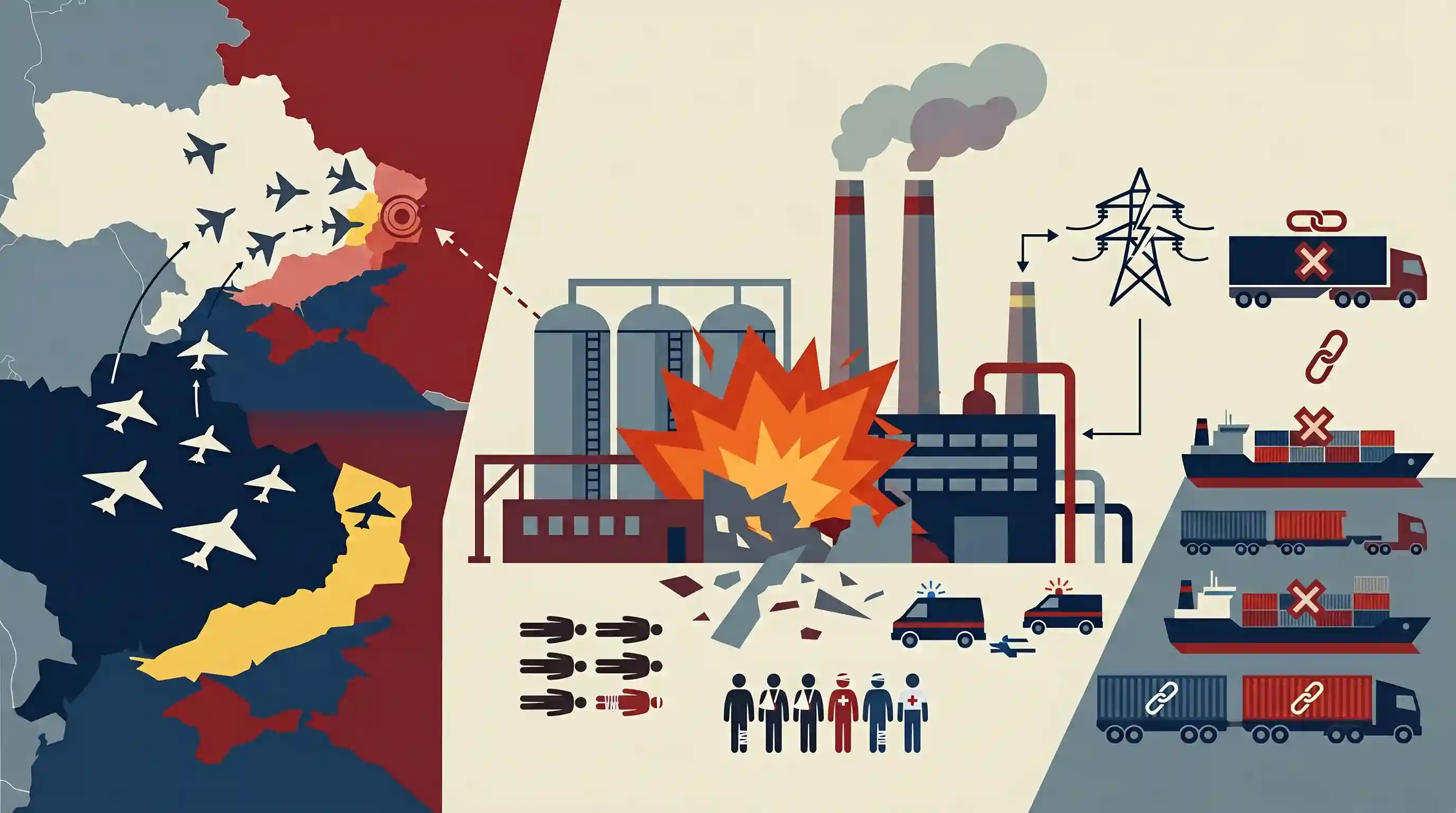
The event is a prime example of the changing face of modern warfare, emphasizing the use of drone technology in cross-border strikes against critical economic infrastructure. It is highly relevant for understanding geopolitical conflicts, the security of global supply chains (like fertilisers), and the strategic implications of asymmetric warfare.
Summary
A deadly Ukrainian drone strike targeted the PJSC Dorogobuzh fertiliser plant in Russia's Smolensk region, utilizing at least 30 explosive-laden drones. The attack resulted in seven fatalities and 10 injuries, marking one of the deadliest strikes on a Russian industrial site during the four-year war. The incident emphasizes the increasing reliance on asymmetric warfare and deep strikes using UAVs, focusing on crippling critical economic and energy infrastructure, which has broader implications for global supply chains.
Key Points
- A Ukrainian drone attack on the PJSC Dorogobuzh fertiliser plant in Russia's western Smolensk region killed seven people and injured 10.
- The strike involved at least 30 explosive-equipped drones and targeted a civilian nitrogen fertiliser facility located 290 kilometres from the Ukrainian border.
- The incident highlights the intensifying use of unmanned aerial vehicles (UAVs) and asymmetric warfare tactics in the ongoing four-year Russia-Ukraine conflict.
- The continued targeting of industrial, energy, and economic sites underscores the vulnerability of critical infrastructure and its potential impact on global supply chains.
Important Terms
Asymmetric Warfare

Warfare between unequal powers where the weaker side uses unconventional tactics (e.g., drones, cyberattacks) to exploit a stronger adversary's vulnerabilities and avoid direct conventional confrontation.
UPSC context
GS Paper 3 (Security). Tests understanding of modern conflict dynamics, including drone-based threats to national security.
Unmanned Aerial Vehicles (UAVs)
Remotely piloted or autonomous aircraft used for surveillance and combat. The Russia-Ukraine conflict marks a turning point for their mass deployment in precision-based, cost-effective deep strikes.
UPSC context
GS Paper 3 (Science & Tech/Security). Tests awareness of emerging defense technologies and changing military doctrines.
PJSC Dorogobuzh
A major Russian chemical enterprise in Smolensk (Acron Group) producing ammonia and ammonium nitrate, essential for both global fertilizer supply chains and industrial/military applications.
UPSC context
GS Paper 3 (Economy/Agriculture). Highlights global fertilizer supply vulnerabilities and geopolitical impacts on Indian food security.
Russia’s Investigative Committee
Russia's primary federal criminal investigation agency, reporting directly to the President. It handles high-profile cases including terrorism, corruption, and serious crimes against the state.
UPSC context
GS Paper 2 (Governance/IR). Relevant for understanding foreign administrative structures and legal responses to international conflicts.
Critical Infrastructure
Physical or virtual assets (e.g., power plants, industrial sites) essential for a nation's functioning; targeting them aims to cripple the adversary's economic and defense capacity.
UPSC context
GS Paper 3 (Security/Infrastructure). Tests knowledge of strategic vulnerabilities and the importance of protecting economic assets.
Prelims Trap
"The Dnieper River originates in Ukraine and flows into the Black Sea."
The Dnieper River actually originates in the Valdai Hills of Russia (near Smolensk) and flows through Belarus before entering Ukraine and emptying into the Black Sea.
Static Concepts Connected
What is the status of India's fertiliser self-sufficiency?
- Urea (Nitrogenous): Highly subsidized; India is moving toward self-sufficiency via domestic plant revival and the widespread rollout of liquid Nano Urea.
- DAP (Phosphatic): India is highly import-dependent for raw materials (rock phosphate) and finished DAP, making it vulnerable to global supply shocks.
- MOP (Potassic): India is 100% import-dependent for MOP, as the country lacks commercially viable domestic potash reserves.
Why is Ammonium Nitrate heavily regulated in India?
- Dual-Use Nature: It is a critical agricultural soil nutrient but also a potent oxidizer used in commercial mining explosives (ANFO) and illicit IEDs.
- Strict Regulation: Its manufacture, transport, and storage are strictly governed under the Ammonium Nitrate Rules, 2012 (framed under the Explosives Act, 1884) to prevent illicit diversion.
Cross-Topic Patterns
UAVs and Critical Infrastructure Protection
The shift to low-cost kamikaze drones bypassing traditional air defenses highlights India's urgent need for comprehensive counter-UAS (C-UAS) strategies to protect domestic civilian and economic nodes.
Geopolitics and India's Subsidy Burden
Attacks on Russian fertiliser hubs directly threaten India's agricultural supply chains, risking imported inflation and swelling the government's Nutrient Based Subsidy (NBS) bill.

Expect a 2026 prelims statement mixing India's potassic/phosphatic fertiliser import dependency with the dual-use nature of ammonium nitrate.
Linked PYQs · 4
Linked PYQs · 4
- 2023MainsGS3
The use of unmanned aerial vehicles (UAVs) by our adversaries across the borders to ferry arms/ammunitions, drugs, etc., is a serious threat to the internal security. Comment on the measures being taken to tackle this threat.
- 2023PrelimsGS1
Consider the following pairs: Area of conflict mentioned in news Country where it is located 1. Donbas : Syria 2. Kachin : Ethiopia 3. Tigray : North Yemen How many of the above pairs are correctly matched?
- 2023PrelimsGS1
Consider the following countries: 1. Bulgaria 2. Czech Republic 3. Hungary 4. Latvia 5. Lithuania 6. Romania How many of the above-mentioned countries share a land border with Ukraine?
- 2023PrelimsGS1
Consider the following pairs: Regions often mentioned in news Reason for being in news 1. North Kivu and Ituri : War between Armenia and Azerbaijan 2. Nagorno-Karabakh : Insurgency in Mozambique 3. Kherson and Zaporizhzhia : Dispute between Israel and Lebanon How many of the above pairs are correctly matched?
