Russia Ukraine conflict and ceasefire deadlock over border regions
Source:Indian Express ↗
Why It Matters
The ongoing Russia-Ukraine conflict and the involvement of global powers like the US in brokering peace underscore shifts in the global world order. It highlights the complexities of conflict resolution, bilateral diplomacy, and enforcement of ceasefires, which are critical themes for Mains GS2. Additionally, conflict zones (Kursk, Belgorod) frequently appear in Prelims GS1 mapping questions.
Summary
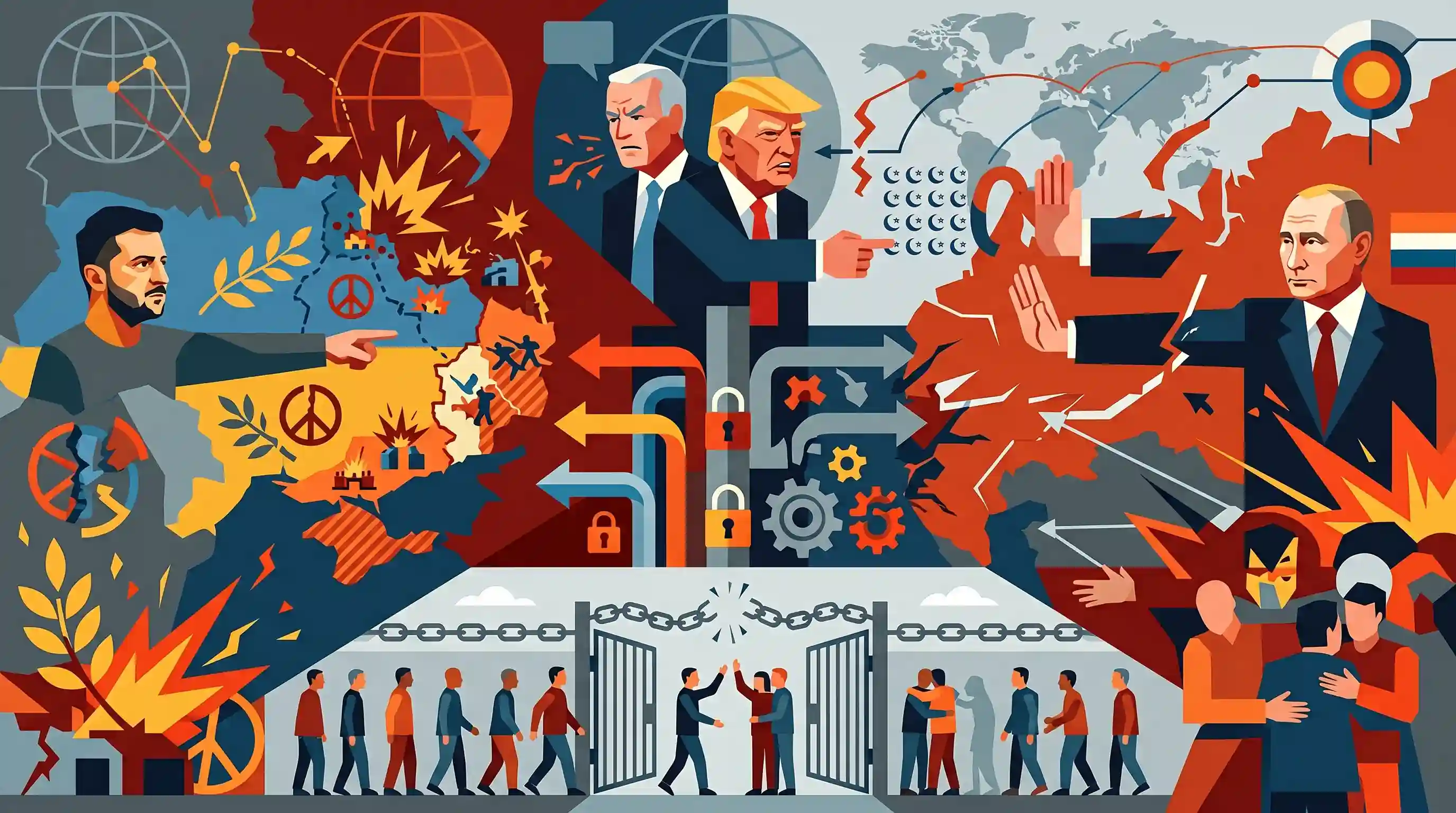
The ongoing Russia-Ukraine war saw a unilateral 'Easter truce' announced by Russian President Vladimir Putin, which Ukrainian President Volodymyr Zelenskyy claims is being violated by continued Russian military action in the Kursk and Belgorod regions. The geopolitical deadlock is further complicated by Russia's refusal to accept a US-brokered 30-day ceasefire, leading to growing frustration within the Trump administration regarding the peace process. The conflict remains volatile, marked by territorial struggles in border regions and large-scale prisoner exchanges.
Key Points
- Russian President Vladimir Putin announced a brief unilateral 'Easter truce' to test Kyiv's commitment to broader ceasefire negotiations.
- Ukrainian President Volodymyr Zelenskyy reported that Russian forces continued artillery strikes and military assaults in the Kursk and Belgorod border regions despite the truce announcement.
- The diplomatic stalemate is exacerbated by Russia's rejection of a 30-day ceasefire proposed by the US (Trump administration), which is reportedly losing patience with the mediation process.
- Recent tactical developments include Russian forces reclaiming territory in the Kursk region from Ukrainian troops and the completion of a large-scale prisoner exchange.
Important Terms
Easter truce

A short-term, unilateral cessation of hostilities declared by Russia during Orthodox Easter (April 2026), often criticized by Ukraine as a tactical pause to regroup rather than a genuine peace effort.
UPSC context
GS-II: International Relations; tests understanding of 'tactical truces' versus 'long-term peace' in global conflict zones.
30-day ceasefire proposal
A diplomatic initiative brokered by the US (Trump administration) in 2025-2026, proposing a month-long pause in the Russia-Ukraine war to facilitate negotiations, contingent on reciprocity.
UPSC context
GS-II: Global Geopolitics; assesses the role of third-party mediation and the impact of conditions-based military aid.
Kremlin
The fortified complex in Moscow serving as the official residence of the Russian President; used metonymically to refer to the executive branch of the Russian government.
UPSC context
GS-II: International Relations; standard terminology for Russian foreign policy decision-making and bilateral diplomatic discourse.
US administration
The executive branch of the United States government (under President Trump in 2026), characterized by transactional diplomacy and active involvement in brokering the Russia-Ukraine peace process.
UPSC context
GS-II: Bilateral Relations; focuses on the shift in US foreign policy and its implications for regional security.
Prelims Trap
"Kursk and Belgorod are strategic border regions located in eastern Ukraine."
Aspirants often assume these are Ukrainian territories due to the active fighting. Both Kursk and Belgorod are actually sovereign Russian regions bordering Ukraine.
Static Concepts Connected
What geographical and resource features make the Kursk region significant?
- Chernozem Soils: Situated in the highly fertile "Black Earth" (Chernozem) territory, making it vital for regional agricultural output.
- Magnetic Anomaly: Houses the Kursk Magnetic Anomaly, which holds some of the world's largest known and unexploited iron-ore reserves.
- Border Geography: It is a western Russian federal subject directly bordering northeastern Ukraine, acting as a critical logistical node.
What does the Third Geneva Convention mandate regarding Prisoners of War?
- Core Mandate: Established in 1949, it establishes binding international humanitarian standards specifically for the treatment of PoWs.
- Strict Prohibitions: Explicitly prohibits torture, physical mutilation, degrading treatment, and the use of prisoners as human shields.
- Repatriation Protocol: Mandates the prompt release and repatriation of prisoners of war immediately following the cessation of active hostilities.
Cross-Topic Patterns
European borderlands + Resource Geopolitics
The strategic focus on regions like Kursk bridges physical geography (Chernozem soils, Iron ore reserves) with border security and international territorial disputes governed by the Helsinki Final Act.
PoW exchanges + Geneva Conventions
Large-scale prisoner swaps frequently test the enforcement of the Third Geneva Convention, linking bilateral war dynamics directly to global humanitarian law and international accountability.

Places in News (Kursk, Belgorod) mapped to their physical geography or natural resources (Iron ore) is highly probable for 2026 Prelims.
Linked PYQs · 3
Linked PYQs · 3
- 2023PrelimsGS1
Consider the following pairs: Area of conflict mentioned in news Country where it is located 1. Donbas : Syria 2. Kachin : Ethiopia 3. Tigray : North Yemen How many of the above pairs are correctly matched?
- 2023PrelimsGS1
Consider the following pairs: Regions often mentioned in news Reason for being in news 1. North Kivu and Ituri : War between Armenia and Azerbaijan 2. Nagorno-Karabakh : Insurgency in Mozambique 3. Kherson and Zaporizhzhia : Dispute between Israel and Lebanon How many of the above pairs are correctly matched?
- 2025MainsGS2
"The reform process in the United Nations remains unresolved, because of the delicate imbalance of East and West and entanglement of the USA vs. Russo-Chinese alliance.” Examine and critically evaluate the East-West policy confrontations in this regard.
