Geneva Peace Talks End Without Territorial Accord on Ukraine
Source:The Hindu ↗
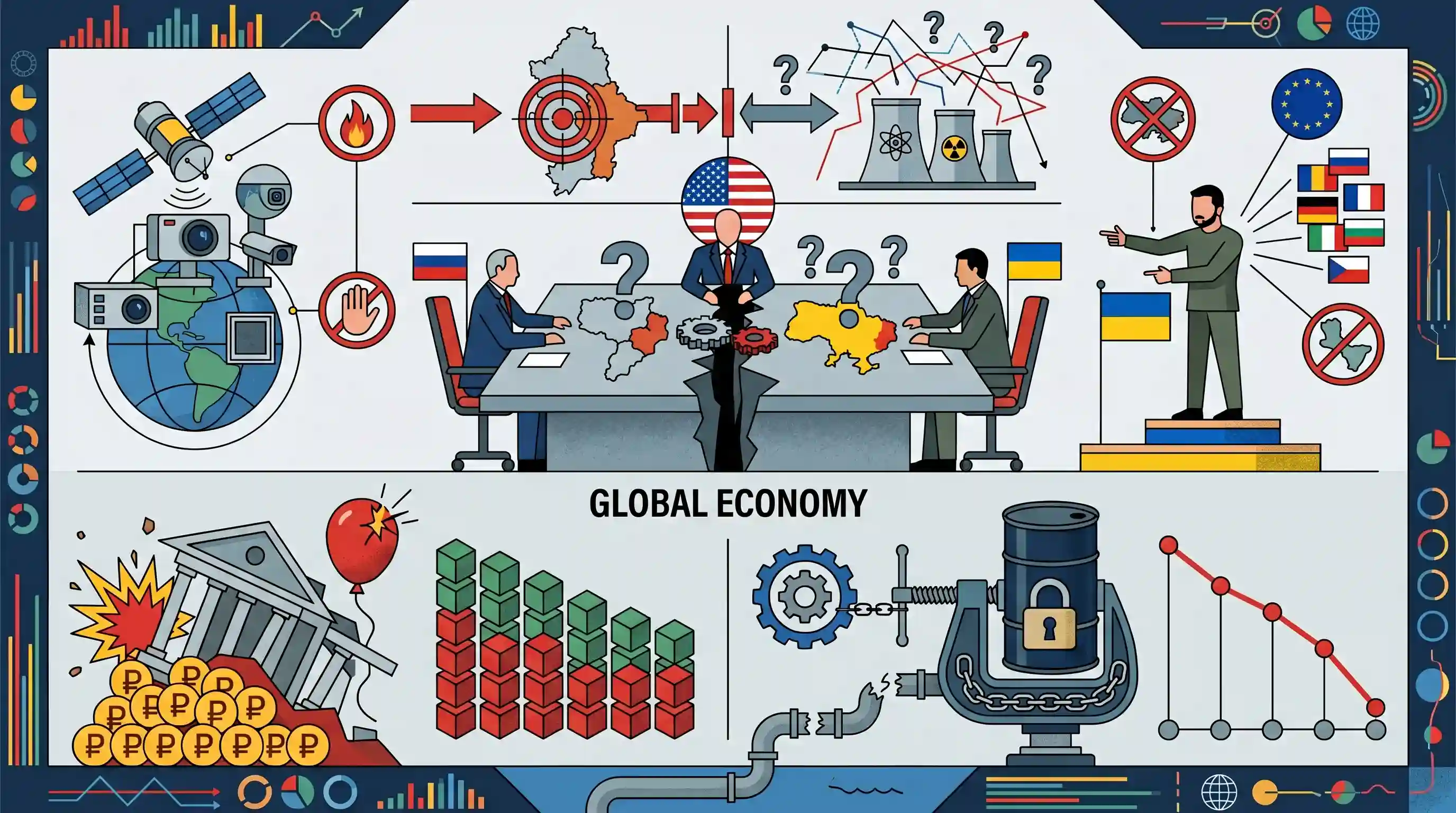
Why It Matters
The article provides critical updates on the Russia-Ukraine conflict, detailing negotiation deadlocks, shifting geopolitical pressures, and the economic impacts of Western sanctions on Russia. Key locations mentioned (Zaporizhzhia, Donetsk, Sumy, Crimea) are highly relevant for Prelims geography mapping.
Summary
U.S.-mediated peace talks between Russia and Ukraine in Geneva have ended without resolving key territorial disputes. While progress was made on a U.S.-involved ceasefire monitoring mechanism, Russia's demand for full control of the Donetsk region and issues surrounding the Zaporizhzhia Nuclear Power Plant remain deadlocked. Ukrainian President Volodymyr Zelenskyy stressed the need for European involvement in any final deal and rejected making unilateral concessions. Meanwhile, despite slow territorial advances, Russia's wartime economy is struggling with a ballooning deficit as international sanctions push its oil revenues to a five-year low.
Key Points
- U.S.-mediated peace talks between Russia and Ukraine in Geneva concluded without an agreement on territorial compromises.
- The two sides agreed on a ceasefire monitoring mechanism involving the United States, but failed to resolve the fate of occupied eastern territories and the Zaporizhzhia Nuclear Power Plant.
- Russia demands full control over Ukraine's eastern Donetsk region, which Ukraine vehemently rejects without solid security guarantees.
- Ukrainian President Zelenskyy noted the importance of European participation (Britain, France, Germany, Italy) for any sustainable peace agreement.
- Russia's domestic economy faces mounting pressure from a ballooning budget deficit and a five-year low in sanction-hit oil revenues despite making slow territorial gains.
Important Terms
Ceasefire monitoring mechanism

Neutral observation and verification process to ensure combatants adhere to a truce. Uses on-the-ground monitors or technology like drones to prevent escalations and build trust.
UPSC context
GS-II: International Relations; GS-III: Security. Tests understanding of peacekeeping frameworks and conflict resolution protocols.
Zaporizhzhia Nuclear Power Plant
Europe's largest nuclear facility, located on the Dnieper River in Ukraine. It is a critical flashpoint for global nuclear safety and energy security during the conflict.
UPSC context
GS-II: Places in News; GS-III: Disaster Management. Tests knowledge of critical infrastructure and international nuclear safety standards (IAEA).
Donetsk Region
A highly industrialized region in Eastern Ukraine (part of the Donbas) rich in coal. Central to Russian territorial claims and a primary theatre of war since 2014.
UPSC context
GS-II: Places in News. Tests geographical awareness and geopolitical significance of disputed territories in international law.
Security Guarantees
Formal, binding commitments by sovereign states to provide military or political support to another if attacked. They provide higher certainty than non-binding security 'assurances.'
UPSC context
GS-II: International Relations. Tests concepts of collective security, alliance politics, and international treaties.
UN Office in Geneva
A premier hub for multilateralism and the second-largest UN office site globally. It facilitates international negotiations on human rights, labor, health, and disarmament.
UPSC context
GS-II: International Institutions. Tests knowledge of global governance structures and diplomatic headquarters.
Economic Sanctions
Financial or trade restrictions, such as asset freezes and oil price caps, used by states to influence behavior or degrade a target nation's economic capacity.
UPSC context
GS-II: Global Politics; GS-III: Economy. Tests the intersection of geopolitics and international trade/financial systems.
Prelims Trap
"The G7 price cap mechanism imposes a global ban on purchasing Russian crude oil."
The mechanism does not ban purchases. It only denies Western maritime shipping and insurance services if the oil is sold above the cap, keeping global markets supplied.
Static Concepts Connected
What are the geographical features of the Ukraine conflict zones?
- Donbas Region: Comprises the Donetsk and Luhansk regions in eastern Ukraine, sharing a direct land border with Russia.
- Zaporizhzhia NPP: Europe's largest nuclear power plant, situated on the banks of the Dnieper River in southeastern Ukraine.
- Crimean Peninsula: Flanked by the Black Sea to the west and the Sea of Azov to the east, connected to mainland Ukraine by the Isthmus of Perekop.
How does the G7 Price Cap on Russian oil work?
- Service Denial: Prohibits Western shipping, financial, and insurance providers from handling Russian oil if it is sold above the capped price.
- Dual Objective: Designed to drastically reduce Russian oil export revenues to fund the war while preventing a global energy supply shock.
- Enforcement Reliance: Relies heavily on the global dominance of Western countries in the maritime insurance and freight markets (e.g., the International Group of P&I Clubs).
Cross-Topic Patterns
Shadow fleets and energy security
The pressure on Russia's oil revenues highlights the rise of "shadow fleets" carrying sanctioned crude, impacting global maritime insurance norms and India's strategic energy sourcing.
IAEA's role in armed conflicts
The Zaporizhzhia deadlock links directly to the mandate of the IAEA in establishing nuclear safety and security protection zones around civilian infrastructure during active wars.

Map-based questions on Ukraine's rivers (Dnieper) and industrial zones will likely be paired with G7 oil price cap mechanics in 2026.
Linked PYQs · 4
Linked PYQs · 4
- 2023PrelimsGS1
Consider the following pairs: Area of conflict mentioned in news Country where it is located 1. Donbas : Syria 2. Kachin : Ethiopia 3. Tigray : North Yemen How many of the above pairs are correctly matched?
- 2023PrelimsGS1
Consider the following pairs: Regions often mentioned in news Reason for being in news 1. North Kivu and Ituri : War between Armenia and Azerbaijan 2. Nagorno-Karabakh : Insurgency in Mozambique 3. Kherson and Zaporizhzhia : Dispute between Israel and Lebanon How many of the above pairs are correctly matched?
- 2023PrelimsGS1
Consider the following countries: 1. Bulgaria 2. Czech Republic 3. Hungary 4. Latvia 5. Lithuania 6. Romania How many of the above-mentioned countries share a land border with Ukraine?
- 2025MainsGS2
"The reform process in the United Nations remains unresolved, because of the delicate imbalance of East and West and entanglement of the USA vs. Russo-Chinese alliance.” Examine and critically evaluate the East-West policy confrontations in this regard.
