Ukraine Drone Strikes Target Moscow Energy Infrastructure
Source:Indian Express ↗
Why It Matters
The incident illustrates the changing nature of modern warfare with the extensive use of drones for deep asymmetric strikes. This is highly relevant for UPSC aspirants as it touches upon global geopolitical stability, the targeting of critical energy infrastructure affecting global markets, and the internal security threats posed by UAVs—a challenge directly applicable to India's border management.
Summary
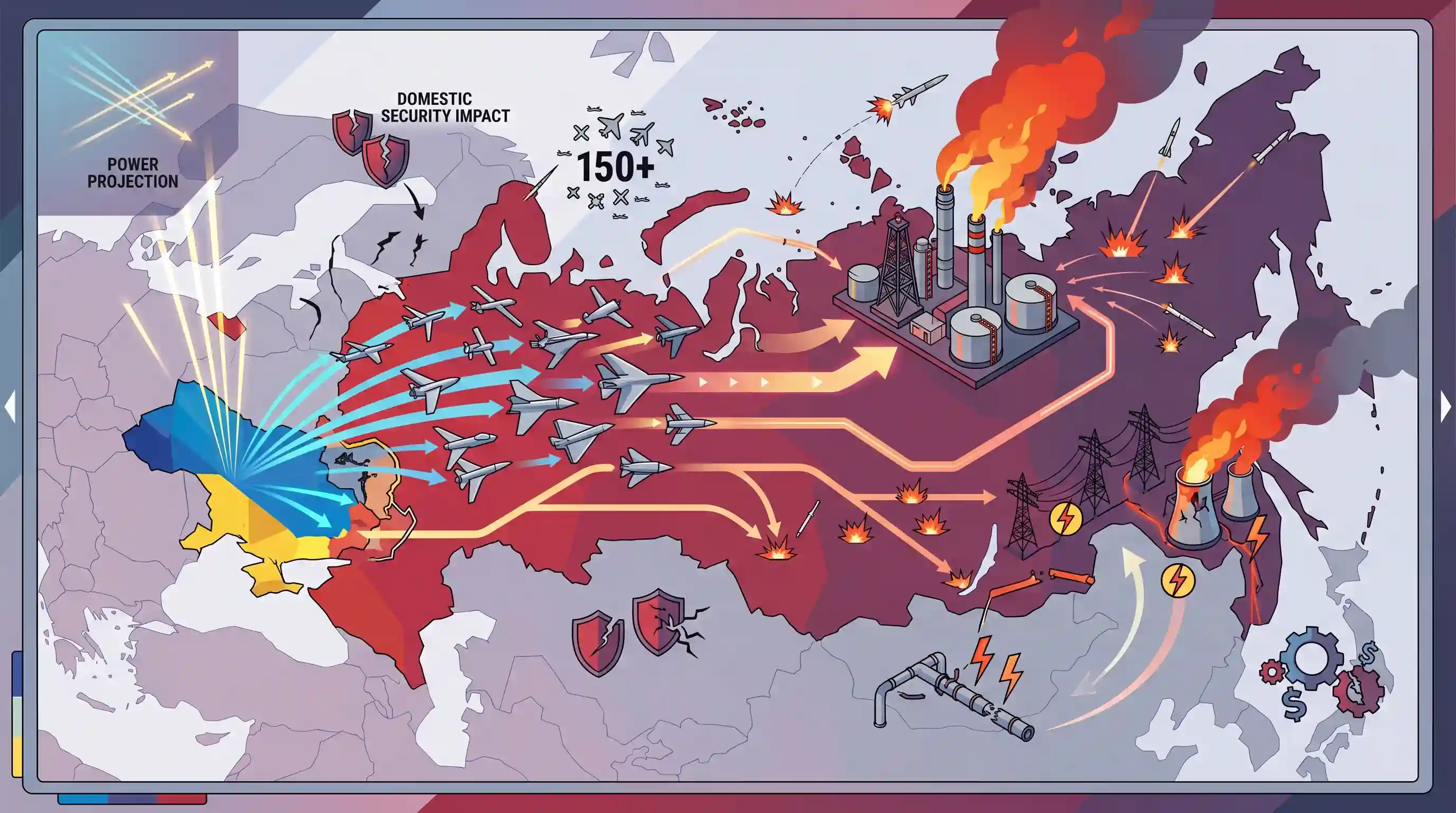
In a major escalation of the ongoing war, Ukraine launched a massive drone strike deep into Russian territory, targeting critical energy infrastructure including an oil refinery in Moscow and the Konakovo Power Station in the Tver region. The Russian Defence Ministry reported destroying over 150 Ukrainian drones across 15 regions. This bold move follows Ukraine's recent incursion into the Kursk region and underscores a shift in tactics, heavily utilizing Unmanned Aerial Vehicles (UAVs) to project power, bypass traditional front lines, and impact Russia's domestic security and war economy.
Key Points
- Ukraine launched a massive drone swarm attack on Russia, striking a major oil refinery in Moscow and a power station in the Tver region.
- Russia claimed to have intercepted 158 Ukrainian drones across 15 regions, demonstrating the large scale of the assault.
- The strategic targeting of energy infrastructure aims to degrade Russia's war economy and military logistics while bringing the war closer to the Russian capital.
- The event highlights a significant escalation in the use of Unmanned Aerial Vehicles (UAVs) in modern asymmetric warfare, allowing deep strikes into enemy territory.
- This attack follows Ukraine's recent surprise incursion into Russia's Kursk region, signalling a shift towards more aggressive, cross-border operations by Kyiv.
Important Terms
Unmanned Aerial Vehicles (UAVs)

Aircraft operated without a human pilot on board, using remote control or autonomous systems for surveillance, reconnaissance, or combat strikes.
UPSC context
GS Paper 3 (Security/Science & Tech); tests knowledge of modern warfare, indigenous defense technology, and cross-border security threats.
Asymmetric Warfare
A conflict where opposing forces differ significantly in military power or resources, leading the weaker side to utilize unconventional tactics like drone strikes or sabotage.
UPSC context
GS Paper 3 (Security); tests understanding of evolving conflict dynamics and non-traditional security threats in global geopolitics.
Kursk Region
A strategic administrative region (Oblast) in western Russia bordering Ukraine, known for the largest tank battle of WWII and recent 2024 Ukrainian incursions.
UPSC context
GS Paper 2 (International Relations) and Geography; relevant for 'Places in News' and understanding territorial border conflicts.
Energy Security
The uninterrupted availability of energy sources at an affordable price, often threatened by attacks on power grids and refineries during geopolitical conflicts.
UPSC context
GS Paper 3 (Economy/Infrastructure); tests impact of global instability on national supply chains and economic sovereignty.
Critical Infrastructure
Physical or cyber assets (e.g., power plants, refineries) so vital that their incapacitation would have a debilitating impact on national security, economy, or public safety.
UPSC context
GS Paper 3 (Internal Security); tests awareness of strategic asset protection and national security frameworks against technological threats.
War of Attrition
A military strategy where one side seeks to win by gradually wearing down the enemy's resources, personnel, and economic capacity to sustain conflict.
UPSC context
GS Paper 2 (International Relations); tests understanding of long-term conflict endurance and its impact on the global war economy.
Prelims Trap
"Kursk, Tver, and Belgorod are highly contested regions located in eastern Ukraine."
UPSC frequently swaps the sovereign ownership of conflict zones. Kursk, Tver, Belgorod, and Rostov are Russian territories, not Ukrainian provinces.
Static Concepts Connected
What are the key geographical features defining the Russia-Ukraine conflict zone?
- Sea of Azov: A vital maritime zone connected to the Black Sea via the Kerch Strait, heavily controlled by Russia to restrict Ukrainian naval access.
- Donbas Region: The heavily industrialized eastern Ukrainian regions of Donetsk and Luhansk, serving as the traditional epicenter of ground combat.
- Bordering Russian Oblasts: Russian regions like Kursk, Belgorod, Voronezh, and Rostov that directly border Ukraine, acting as staging grounds and recent targets.
How do modern counter-UAS (Unmanned Aircraft Systems) architectures neutralize drone swarms?
- Electronic Warfare (EW): Jammers disrupt GPS navigation signals and sever the radio-frequency communication links between the drones and their remote operators.
- Directed Energy Weapons: High-energy lasers or high-power microwaves (HPM) are used to physically burn or fry the internal electronics of incoming UAVs at the speed of light.
- Kinetic Interceptors: Traditional surface-to-air missiles, anti-aircraft artillery, or specialized "kamikaze" interceptor drones that physically ram and destroy the incoming threats.
Cross-Topic Patterns
Asymmetric warfare & internal border security
The success of low-cost drone swarms bypassing traditional air defenses has severe implications for India's border security, particularly regarding cross-border narco-terrorism and weapon drops via drones in Punjab and J&K.
Energy infrastructure strikes & macroeconomic shocks
Strategic strikes on Russian oil infrastructure can tighten global crude supply, directly impacting India's import bill, exacerbating currency depreciation, and triggering imported inflation.

UAV swarms as asymmetric warfare + mapping of Russian border regions (Kursk, Belgorod) will likely form a composite IR/Tech prelims MCQ.
Linked PYQs · 3
Linked PYQs · 3
- 2023MainsGS3
The use of unmanned aerial vehicles (UAVs) by our adversaries across the borders to ferry arms/ammunitions, drugs, etc., is a serious threat to the internal security. Comment on the measures being taken to tackle this threat.
- 2023PrelimsGS1
Consider the following pairs: Area of conflict mentioned in news Country where it is located 1. Donbas : Syria 2. Kachin : Ethiopia 3. Tigray : North Yemen How many of the above pairs are correctly matched?
- 2023PrelimsGS1
Consider the following pairs: Regions often mentioned in news Reason for being in news 1. North Kivu and Ituri : War between Armenia and Azerbaijan 2. Nagorno-Karabakh : Insurgency in Mozambique 3. Kherson and Zaporizhzhia : Dispute between Israel and Lebanon How many of the above pairs are correctly matched?
