Ukraine Energy Crisis and IAEA Intervention Amid Russian Strikes
Source:The Hindu ↗
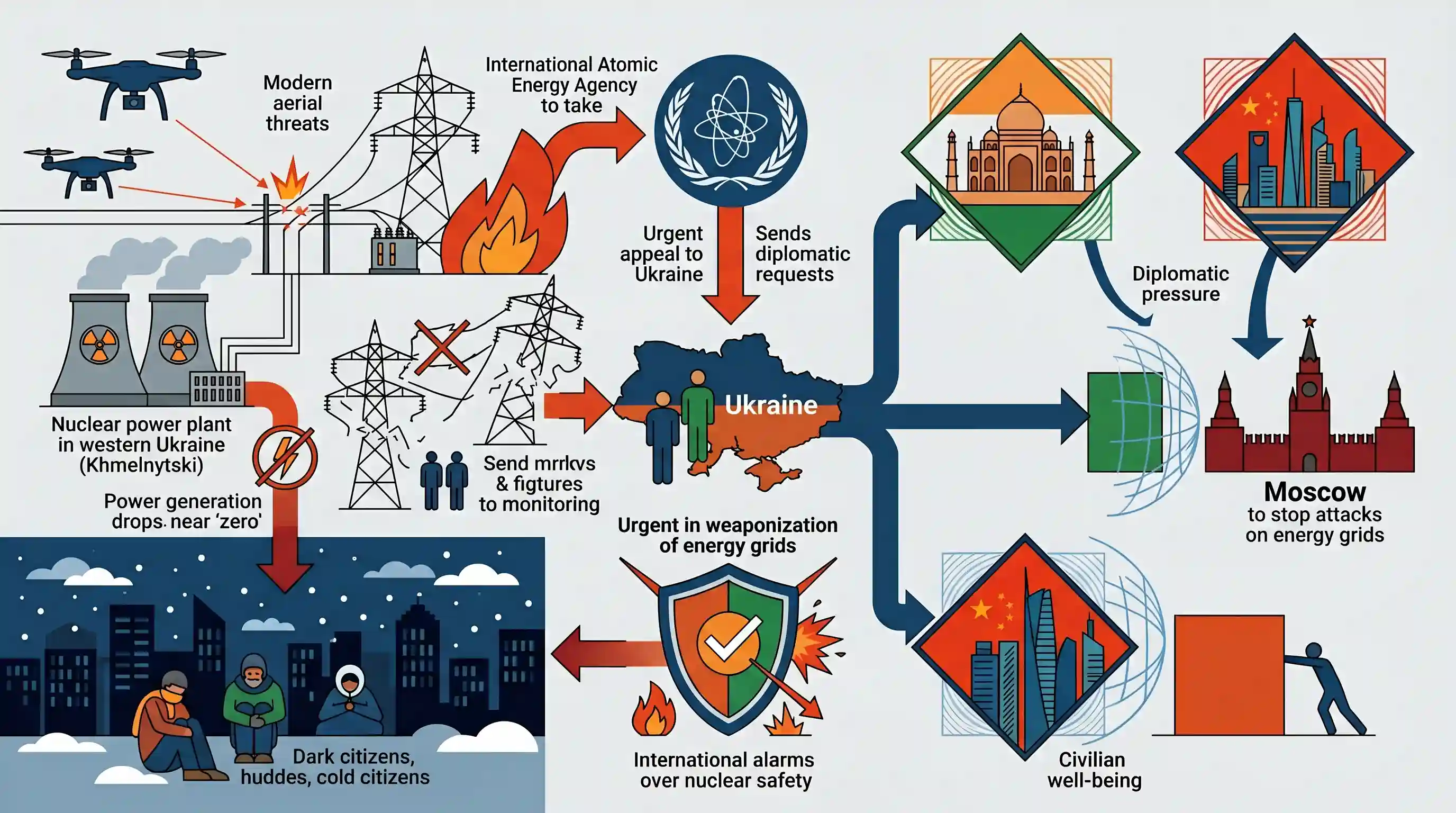
Why It Matters
The targeted destruction of nuclear and civilian energy infrastructure highlights the 'weaponization of energy' in modern warfare. It underscores the critical role of international bodies like the IAEA in conflict zones and tests India's diplomatic balancing act as Ukraine explicitly seeks New Delhi's intervention to pressure Russia.
Summary
Recent Russian drone strikes targeted critical nuclear power substations in western Ukraine, severely crippling the country's power generation and bringing it to near 'zero'. These attacks explicitly threaten the safe operation of the Khmelnytskyi and Rivne nuclear plants. In response, Ukrainian officials have formally requested intervention from the International Atomic Energy Agency (IAEA) to uphold nuclear safety protocols. Furthermore, Ukraine has appealed to key global players, specifically India and China, to exert diplomatic pressure on Moscow to cease targeting civilian energy grids. As the war continues through winter, the deliberate destruction of energy infrastructure highlights the weaponization of energy grids and raises critical international alarms over nuclear safety and civilian well-being.
Key Points
- Russian drone strikes severely damaged two critical nuclear power substations in western Ukraine, dropping power generation to near 'zero'.
- The attacks directly threaten the safe operation of the Khmelnytskyi and Rivne nuclear power plants, raising global nuclear safety alarms.
- Ukraine's Foreign Minister called on the IAEA to intervene and requested India and China to pressure Moscow to halt attacks on energy infrastructure.
- In retaliation, Ukraine has escalated drone strikes on Russian oil depots and refineries to disrupt Moscow's energy exports.
Important Terms
International Atomic Energy Agency (IAEA)

An autonomous intergovernmental organization within the UN system that promotes peaceful nuclear energy use and inhibits military applications. Known as the global 'nuclear watchdog', it oversees safety, security, and safeguards.
UPSC context
GS Paper 2 (International Institutions); tests knowledge of nuclear safeguards, India's founding membership, and global security mandates.
Energy Security
The uninterrupted availability of energy sources at an affordable price, encompassing physical availability, infrastructure accessibility, and economic affordability to sustain national functions and growth.
UPSC context
GS Paper 3 (Energy/Security); tests understanding of import dependency, strategic reserves, and conflict-driven supply chain vulnerabilities.
Seven Indispensable Pillars of Nuclear Safety
Specific IAEA-developed safety principles for nuclear facilities in conflict zones, ensuring physical integrity, functional safety systems, secure off-site power, and staff freedom from undue pressure.
UPSC context
GS Paper 2 (International Relations); tests awareness of evolving safety protocols and international response to 'nuclear terrorism' or warfare.
Weaponization of Energy
The strategic use of energy resources, infrastructure (like power grids), or supply disruptions as a tool of political coercion or military advantage to influence or weaken an adversary.
UPSC context
GS Paper 2/3 (IR/Security); tests analysis of non-traditional threats and the intersection of global trade with geopolitical strategy.
International Humanitarian Law (IHL)
A set of rules (primarily Geneva Conventions) that limit conflict effects by protecting non-combatants and restricting methods of warfare, particularly prohibiting attacks on essential civilian infrastructure.
UPSC context
GS Paper 2 (International Law); tests understanding of legal distinctions between military and civilian targets in global conflicts.
United Nations (UN)
The primary global intergovernmental organization established in 1945 to maintain international peace, security, and cooperation, and to coordinate humanitarian efforts during crises.
UPSC context
GS Paper 2 (International Institutions); foundational for understanding multilateral diplomacy, conflict resolution, and the mandate of specialized agencies.
Prelims Trap
"The IAEA possesses binding enforcement powers to halt military attacks on nuclear facilities."
The IAEA is a monitoring and reporting watchdog. It lacks direct military or binding enforcement powers to physically halt attacks; it can only report violations to the UN Security Council.
Static Concepts Connected
What is the IAEA 'Additional Protocol' and India's status regarding it?
- Verification scope: Expands IAEA's inspection rights, allowing broader access to information and undeclared nuclear locations to verify the peaceful use of nuclear material.
- India-specific agreement: India signed a customized Additional Protocol in 2009, placing its declared civilian reactors under IAEA safeguards while keeping its military nuclear facilities strictly exempt.
How do the Geneva Conventions treat attacks on nuclear power plants?
- Protocol I protection: Additional Protocol I prohibits targeting installations containing 'dangerous forces' (like nuclear plants) if such attacks risk severe radiation release and consequent civilian losses.
- Dual-use loophole: Power grids supplying both military and civilian domains often blur legal lines, complicating the enforcement of the international humanitarian principle of proportionality.
Cross-Topic Patterns
Hybrid Warfare & Grid Cybersecurity
Kinetic drone strikes on nuclear substations parallel past cyber-attacks on critical energy infrastructure, merging GS2 International Relations with GS3 Cybersecurity and disaster management themes.
Strategic Autonomy to Active Mediation
Ukraine’s direct appeal to New Delhi tests India's transition from a neutral non-aligned observer to a potential global peacemaker leveraging its strategic ties with Russia.

Expect a multi-statement question blending IAEA Additional Protocol provisions with map-based pairs of contested European nuclear plants.
Linked PYQs · 3
Linked PYQs · 3
- 2018PrelimsGS1
In the Indian context, what is the implication of ratifying the 'Additional Protocol' with the 'International Atomic Energy Agency (IAEA)'?
- 2020PrelimsGS1
In India, why are some nuclear reactors kept under "IAEA Safeguards" while others are not?
- 2025MainsGS2
"Energy security constitutes the dominant kingpin of India's foreign policy, and is linked with India's overarching influence in Middle Eastern countries.” How would you integrate energy security with India's foreign policy trajectories in the coming years?
