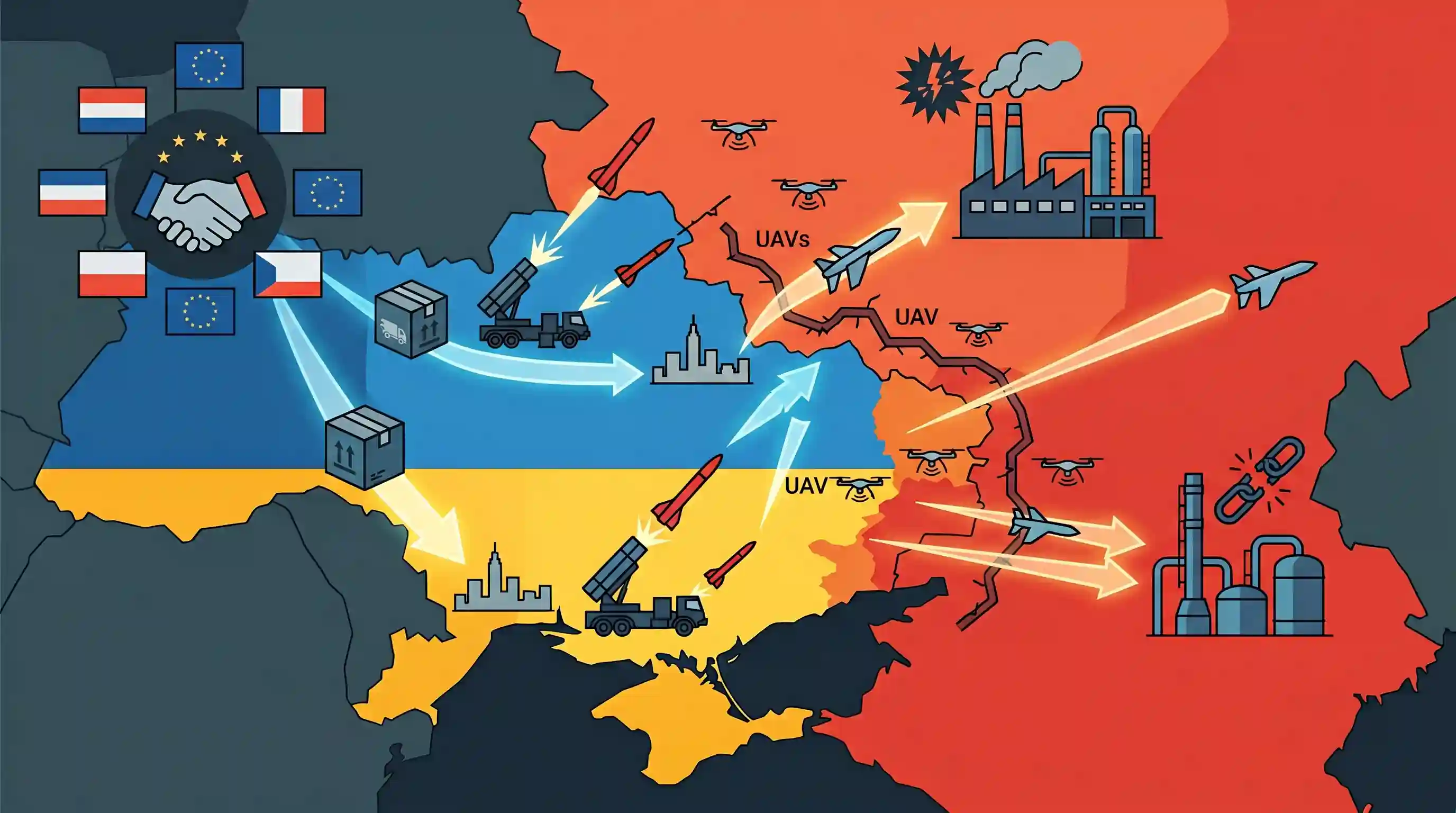
Ukraine long-range strikes on Russian energy and military sites
Source:The Hindu ↗
Why It Matters
The conflict highlights the profound shift in modern warfare through the aggressive use of UAVs and long-range precision strikes (relevant for GS-3 Security). It also underscores the weaponization of energy infrastructure and the resulting impact on global energy markets, which is highly pertinent to India's foreign policy and global geopolitics (GS-2 IR).
Summary
Ukraine has intensified its military strategy by launching extensive long-range drone and missile strikes deep inside Russia, targeting critical military factories and energy infrastructure. High-profile targets include drone-component factories and oil refineries, aimed at disrupting Russia's war economy and supply chains. As the war stretches on, both nations are relying heavily on unmanned aerial vehicles (UAVs) to strike behind static front lines. Simultaneously, Ukraine continues diplomatic engagements with European allies to secure advanced air defense systems to protect cities like Kharkiv and Odesa from ongoing Russian bombardment.
Key Points
- Ukraine launched deep long-range drone and missile strikes into Russian territory, targeting military and energy infrastructure.
- Significant targets included the VNIIR-Progress plant producing drone components in Cheboksary and oil facilities in the Samara and Vladimir regions.
- The widespread use of drones by both sides is reshaping military tactics, acting as a force multiplier while ground frontlines remain static.
- Ukraine's strategy aims to cripple the Russian war economy, disrupt supply chains, and increase the political and economic cost of the conflict for Moscow.
- Ukraine has secured new commitments from Western allies for additional air defense systems to counter continuous Russian retaliatory strikes on its cities.
Important Terms
Unmanned Aerial Vehicles (UAVs)

Pilotless aircraft operated remotely or autonomously for reconnaissance or offensive missions. They have redefined modern combat by providing low-cost, high-precision strike capabilities deep behind enemy lines.
UPSC context
GS Paper 3: Science & Tech and Internal Security. Tests knowledge of indigenous defense production and evolving battlefield technologies.
Asymmetric Warfare
A conflict where belligerents possess significantly different levels of military power or resources, leading the weaker party to use unconventional tactics like sabotage or drone strikes.
UPSC context
GS Paper 3: Security. Relevant for studying non-traditional threats, proxy wars, and the limitations of conventional military superiority.
Security Service of Ukraine (SBU)
Ukraine's principal internal security and intelligence agency. It is tasked with counter-intelligence, combating terrorism, and protecting state secrets, often conducting special operations during wartime.
UPSC context
GS Paper 2/3: International Relations/Security. Tests understanding of the role of intelligence agencies in statecraft and regional stability.
Energy Security
The uninterrupted availability of energy sources at an affordable price. In a global context, it involves protecting energy infrastructure and supply chains from geopolitical disruptions.
UPSC context
GS Paper 3: Economy/Resources. Crucial for assessing supply chain vulnerabilities and India's strategic energy interests during global conflicts.
Air Defense Systems
Military systems, including missiles and radar, designed to detect and intercept incoming aerial threats like aircraft, missiles, and drones to protect civilian and strategic sites.
UPSC context
GS Paper 3: Science & Tech/Defense. Important for understanding national security infrastructure and the strategic value of advanced weapon transfers.
Prelims Trap
"Under International Humanitarian Law, dual-use energy infrastructure like oil refineries are unconditionally exempt from military strikes."
Under IHL, dual-use infrastructure (like refineries) can be legitimate targets if they actively support military operations and their destruction offers definite military advantage.
Static Concepts Connected
What comprises India's multi-layered Air Defence system?
- Long-range: S-400 Triumf (up to 400km range) and the indigenous two-tier Ballistic Missile Defence (BMD) shield.
- Medium-range: Medium-Range Surface-to-Air Missile (MRSAM / Barak-8), developed jointly with Israel to intercept aerial threats.
- Short-range: Indigenous Akash missile batteries and very-short-range point-defense MANPADS like the Igla-S.
How does International Humanitarian Law define legitimate targets?
- Principle of Distinction: Belligerents must at all times distinguish between combatants/military objectives and civilians/civilian objects.
- Principle of Proportionality: Incidental civilian harm must not be excessive in relation to the direct military advantage anticipated.
- Dual-use infrastructure: Civilian infrastructure (e.g., power grids, transport) can become military targets if actively supporting war efforts.
Cross-Topic Patterns
Asymmetric UAVs & Border Security
The deployment of cheap, swarming drones to penetrate deep airspace mirrors India's internal security challenge with cross-border narco-terror drones dropping payloads in Punjab and J&K.
Energy Strikes & India's CAD
Disruptions to Russian oil infrastructure tighten global crude supplies, directly threatening to widen India's Current Account Deficit (CAD) and stoke imported inflation.

GS-3 Mains 2026 is highly likely to feature a question on how asymmetric UAV warfare is forcing a pivot in India's air defense doctrines.
Linked PYQs · 5
Linked PYQs · 5
- 2024MainsGS2
Discuss the geopolitical and geostrategic importance of Maldives for India with a focus on global trade and energy flows. Further also discuss how this relationship affects India's maritime security and regional stability amidst international competition ?
- 2012MainsGS2
Does Putin's return as President of Russia mark a shift to a confrontationist stance in international diplomacy towards the West?
- 2023MainsGS3
The use of unmanned aerial vehicles (UAVs) by our adversaries across the borders to ferry arms/ammunitions, drugs, etc., is a serious threat to the internal security. Comment on the measures being taken to tackle this threat.
- 2025MainsGS3
Why is maritime security vital to protect India's sea trade? Discuss maritime and coastal security challenges and the way forward.
- 2025MainsGS2
"Energy security constitutes the dominant kingpin of India's foreign policy, and is linked with India's overarching influence in Middle Eastern countries.” How would you integrate energy security with India's foreign policy trajectories in the coming years?
