Ukrainian Drone Attack on Russian Facility Disables Kazakh Gas Output
Source:Indian Express ↗
Why It Matters
It demonstrates the interconnectedness of Eurasian energy infrastructure, highlighting how regional conflicts can directly threaten global energy supplies and expose the strategic vulnerabilities of landlocked countries like Kazakhstan that rely on Russian export routes.
Summary
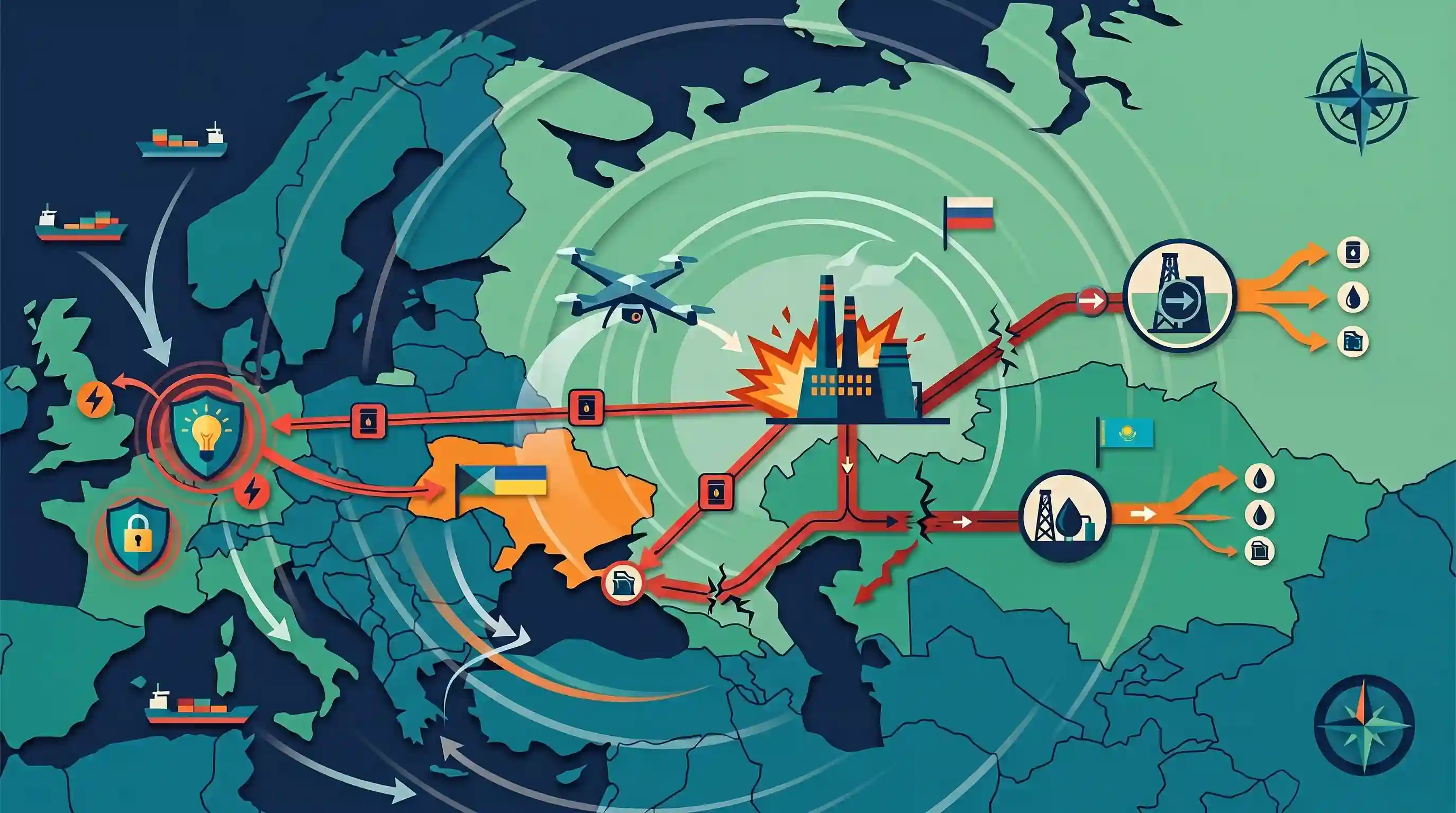
A Ukrainian drone attack on Russia's Orenburg gas plant has severely disrupted operations at Kazakhstan's Karachaganak oil and gas field, reducing its output by 25-30%. The incident exposes the vulnerability of Central Asian energy exports, which rely heavily on Russian infrastructure for processing and pipeline transport (e.g., Caspian Pipeline Consortium, Druzhba pipeline). This highlights the cascading geopolitical impacts of the Russia-Ukraine conflict on global energy supply chains and European energy security.
Key Points
- A Ukrainian drone strike on Russia's Orenburg gas plant forced a 25-30% production cut at Kazakhstan's major Karachaganak oil and gas field.
- The Karachaganak field relies heavily on the Orenburg plant to process its raw gas, which is then re-injected to maintain reservoir pressure.
- Operated by an international consortium including Chevron, Shell, and Eni, the field produced approximately 263,000 barrels per day of oil in 2024.
- Kazakhstan's oil exports primarily reach European markets via the Caspian Pipeline Consortium to the Black Sea and Russia's Druzhba pipeline.
- The attack underscores the vulnerability of global energy supply chains and the dependency of Central Asian nations on Russian infrastructure for export.
Important Terms
Caspian Pipeline Consortium (CPC)

A 1,511 km pipeline transporting crude from Kazakhstan’s major fields to the Russian Black Sea port of Novorossiysk. It handles roughly 80% of Kazakhstan's oil exports.
UPSC context
GS Paper 2 & 3: Crucial for Central Asian geopolitics, global energy security, and India's diversification of oil imports.
Druzhba Pipeline
One of the world’s longest oil pipeline networks, connecting Russia to Central and Eastern Europe. It is a vital artery for Russian and Kazakh crude exports to EU markets.
UPSC context
GS Paper 2: Tests knowledge of European energy dependence and infrastructure vulnerability in the Russia-Ukraine conflict.
KazMunayGaz (KMG)
Kazakhstan’s state-owned oil and gas company. It manages the country's interests in all major hydrocarbon projects, including the Karachaganak field and various international pipelines.
UPSC context
GS Paper 2: Relevant for bilateral relations and the strategic role of national oil companies in regional energy diplomacy.
Karachaganak Field
One of the world’s largest oil and gas condensate fields, located in northwest Kazakhstan. Its output is highly dependent on Russian processing infrastructure.
UPSC context
GS Paper 1 & 3: Important for world resource mapping and understanding the interconnected nature of global energy supply chains.
Orenburg Gas Plant
A massive gas processing facility in Russia operated by Gazprom. It serves as a critical processing hub for gas from Kazakhstan's Karachaganak field.
UPSC context
GS Paper 2: Demonstrates cross-border energy dependencies and the impact of targetting infrastructure in modern geopolitical conflicts.
Prelims Trap
"The Caspian Pipeline Consortium (CPC) transports Central Asian oil directly to European markets, completely bypassing Russian territory."
The CPC pipeline does not bypass Russia; it transports crude from Kazakhstan to the Russian Black Sea port of Novorossiysk, making it vulnerable to Russian geopolitical risks.
Static Concepts Connected
Why are Central Asian Republics (CARs) highly vulnerable in global energy markets?
- Landlocked Geography: Lacking direct access to the open ocean, CARs must rely entirely on neighboring countries for transit to global energy markets.
- Soviet Legacy Infrastructure: Most existing export pipelines (like CPC and Druzhba) were built to flow through Russia, creating a deep, path-dependent structural reliance on Moscow.
- Geopolitical Chokepoints: Conflicts in transit nations (like the Russia-Ukraine war) instantly bottleneck their exports, demonstrating the fragility of cross-border energy supply chains.
What are the major Eurasian pipeline networks important for Prelims mapping?
- Caspian Pipeline Consortium (CPC): Connects western Kazakhstan’s major oil fields to the Russian Black Sea port of Novorossiysk for seaborne export.
- Druzhba Pipeline: One of the world's longest oil pipelines, built during the Soviet era, carrying Russian and Kazakh crude into Central and Eastern Europe.
- TAPI Pipeline: A planned natural gas pipeline connecting Turkmenistan’s Galkynysh gas field to India via Afghanistan and Pakistan, bypassing Russian/Chinese routes.
Cross-Topic Patterns
Asymmetric warfare & energy chokepoints
Just as Houthi strikes in the Red Sea disrupt global shipping, Ukrainian drone strikes on Russian infrastructure illustrate how asymmetric drone warfare can cripple interconnected global energy supply chains.
India's Connect Central Asia policy
The vulnerability of CARs to Russian transit routes underscores the strategic importance of India's Connect Central Asia policy, the INSTC, and Chabahar Port for independent energy access.

Expect a multi-statement Prelims question in 2026 pairing Eurasian pipelines (CPC, Druzhba, Nord Stream) with their terminal seas or source countries.
Linked PYQs · 4
Linked PYQs · 4
- 2025MainsGS2
"Energy security constitutes the dominant kingpin of India's foreign policy, and is linked with India's overarching influence in Middle Eastern countries.” How would you integrate energy security with India's foreign policy trajectories in the coming years?
- 2024MainsGS2
Critically analyse India's evolving diplomatic, economic and strategic relations with the Central Asian Republics (CARs) highlighting their increasing significance in regional and global geopolitics.
- 2024PrelimsGS1
Consider the following statements : Statement-I : Sumed pipeline is a strategic route for Persian Gulf oil and natural gas shipments to Europe. Statement-II : Sumed pipeline connects the Red Sea with the Mediterranean Sea. Which one of the following is correct in respect of the above statements?
- 2014PrelimsGS1
Turkey is located between
