Ukrainian Drone Strikes Target Russian Energy Infrastructure
Source:The Hindu ↗
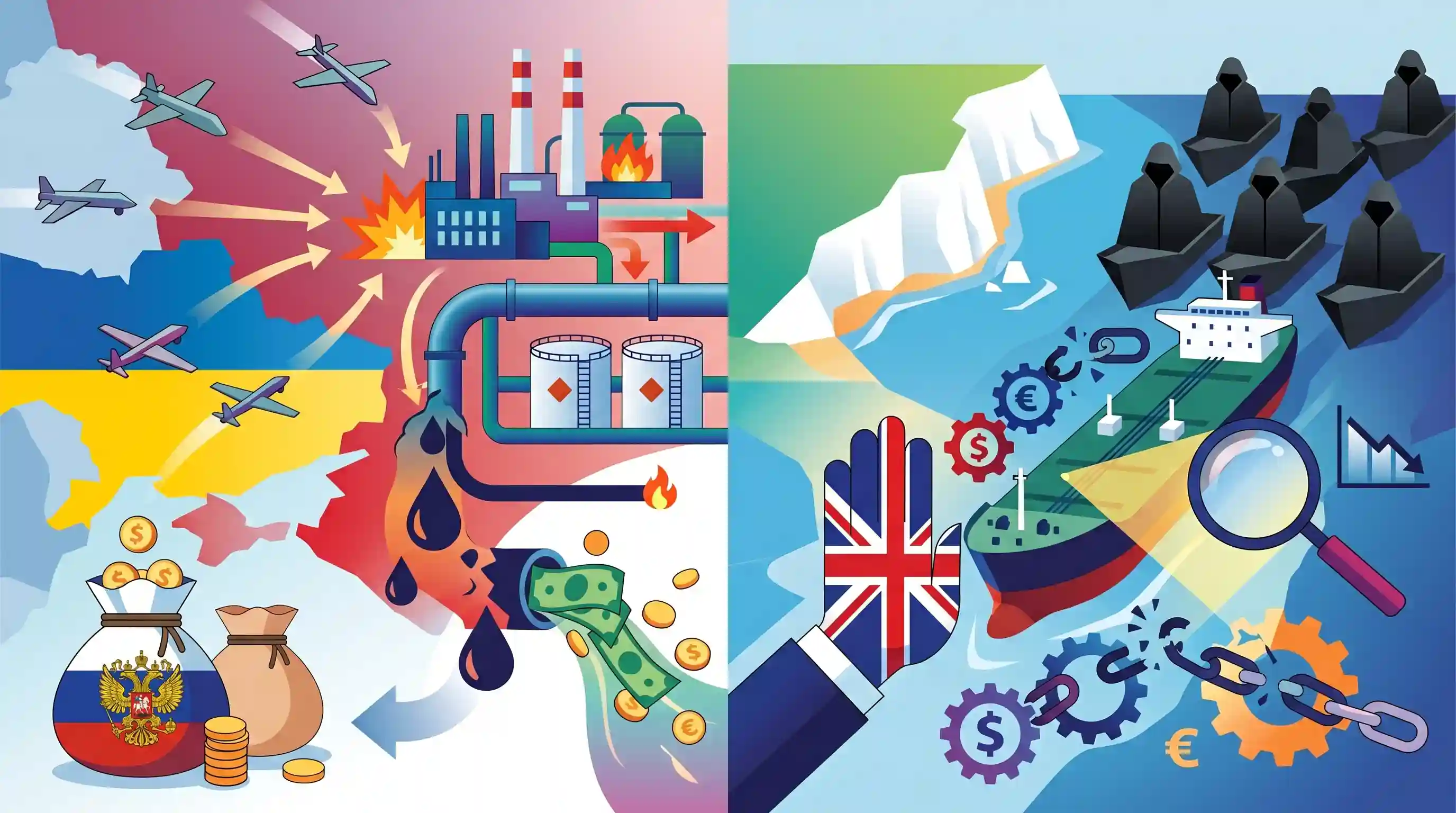
Why It Matters
The article is critical for understanding the evolving tactics in modern conflicts (like drone warfare targeting critical infrastructure) and the geopolitical ramifications of economic sanctions, notably the emergence of 'shadow fleets' in the global oil trade.
Summary
Ukraine has intensified drone strikes against Russia, targeting a residential building in the Oryol region and a fuel facility in Yaroslavl as part of a broader strategy to cripple Russia's energy sector, which funds its war effort. Concurrently, Britain is investigating a sanctioned tanker, 'Smyrtos', in the English Channel. The vessel is suspected of belonging to Russia's 'shadow fleet'—a network of ships used to transport oil and circumvent international economic sanctions.
Key Points
- Ukrainian drone strikes targeted Russian territory, hitting a residential area in the Oryol region and an oil facility in the Yaroslavl region.
- Ukraine is strategically targeting Russia's energy infrastructure to disrupt the funding and logistical support for Russia's military operations.
- Britain is investigating the tanker 'Smyrtos' in the English Channel, suspected of being part of Russia's 'shadow fleet'.
- The 'shadow fleet' is a network of vessels used to bypass international economic sanctions and secretly transport Russian oil globally.
Important Terms
Shadow Fleet

A clandestine network of aging tankers with obscured ownership used to transport oil and circumvent international sanctions or price caps.
UPSC context
GS Paper II/III: International Relations and Security. Tests knowledge of sanction-evasion mechanisms and their impact on global trade and maritime safety.
Oil Price Cap
A sanction mechanism implemented by the G7, EU, and Australia to limit Russian oil revenues by banning Western maritime services for oil sold above $60/barrel.
UPSC context
GS Paper III: Economy. Crucial for understanding global energy pricing, inflation control, and India's strategic oil imports.
Economic Sanctions
Commercial and financial penalties applied by states or international organizations against a target state to influence behavior or degrade military capacity.
UPSC context
GS Paper II: International Relations. Tests understanding of non-military statecraft and its secondary effects on third-party nations like India.
Asymmetric Warfare
Unconventional conflict where a belligerent uses low-cost tools, such as long-range drones, to target a more powerful adversary's high-value strategic or economic infrastructure.
UPSC context
GS Paper III: Internal Security/Defense. Relevant for modern technological warfare and its role in disrupting national security.
Flags of Convenience
The practice of registering a merchant ship in a country other than the owner's to bypass strict regulations or taxes.
UPSC context
GS Paper III: Economy/Environment. Important for maritime law, illegal trade monitoring, and environmental risks of unregulated shipping.
Yaroslavl
A Russian industrial region approx. 700km from Ukraine; its fuel storage facilities are strategic targets in the conflict.
UPSC context
GS Paper I: Geography. 'Places in News' category; signifies the increasing range and depth of conflict-related strikes.
Prelims Trap
"Flags of Convenience vessels are registered in their home countries to ensure protection under domestic maritime laws and naval forces."
FoC involves registering a ship in a foreign jurisdiction (like Panama or Liberia) with lax regulations, specifically to bypass stringent home-country rules or evade sanctions.
Static Concepts Connected
What does "Flag of Convenience" (FoC) mean in international maritime law?
- Definition: The business practice of registering a merchant ship in a sovereign state different from that of the ship's actual owners.
- Strategic Purpose: Used to bypass strict labor and environmental laws, reduce operating costs, or evade international economic sanctions like the G7 oil price cap.
- UNCLOS Mandate: The UN Convention on the Law of the Sea requires a "genuine link" between a vessel and its flag state, though enforcement remains weak.
What are the key geographical features of the English Channel?
- Geographic Extent: It separates southern England from northern France, acting as one of the world's busiest and most tightly monitored maritime shipping chokepoints.
- Waterway Links: It connects the Atlantic Ocean to the North Sea specifically via the Strait of Dover at its northeastern end.
Cross-Topic Patterns
Shadow fleets and Indian energy security
India's import of discounted Russian crude via shadow fleets links global economic sanctions directly to its domestic inflation management and strategic autonomy.
Modern warfare and energy infrastructure
The reciprocal targeting of energy grids by Ukraine and Russia illustrates a shift in modern warfare, where crippling civilian economic lifelines is prioritized alongside battlefield victories.

'Flags of Convenience', shadow fleets, and G7 oil price caps are prime candidates for a multi-statement IR/Economy question in 2026.
Linked PYQs · 3
Linked PYQs · 3
- 2023PrelimsGS1
Consider the following pairs: Regions often mentioned in news Reason for being in news 1. North Kivu and Ituri : War between Armenia and Azerbaijan 2. Nagorno-Karabakh : Insurgency in Mozambique 3. Kherson and Zaporizhzhia : Dispute between Israel and Lebanon How many of the above pairs are correctly matched?
- 2021MainsGS1
Discuss the multi-dimensional implications of uneven distribution of mineral oil in the world.
- 2012MainsGS2
How have the US sanctions against Iran affected India's bilateral relations with Iran?
