UK to Share Classified Missile Technology with Ukraine for Production
Source:The Hindu ↗
આ શા માટે મહત્વનું છે
Highlights a significant evolution in Western military assistance—from providing finished weaponry to transferring classified technology and establishing local production lines in a conflict zone. It is relevant for understanding defense indigenization, geopolitics of the Russia-Ukraine war, and the strategic implications of high-precision cruise missiles.
સારાંશ
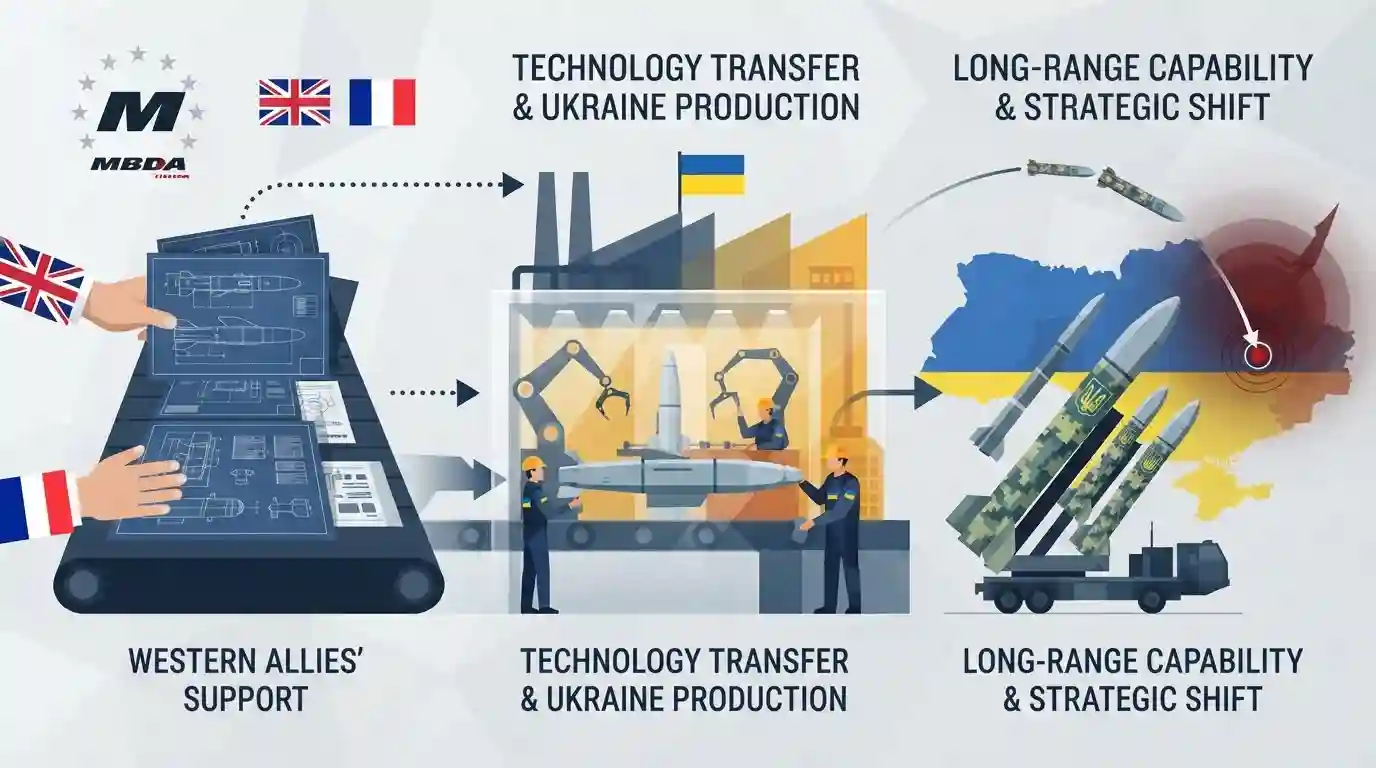
The United Kingdom plans to help Ukraine domestically manufacture long-range missiles by sharing classified technical data. European defense firm MBDA will release details of UK-made components for the Storm Shadow missile, while France works similarly on its SCALP variant. This technology transfer represents a strategic shift by Western allies to build Ukraine's indigenous defense-industrial base, enabling long-term self-sufficiency in high-precision strike capabilities amidst the ongoing war with Russia.
મુખ્ય મુદ્દા
- The UK government has decided to share classified technical information with Ukraine to enable domestic production of long-range missiles.
- European missile manufacturer MBDA will release details on UK-made components of the Storm Shadow missile to assist Ukrainian manufacturing efforts.
- The French version of the Storm Shadow is called SCALP; both are air-launched, high-precision cruise missiles with ranges exceeding 250 km.
- France and the UK are actively working to set up assembly lines within Ukraine, shifting the strategy from merely supplying weapons to building local defense industrial capacity.
- The UK was the first nation to supply Ukraine with long-range strike capabilities in 2023, setting a precedent for deeper technological integration.
મહત્વપૂર્ણ શબ્દો
NATO (North Atlantic Treaty Organization)

An intergovernmental military alliance established in 1949 by the Washington Treaty, founded on the principle of collective defense among 32 North American and European member states.
UPSC context
GS Paper II: International Relations. Tests knowledge of global security architectures, multilateral organizations, and geopolitical shifts.
Storm Shadow / SCALP-EG
An Anglo-French long-range, air-launched, low-observable cruise missile manufactured by MBDA, featuring advanced triple navigation systems and a multi-stage BROACH penetrating warhead.
UPSC context
GS Paper III: Security & Defence Technology. Tests awareness of state-of-the-art weapon systems and missile classifications.
MBDA
A European multinational joint venture and leader in missile systems, formed by major aerospace and defense companies from the UK, France, and Italy.
UPSC context
GS Paper III: Defence and S&T. Tests understanding of global defense-industrial consortia and joint development projects.
Technology Transfer (Defence)
The transfer of classified technical data, designs, and assembly capabilities from one nation to another to enable the localized, self-sufficient production of advanced military hardware.
UPSC context
GS Paper III: Indigenisation of Technology. Tests concepts of defense-industrial collaborations, self-reliance, and strategic technology sharing.
પ્રિલિમ્સ ટ્રેપ
Cruise missiles, like ballistic missiles, carry their own oxidizers to sustain combustion throughout their flight path.
Cruise missiles use air-breathing jet engines (turbofans/turbojets) and rely on atmospheric oxygen, whereas ballistic missiles carry both fuel and oxidizers to operate in the vacuum of space.
સંલગ્ન સ્થિર ખ્યાલો
What are the fundamental differences between Cruise and Ballistic Missiles?
- Trajectory: Cruise missiles fly horizontally entirely within the atmosphere at low altitudes; ballistic missiles follow a high-altitude parabolic arc, entering outer space before descending.
- Propulsion: Cruise missiles use jet engines (turbofans/ramjets) requiring atmospheric oxygen; ballistic missiles are powered by rocket boosters carrying their own oxidizers.
- Guidance: Cruise missiles are actively guided throughout their flight path; ballistic missiles are unguided during their free-fall ballistic phase after the rocket engine burns out.
What is the Missile Technology Control Regime (MTCR)?
- Nature: An informal, non-treaty-based voluntary partnership of 35 countries established in 1987 to prevent the proliferation of missile and unmanned aerial vehicle technology.
- Thresholds: Restricts the transfer of missiles and technology capable of carrying a 500 kg payload to a range of at least 300 km (Category I items).
- India Membership: India joined as a full member in 2016, which eased its access to high-end dual-use technologies and boosted joint ventures like BrahMos.
આંતર-વિષય પેટર્ન
Defense Tech Sharing vs MTCR Limits
Western tech-sharing deals in conflict zones test the limits of voluntary export control regimes like MTCR, highlighting geopolitical alignments over traditional non-proliferation norms.
Strategic Shift to Co-production
Ukraine's transition from arms recipient to localized manufacturer mirrors India's defense indigenization strategy, showing that modern strategic partnership requires co-development over simple imports.

Compare-and-contrast questions on cruise vs ballistic propulsion, alongside MTCR threshold limits, are highly probable in S&T/IR.
સંલગ્ન PYQ · 4
સંલગ્ન PYQ · 4
- 2023MainsGS2
‘The expansion and strengthening of NATO and a stronger US-Europe strategic partnership works well for India.’ What is your opinion about this statement ? Give reasons and examples to support your answer.
- 2021MainsGS3
How is S-400 air defence system technically superior to any other system presently available in the world?
- 2025PrelimsGS1
What is the common characteristic of the chemical substances generally known as CL-20, HMX and LLM-105, which are sometimes talked about in media?
- 2026PrelimsGS1
Consider the following statements about Mission Sudarshan Chakra of India : 1. It aims to enhance India's air defence, ballistic missile defence and aerial offensive capabilities. 2. This Mission is being designed to enhance rapid, precise, and powerful defence responses, reinforcing India's strategic autonomy. 3. One of the aims of this Mission is to cover all public places of India by an expanded nationwide security shield by 2035. Which of the statements given above is/are correct ?
