UK Military Troop Reinforcement in Norway and Arctic Region
Source:The Hindu ↗
Why It Matters
The militarization of the Arctic and changes in NATO's burden-sharing dynamics highlight significant shifts in global geopolitics. Understanding the protection of critical maritime infrastructure and evolving defense postures in the High North is crucial for analyzing contemporary international relations and maritime security paradigms.
Summary
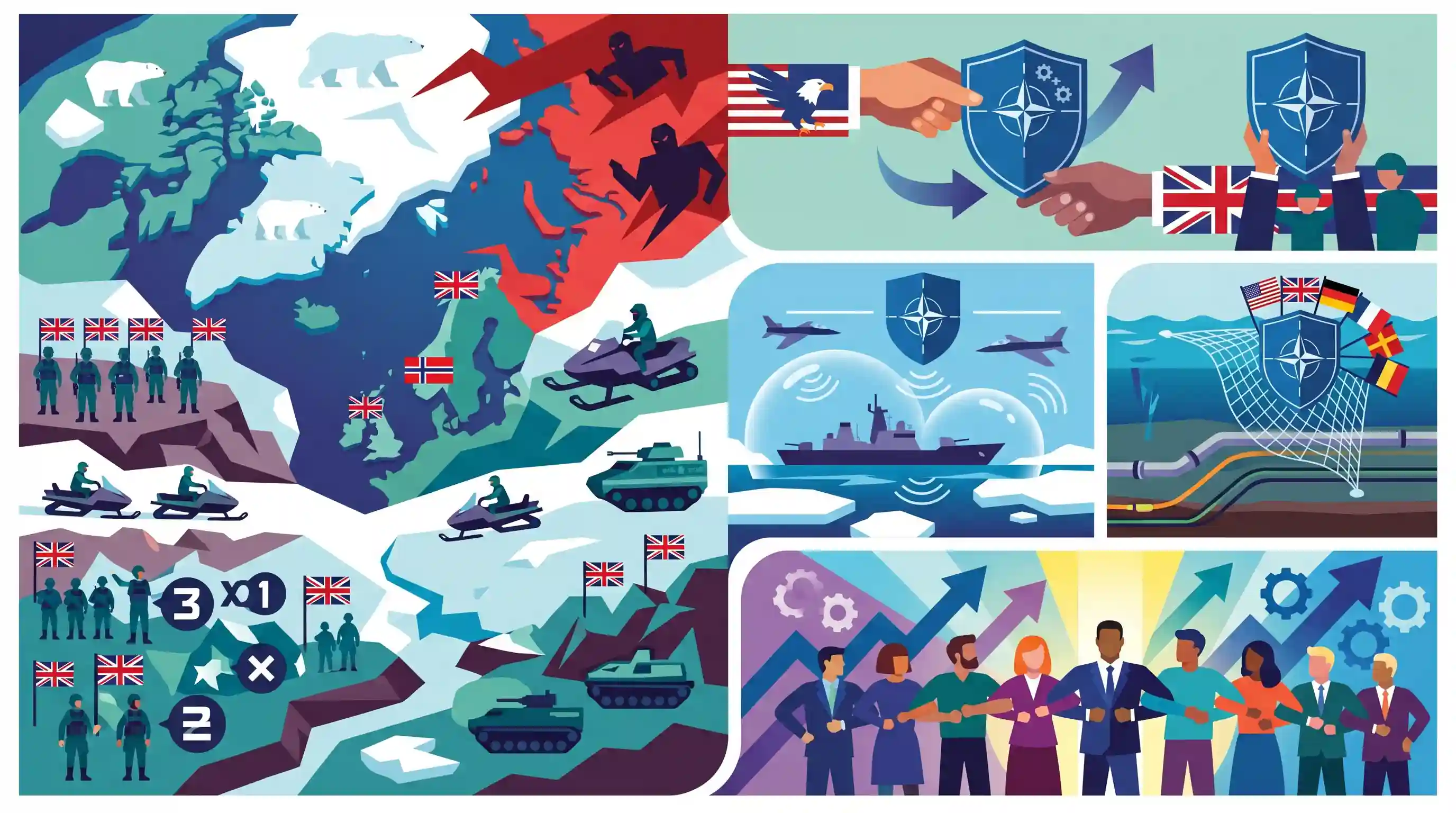
The UK is significantly expanding its military presence in Norway and the broader Arctic region to defend against perceived Russian threats. By doubling its troop deployment and taking over key NATO command responsibilities from the US, the UK is spearheading European efforts to secure the High North. This includes leading the NATO 'Arctic Sentry' mission and the Joint Expeditionary Force's 'Lion Protector' initiative to protect critical undersea infrastructure, reflecting a strategic realignment within NATO towards enhanced European self-reliance in regional security.
Key Points
- The UK is set to double its troop deployment in Norway from 1,000 to 2,000 over the next three years to counter rising Russian threats.
- Britain will assume a leading role in 'Arctic Sentry', a NATO Arctic mission, as the US hands over the leadership of its Norfolk command to encourage European allies to take greater responsibility.
- The strategic shifts follow alleged statements by Donald Trump using perceived threats from Russia and China to justify claims on Greenland, prompting European NATO members to bolster regional defenses.
- The UK and Norway have strengthened their defense ties, signing a pact to jointly operate a warship fleet to hunt Russian submarines and Norway purchasing five Type-26 frigates from Britain.
- Britain plans to lead a Joint Expeditionary Force (JEF) initiative called 'Lion Protector' involving northern European and Baltic nations to defend critical national infrastructure against sabotage.
Important Terms
Joint Expeditionary Force (JEF)

A UK-led multinational partnership of 10 Northern European nations designed for rapid response, high-readiness operations, and countering gray-zone threats. It operates independently or in support of NATO and the UN.
UPSC context
GS II: International Relations. Relevant for studying regional security architectures, 'minilateral' groupings, and European self-reliance in the post-Ukraine invasion era.
NATO (North Atlantic Treaty Organization)
A 32-member intergovernmental military alliance. In the Arctic, it focuses on collective defense, deterrence against Russian expansion, and monitoring the Greenland-Iceland-UK (GIUK) gap following the accession of Finland and Sweden.
UPSC context
GS II: Important International Institutions. Tests understanding of global security alliances and their impact on Indo-Pacific and Arctic strategic stability.
Arctic Sentry
A multi-domain NATO mission launched in February 2026 to enhance collective defense and surveillance in the Arctic. It integrates national exercises like 'Cold Response' into a coherent regional security posture.
UPSC context
GS II: Effect of Policies of Developed Countries. Critical for understanding the militarization of the Arctic and its implications for India’s Arctic Policy.
Lion Protector
A 2026 JEF-led initiative focused on protecting critical undersea infrastructure (cables/pipelines) and countering sabotage and hybrid threats in the North Atlantic and High North regions.
UPSC context
GS III: Security Challenges. Relevant for 'Critical Infrastructure Protection' and managing 'Gray Zone' warfare in maritime domains.
Royal Marines
The UK’s specialized commando force for mountain and cold-weather warfare. Under the 2025 'Lunna House Agreement,' they maintain a year-round presence in Norway to defend NATO’s northern flank.
UPSC context
GS III: Security. Illustrates specialized military cooperation between developed nations and the evolution of 'Commando Force' roles in extreme environments.
High North
The strategically significant Arctic and sub-Arctic maritime and terrestrial region. It is a focal point for resource competition, new shipping routes (Northern Sea Route), and geopolitical friction between Russia and NATO.
UPSC context
GS I: Geography & GS II: IR. Important for India’s interest in the Northern Sea Route and Arctic mineral exploration.
Prelims Trap
The Joint Expeditionary Force (JEF) is a specialized standing military command operating directly under the NATO framework.
JEF is a UK-led multinational force. While composed of NATO members, it operates independently of NATO's formal command structure, allowing rapid, flexible deployments without requiring a full NATO consensus.
Static Concepts Connected
What is the Arctic Council and what is India's role?
- Core mandate: An intergovernmental forum promoting cooperation among Arctic States (Ottawa Declaration 1996). Its mandate explicitly excludes military security issues.
- Members: The 8 circumpolar states: Canada, Denmark (Greenland), Finland, Iceland, Norway, Russia, Sweden, and the US.
- India's status: India holds Observer status (since 2013) and maintains a research station (Himadri) in Svalbard, Norway. It launched its Arctic Policy in 2022.
What constitutes Critical Undersea Infrastructure (CUI)?
- Definition: Physical assets located on the ocean floor, primarily submarine telecommunication data cables and energy/gas pipelines.
- Vulnerability: Highly susceptible to "gray zone" sabotage (e.g., Nord Stream) and espionage, often lying in international waters with limited continuous surveillance.
- Protection mechanisms: Emerging naval domain ("seabed warfare") requiring specialized submersibles, autonomous underwater vehicles (AUVs), and multi-domain sensor networks.
Cross-Topic Patterns
Arctic militarization vs. India's monsoon
Escalating great-power competition in the High North disrupts scientific cooperation in the Arctic Council, directly impacting India's long-term climate research and monsoon forecasting capabilities (Himadri station).
Seabed warfare and underwater domains
The NATO/JEF focus on seabed warfare mirrors strategic aspects of India's Deep Ocean Mission, highlighting the global vulnerability of submarine data cables and energy pipelines to state-sponsored sabotage.

Expect a Prelims pairs question matching military operations (Arctic Sentry, Lion Protector) to their respective regions and coalitions.
Linked PYQs · 3
Linked PYQs · 3
- 2023MainsGS2
‘The expansion and strengthening of NATO and a stronger US-Europe strategic partnership works well for India.’ What is your opinion about this statement ? Give reasons and examples to support your answer.
- 2025MainsGS3
Why is maritime security vital to protect India's sea trade? Discuss maritime and coastal security challenges and the way forward.
- 2022MainsGS3
What are the maritime security challenges in India ? Discuss the organisational, technical and procedural initiatives taken to improve the maritime security.
