UK High Court Rules Terrorism Ban on Palestine Action Group Unlawful
Source:The Hindu ↗
Why It Matters
This international ruling provides a highly relevant comparative case study for UPSC aspirants regarding the 'proportionality test' in fundamental rights. It is directly applicable to GS2 and GS3 answers discussing the potential misuse of anti-terror laws (like India's UAPA) to stifle political dissent and the threshold at which civil disobedience or protest becomes classified as terrorism.
Summary
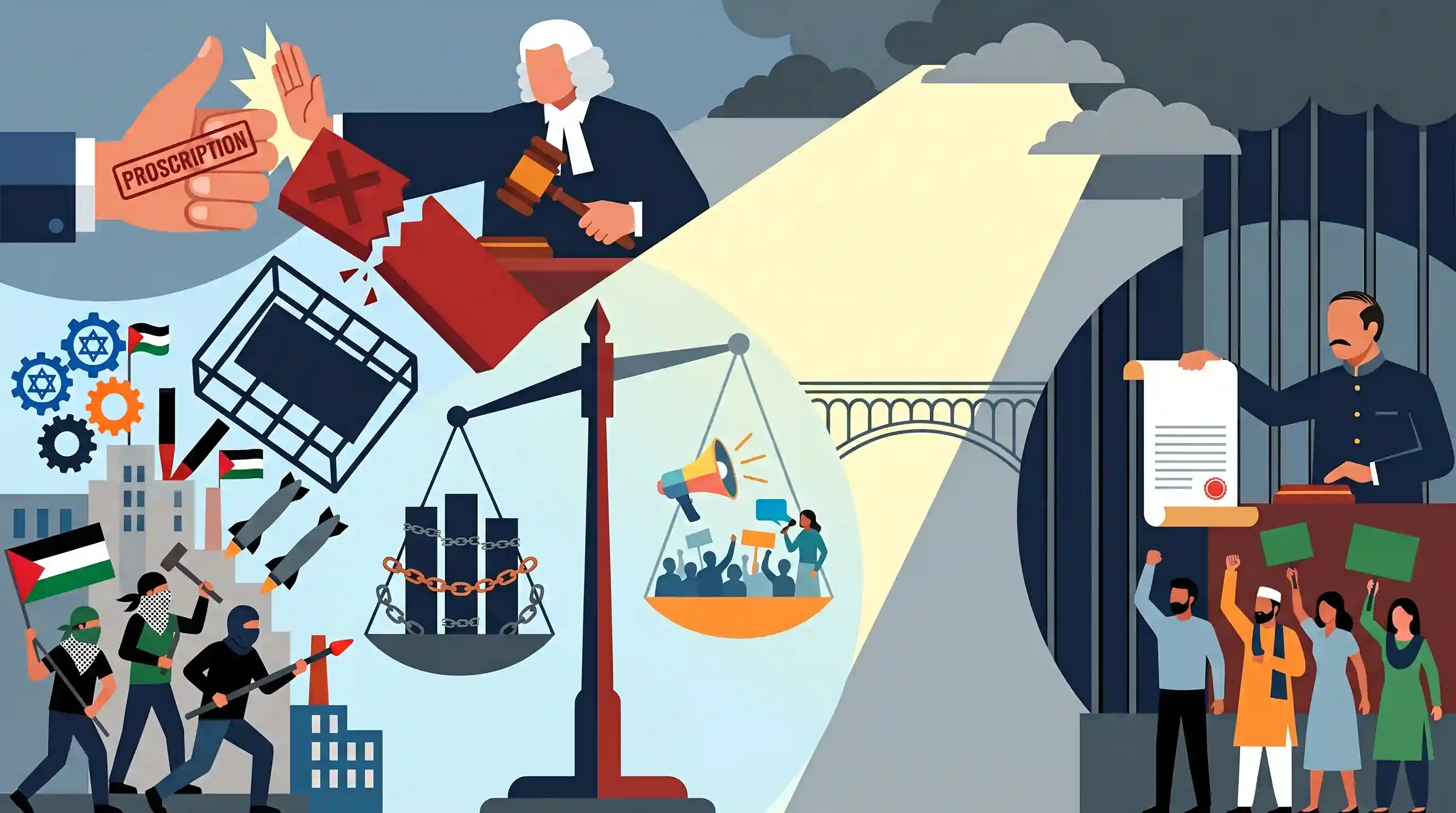
London's High Court has ruled the UK government's decision to proscribe the activist group 'Palestine Action' under terrorism laws as unlawful. The court found that while the group used criminality and direct action to target Israel-linked defense firms, branding them a terrorist organization disproportionately infringed upon their rights to freedom of expression and assembly. The case serves as a crucial comparative example of the tension between national security imperatives (anti-terror laws) and democratic civil liberties, echoing debates seen in India regarding the use of laws like the UAPA against political activists and protestors.
Key Points
- London's High Court ruled that the UK government's terrorism ban on the pro-Palestinian direct-action group 'Palestine Action' is unlawful.
- The court stated that the ban was a disproportionate interference with the fundamental rights to freedom of expression and freedom of assembly.
- Palestine Action was originally proscribed for using disruptive direct action and sabotage against Israel-linked defense companies in Britain.
- The ruling highlights the delicate balance between penalizing political criminality/vandalism and misapplying anti-terrorism legislation against protest groups.
Important Terms
Unlawful Activities (Prevention) Act (UAPA)

India's primary anti-terror law (1967), amended in 2004 and 2019 to designate groups and individuals as terrorists. Known for stringent bail conditions and extended pre-charge detention.
UPSC context
GS II (Governance) & GS III (Internal Security). Focuses on the balance between national security and fundamental rights like Article 19.
Terrorism Act 2000 (UK)
The UK's principal counter-terrorism legislation. It empowers the Home Secretary to 'proscribe' (ban) organizations believed to be 'concerned in terrorism,' a definition that includes serious property damage for political causes.
UPSC context
GS II (Comparative Constitutions). Useful for comparing India's anti-terror framework with other democratic legal systems.
Proscription
The legal and administrative process of outlawing an organization, making membership, support, or funding for it a criminal offense. It is a key tool in national security and counter-terrorism.
UPSC context
GS II (Executive Powers) & GS III (Counter-terrorism). Tests understanding of administrative law and judicial review of executive decisions.
Palestine Action
A British direct-action network targeting Israel-linked defense firms (e.g., Elbit Systems). Its 2025 proscription as a terrorist group was ruled 'unlawful' by London's High Court in 2026 for being disproportionate.
UPSC context
GS II (International Relations/Fundamental Rights). Illustrates the legal line between militant political activism and terrorism.
Freedom of Expression and Assembly
Fundamental rights (protected by India's Article 19 and UK's HRA 1998) that allow citizens to voice dissent and gather. These rights are often at the center of anti-terror law disputes.
UPSC context
GS II (Fundamental Rights). Central to debates on 'reasonable restrictions' and the 'chilling effect' of overbroad security laws.
Direct Action
A form of activism using immediate, often disruptive or illegal physical acts (e.g., lock-ons, property damage) to achieve political goals, rather than traditional negotiation or peaceful picketing.
UPSC context
GS II (Polity/Society). Relevant for examining the evolution of protest methods and their legal classification under criminal vs. terror law.
Prelims Trap
Executive actions invoking 'national security' are entirely immune from judicial review and cannot be struck down by constitutional courts.
While courts afford leeway to the executive on security, rulings like Pegasus and Anuradha Bhasin firmly establish that the state cannot evade judicial scrutiny merely by citing national security.
Static Concepts Connected
What is the four-pronged 'proportionality test' for restricting Fundamental Rights?
- Legitimate state aim: The restriction must serve a valid, constitutionally permissible state objective.
- Rational nexus: There must be a direct, rational connection between the restrictive measure and the intended aim.
- Necessity: No less restrictive alternative should be available to achieve the exact same state goal.
- Strict balancing: The restriction must not disproportionately impact the citizen's rights compared to the state's intended benefit.
What are the constitutional limits on the freedom of assembly under Article 19?
- Peaceful and unarmed: The assembly must inherently be non-violent and conducted without weapons, as per Article 19(1)(b).
- Sovereignty and integrity: The state can impose reasonable restrictions if the assembly threatens India's unity or security.
- Public order: Indefinite occupation of public pathways falls outside constitutional protection, as held in the Amit Sahni case.
Cross-Topic Patterns
Vandalism vs. Terrorism under UAPA
The UK ruling mirrors Indian judicial debates where courts have cautioned against expanding UAPA's Section 15 to classify disruptive, non-kinetic political protests as "terrorist acts."
Geopolitics spilling into domestic security
Targeting Israel-linked defense firms demonstrates how international conflicts create internal law-and-order challenges, forcing democracies to balance foreign policy alignments with domestic civil liberties.

Expect a 2026 GS2 Mains question asking to evaluate UAPA’s broad 'terrorist act' definition against the SC's proportionality test.
Linked PYQs · 4
Linked PYQs · 4
- 2019MainsGS3
Indian Government has recently strengthened the anti-terrorism laws by amending the Unlawful Activities (Prevention) Act (UAPA), 1967 and the NIA Act. Analyze the changes in the context of prevailing security environment while discussing the scope and reasons for opposing the UAPA by human rights organizations.
- 2024MainsGS2
‘Terrorism has become a significant threat to global peace and security.’ Evaluate the effectiveness of the United Nations Security Council's Counter Terrorism Committee (CTC) and its associated bodies in addressing and mitigating this threat at the international level.
- 2017MainsGS2
Examine the scope of Fundamental Rights in the light of the latest judgement of the Supreme Court on Right to Privacy.
- 2018MainsGS2
“India’s relations with Israel have, of late, acquired a depth and diversity, which cannot be rolled back.” Discuss.
