United Kingdom and European Union artificial intelligence pact
Source:The Hindu ↗
Why It Matters
This article highlights the evolving nature of post-Brexit UK-EU relations and the growing geopolitical importance of technological cooperation (especially in AI). For UPSC aspirants, it provides a contemporary example of how advanced economies use technology pacts to assert global competitiveness and how carbon markets (ETS) are integrated into international diplomacy.
Summary
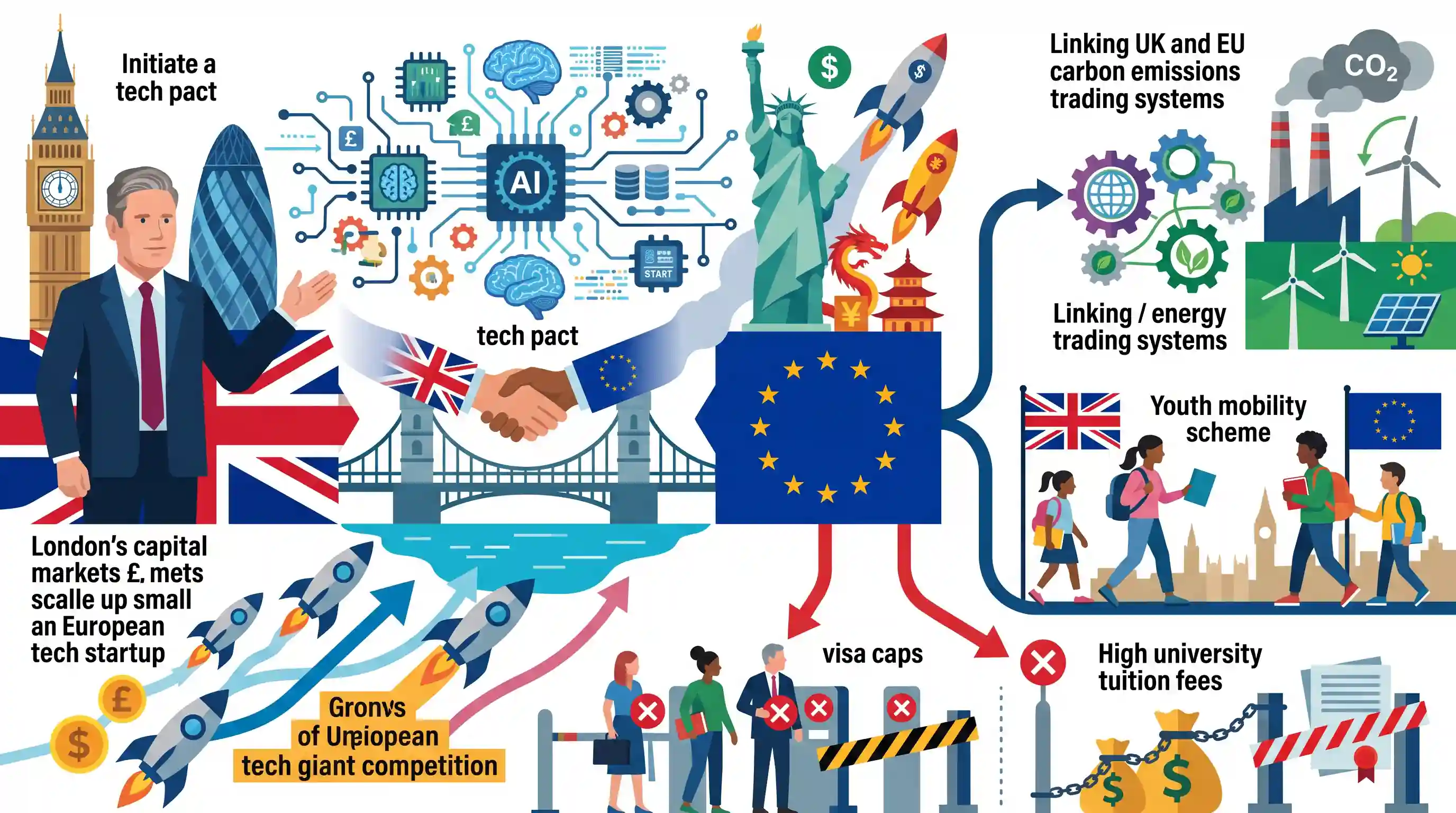
The United Kingdom is seeking to establish a new 'tech pact' with the European Union focused on Artificial Intelligence and other technological innovations. Spearheaded by UK Prime Minister Keir Starmer, the proposal is a key component of a post-Brexit effort to reset bilateral relations. By leveraging London's robust capital markets, the UK hopes to scale up European tech start-ups to rival dominant firms in the US and Asia. The pact is envisioned alongside other strategic discussions—including linking the UK and EU carbon emissions trading systems and implementing a youth mobility scheme—though disagreements over visa caps and university tuition fees remain potential roadblocks.
Key Points
- The UK has proposed a 'tech pact' with the EU to enhance collaboration in Artificial Intelligence and innovative sectors as part of a post-Brexit relations reset.
- The initiative aims to utilize London's capital markets to scale European tech firms, allowing them to compete more effectively with US and Asian tech giants.
- The pact is part of a broader agenda for a potential UK-EU summit in July, which may also discuss linking carbon emissions trading systems and food safety standards.
- Negotiations face hurdles, including the UK's desire to cap visas under a youth mobility scheme and reluctance to pay into EU funds, versus EU demands for domestic tuition fee status for its students in UK universities.
Important Terms
Youth Mobility Scheme

A reciprocal visa arrangement allowing young adults (typically 18–30) to live, work, and study in partner countries for a limited period (2–3 years) without full free-movement rights.
UPSC context
GS Paper II (International Relations); relevant for migration policies, bilateral ties, and India-UK/EU professional mobility negotiations.
Emissions Trading System (ETS)
A market-based 'cap-and-trade' mechanism where a limit is set on total greenhouse gas emissions, and entities trade allowances to cover their output.
UPSC context
GS Paper III (Economy & Environment); tests knowledge of carbon pricing, global climate governance, and Net Zero pathways.
Carbon Border Adjustment Mechanism (CBAM)
An EU policy imposing carbon costs on imports of carbon-intensive goods (e.g., steel, cement) to prevent 'carbon leakage' and equalize competition for EU firms.
UPSC context
GS Paper III (Economy); critical for Indian exports and understanding green trade barriers and WTO compliance.
Technology Prosperity Deal
A strategic bilateral framework aimed at deepening cooperation in critical sectors like AI, quantum computing, and nuclear energy through shared research and private investment.
UPSC context
GS Paper II (IR) & III (Science & Tech); concerns global tech geopolitics and strategic alliances in emerging technologies.
Post-Brexit Reset
A diplomatic initiative to normalize UK-EU ties post-departure from the bloc by establishing new partnerships in security, technology, and climate without rejoining the single market.
UPSC context
GS Paper II (IR); analyzes the evolving European security architecture and India’s strategic stakes in a post-Brexit landscape.
Prelims Trap
Sectoral agreements like the tech pact and ETS linkage indicate the UK's partial reentry into the European Single Market.
Post-Brexit negotiations under Keir Starmer strictly pursue isolated sectoral pacts to reduce friction, explicitly rejecting any return to the EU single market.
Static Concepts Connected
How do Cap-and-Trade Carbon Markets (like ETS) function?
- Emission Caps: Governments set a maximum statutory limit on total greenhouse gas emissions in specific sectors, which decreases over time.
- Tradable Allowances: Companies receive or buy carbon permits; those emitting less can sell their surplus to high-emitters.
- Financial Incentive: It establishes a market price for carbon, driving corporate investment into low-carbon technological innovations.
How do Youth Mobility and Young Professionals Schemes operate?
- Age & Eligibility: Allows degree-holding citizens (usually aged 18-30) to live, study, or work in the host country.
- Bilateral Reciprocity: Operates as a mutual bilateral exchange, distinct from traditional employer-sponsored skilled work visas.
- India-UK Precedent: India and the UK operationalized a similar reciprocal scheme in 2023 for up to 3,000 citizens annually.
Cross-Topic Patterns
Tech Diplomacy as Geopolitics
The UK-EU AI pact mirrors a broader global trend of 'tech-minilateralism', where regions pool capital and R&D to counterbalance US and Chinese dominance in critical emerging technologies.
Carbon Markets & Trade Barriers
Linking the UK and EU Emissions Trading Systems is a strategic move to harmonize carbon pricing, thereby avoiding the punitive tariffs of the EU's Carbon Border Adjustment Mechanism (CBAM).

Expect a 2026 Prelims question linking domestic Carbon ETS with cross-border trade policies like CBAM and Paris Agreement Article 6.
Linked PYQs · 2
Linked PYQs · 2
- 2023MainsGS3
Introduce the concept of Artificial Intelligence (AI). How does Al help clinical diagnosis? Do you perceive any threat to privacy of the individual in the use of Al in healthcare?
- 2025PrelimsGS1
Consider the following statements : Statement I: Article 6 of the Paris Agreement on climate change is frequently discussed in global discussions on sustainable development and climate change. Statement II: Article 6 of the Paris Agreement on climate change sets out the principles of carbon markets. Statement III : Article 6 of the Paris Agreement on climate change intends to promote inter-country non-market strategies to reach their climate targets. Which one of the following is correct in respect of the above statements?
