UK India Young Professionals scheme opens final visa ballot
Source:Indian Express ↗
Why It Matters
This scheme is a prime example of institutionalized bilateral youth mobility and legal migration pathways. It reflects how modern trade and diplomatic partnerships integrate labor mobility and diaspora growth, transforming traditional 'brain drain' dynamics into 'brain circulation' between India and Western nations.
Summary
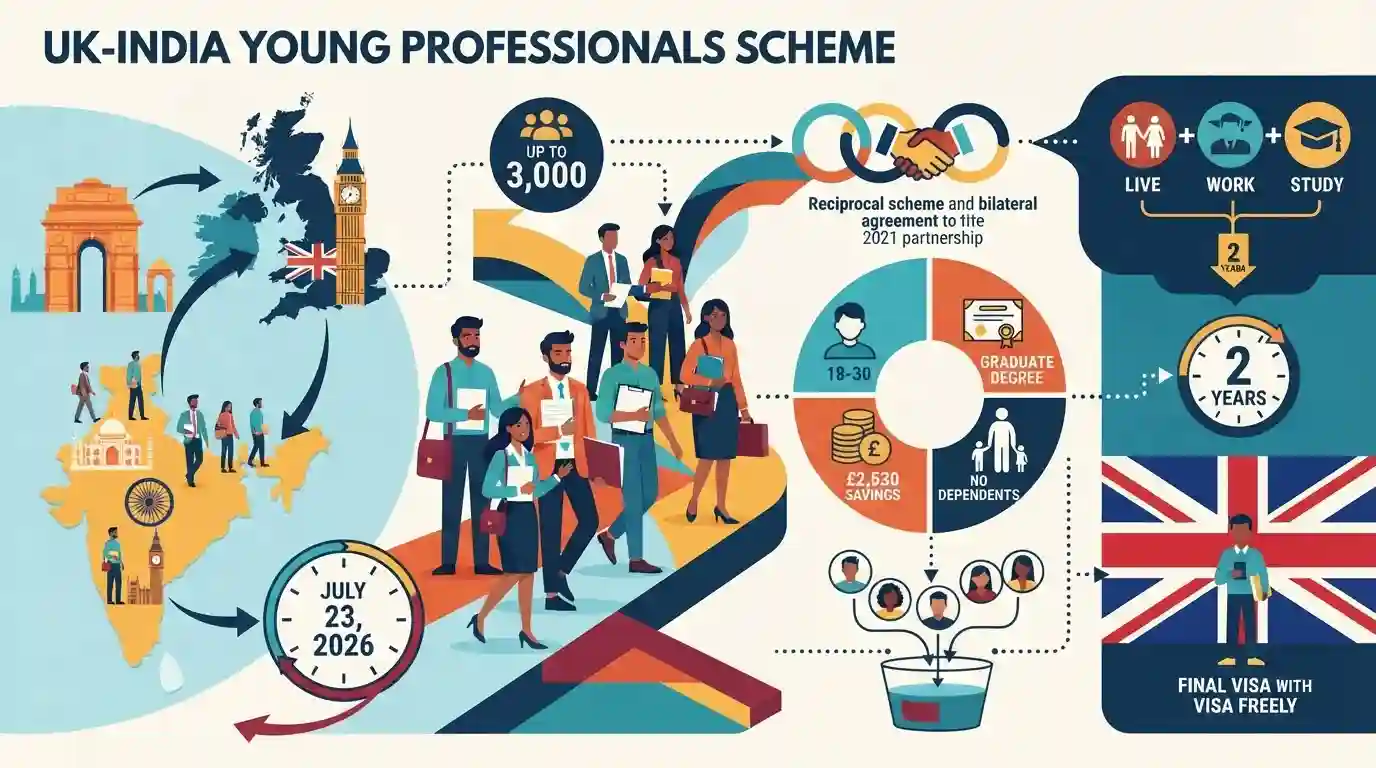
The UK-India Young Professionals Scheme (IYPS) has opened its second and final ballot for the 2026 cycle, with a deadline of July 23, 2026. Under this reciprocal scheme, derived from the 2021 UK-India Migration and Mobility Partnership, up to 3,000 eligible Indian citizens aged 18 to 30 can obtain a visa to live, work, or study in the UK for up to two years. Crucially, applicants do not require a prior job offer or employer sponsorship, and selection is made through a random ballot. To qualify, applicants must hold a graduate degree, have at least £2,530 in savings, and have no dependent children under 18.
Key Points
- The UK-India Young Professionals Scheme (IYPS) is a reciprocal program established under the UK-India Migration and Mobility Partnership signed in May 2021.
- The scheme allocates 3,000 visas annually for young Indian citizens (aged 18–30) to live, work, study, and travel in the UK for up to 24 months (2 years) without needing a job offer or sponsor.
- Key eligibility requirements include being an Indian citizen, possessing a bachelor's degree or higher qualification, having at least £2,530 in personal savings, and having no dependent children under 18 years of age.
- Selection is conducted via a random draw (ballot system), and the second ballot for the 2026 cycle closes on July 23, 2026.
- This scheme facilitates 'brain circulation' and cultural exchange, lowering barriers to legal, skilled migration while enhancing bilateral people-to-people ties.
Important Terms
UK-India Young Professionals Scheme

A reciprocal visa initiative allowing up to 3,000 educated citizens aged 18-30 from India and the UK to live, work, or study in each other's country for up to two years without sponsorship.
UPSC context
GS Paper II (Bilateral agreements); tests understanding of youth mobility, immigration diplomacy, and talent exchange between India and European nations.
UK-India Migration and Mobility Partnership
A bilateral framework signed in 2021 to facilitate legal, temporary migration of students and skilled professionals between India and the UK, while strengthening cooperation to curb illegal immigration.
UPSC context
GS Paper II (Bilateral Groupings & Agreements); tests understanding of strategic immigration policy, labor market integration, and international security partnerships.
Indian Diaspora
The global community of people of Indian origin residing outside India, encompassing Non-Resident Indians (NRIs) and Persons of Indian Origin (PIOs) who maintain socio-cultural or economic ties.
UPSC context
GS Paper II (Indian Diaspora); tests knowledge of the role of overseas Indians in soft power diplomacy, remittances, and bilateral relationships.
Bilateral Mobility Agreements
Treaties or pacts negotiated between two countries to facilitate the structured, legal, and reciprocal flow of people—such as students, researchers, and professionals—across borders.
UPSC context
GS Paper II (Bilateral Agreements); tests knowledge of geopolitical and economic arrangements regulating international migration and skilled labor supply.
Prelims Trap
The Young Professionals Scheme allows selected applicants to bring dependent children to the UK during their two-year stay.
The scheme explicitly mandates that applicants must have no dependent children under the age of 18 to qualify, making it a strictly individual mobility visa.
Static Concepts Connected
What is 'Brain Circulation' and how does it differ from 'Brain Drain'?
- Definition: Refers to the multi-directional, circular flow of skilled professionals who return home with advanced expertise and capital.
- Key distinction: Unlike unidirectional brain drain, brain circulation creates mutual benefits through continuous exchange of knowledge and remittances.
- Policy engine: Managed mobility programs with restricted stay limits are key instruments to facilitate this circular migration.
How does the diaspora function as an instrument of foreign policy?
- Remittances and investment: Acts as a primary channel for financial capital, technology transfers, and foreign direct investment into the home nation.
- Political lobbying: Highly placed professionals influence host government policies, fostering stronger bilateral treaties and strategic partnerships.
- Soft power projection: Serves as organic ambassadors of Indian culture, language, and values, building strong people-to-people diplomatic bridges.
Cross-Topic Patterns
FTAs and Mobility Chapters
India consistently prioritizes services and "Mode 4" (movement of natural persons) access in Free Trade Agreement (FTA) negotiations with Western partners like the UK and EU.
Bilateral Security and Migration
Facilitating legal pathways for skilled professionals is systematically leveraged by Western nations to secure India’s cooperation in combating irregular migration and deporting undocumented nationals.

GS-2 bilateral questions may analyze MMPs as a strategic tool to counter brain drain while securing Indian interest in Mode 4 services.
Linked PYQs · 2
Linked PYQs · 2
- 2023MainsGS2
Indian diaspora has scaled new heights in the West. Describe its economic and political benefits for India.
- 2020MainsGS2
Indian diaspora has a decisive role to play in the politics and economy of America and European Countries'. Comment with examples.
