Diplomatic efforts to address Iran nuclear program and UN sanctions
Source:Indian Express ↗
Why It Matters
The collapse of the JCPOA and the reimposition of UN sanctions on Iran carry significant implications for Middle East stability and global energy security. For India, these developments impact its strategic investments (like the Chabahar port) and its delicate balancing act between Iran, the US, and Israel. The article also highlights the institutional mechanisms of the UN Security Council and IAEA safeguards.
Summary
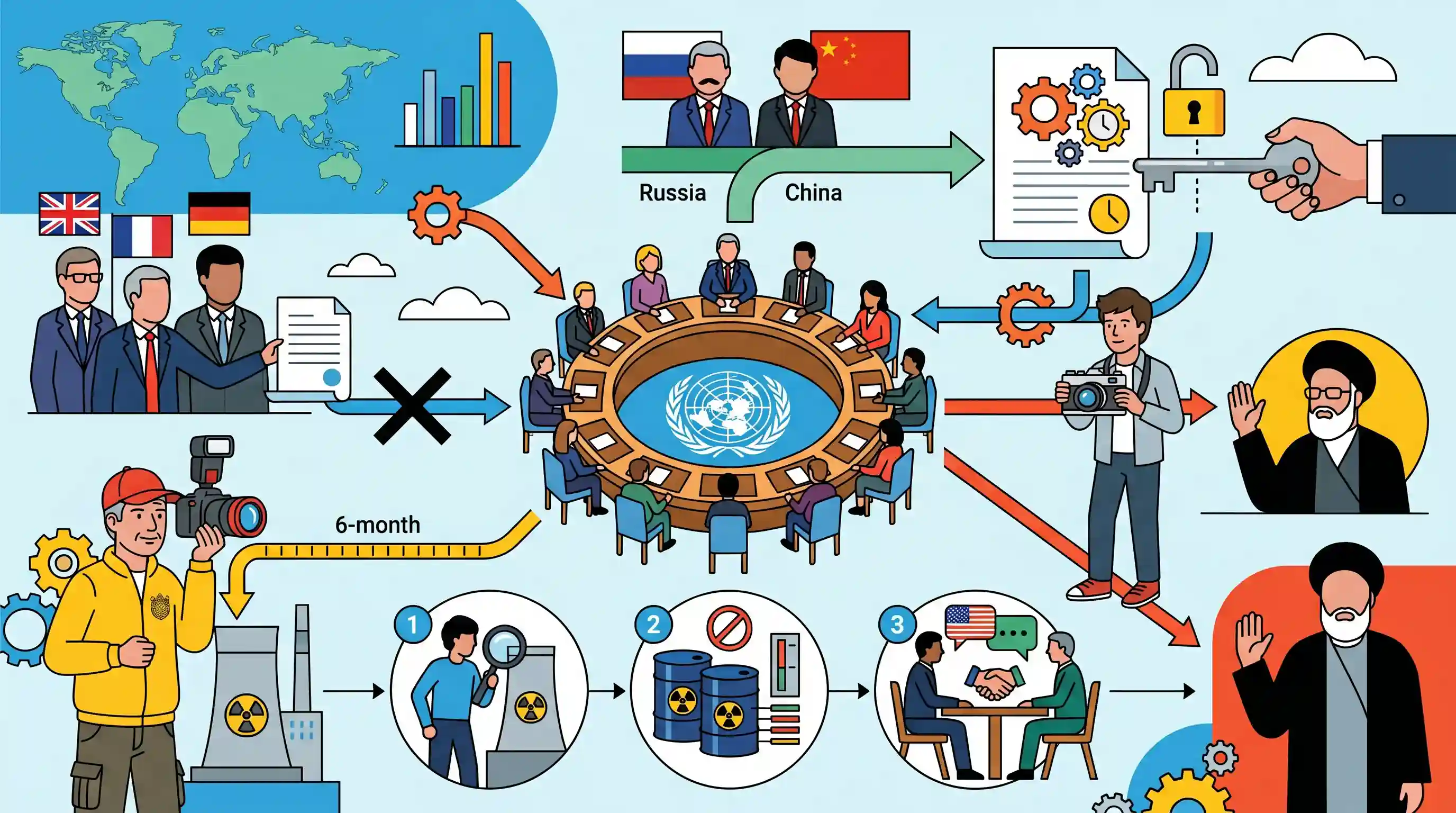
The UK, France, and Germany (the E3) have initiated a process at the UN Security Council to reinstate international sanctions against Iran over its advancing nuclear program. However, they offered a six-month delay on this 'snapback' mechanism if Iran agrees to restore full access for IAEA inspectors, limit its enriched uranium stockpiles, and engage in talks with the US. Iran rejected the offer, calling its preconditions unrealistic. Meanwhile, Russia and China are backing Iran by proposing a separate UN resolution to extend the 2015 JCPOA agreement while removing the E3's unilateral power to reimpose sanctions.
Key Points
- The E3 (UK, France, Germany) initiated a 30-day 'snapback' process to reimpose UN sanctions on Iran over its nuclear program.
- The E3 offered to pause the sanctions for six months if Iran restores IAEA access, addresses its enriched uranium stockpile, and engages with the US.
- Iran rejected the E3 proposal as unrealistic, favoring an unconditional extension of UN Resolution 2231, which enshrined the original 2015 JCPOA deal.
- Russia and China circulated a draft resolution to extend the 2015 deal by six months while stripping the E3's ability to easily invoke snapback sanctions.
- IAEA inspectors have returned to Iran following recent strikes by Israel and the US, but face continued restrictions on their monitoring activities.
Important Terms
Joint Comprehensive Plan of Action (JCPOA)

The 2015 landmark accord between Iran and the P5+1 (US, UK, France, China, Russia, Germany) to limit Iran's nuclear program in exchange for international sanctions relief.
UPSC context
GS Paper II (International Relations). Tests knowledge of global nuclear governance, West Asian geopolitics, and agreements affecting India's interests.
Snapback Mechanism
A unique provision in UNSC Resolution 2231 allowing any JCPOA participant to unilaterally reimpose all prior UN sanctions on Iran if it violates the deal, without a possible veto.
UPSC context
GS Paper II (International Relations). Focuses on veto-proof enforcement mechanisms and their impact on multilateral diplomacy and regional stability.
UN Security Council Resolution 2231
The 2015 United Nations Security Council resolution that endorsed the JCPOA, setting the legal framework for lifting nuclear-related sanctions and establishing the snapback mechanism.
UPSC context
GS Paper II (International Institutions). Tests understanding of UN mandates and the international legal architecture governing nuclear non-proliferation.
International Atomic Energy Agency (IAEA)
A Vienna-based UN-affiliated watchdog that monitors nuclear facilities to ensure technology is used for peaceful purposes and not diverted for weapons development.
UPSC context
GS Paper II (Important International Institutions). Tests knowledge of global verification regimes and India's relationship with international safeguard protocols.
E3 (European Three)
An informal diplomatic grouping of the United Kingdom, France, and Germany that leads European negotiations on Iran’s nuclear program.
UPSC context
GS Paper II (Bilateral/Regional Groupings). Highlights the role of "minilateralism" and European powers in managing West Asian security crises.
Prelims Trap
Russia and China can use their UNSC veto to block the JCPOA snapback sanctions.
The snapback mechanism in UNSC Res 2231 allows any JCPOA participant to reinstate sanctions automatically, deliberately circumventing the standard P5 veto power.
Static Concepts Connected
How does the 'snapback' mechanism work under UNSC Resolution 2231?
- The Trigger: Any original JCPOA participant state can notify the UNSC of 'significant non-performance' by Iran regarding its nuclear obligations.
- Automaticity: After 30 days of notification, previous UN sanctions are automatically reimposed unless a new UNSC resolution is actively passed to continue lifting them.
- Veto-proof Design: The complaining state can simply veto the new resolution, ensuring the sanctions revival is effectively veto-proof against other P5 members.
What is the IAEA 'Additional Protocol' in nuclear non-proliferation?
- Expanded Mandate: It is a legal document granting IAEA inspectors expanded, intrusive rights of access to information and sites within a State.
- Snap Inspections: It allows for short-notice inspections of all nuclear-related sites, whether declared or undeclared, to ensure peaceful use.
- India's Status: India signed a country-specific Additional Protocol in 2014, which applies only to its civilian facilities, exempting its military nuclear programme.
Cross-Topic Patterns
UNSC Polarization & Sanctions Regimes
The Russia-China push against the E3 reflects a broader fracturing of the P5 consensus, mirroring recent UNSC gridlocks over North Korean sanctions and Syrian humanitarian aid.
Iran Sanctions & India's Strategic Interests
Reinstated UN sanctions would drastically complicate India's operation of the Chabahar Port and INSTC, which currently rely on narrow, fragile exemptions from unilateral US sanctions.

A multi-statement Prelims question will likely test the 'snapback' mechanism's veto-proof nature and India's Additional Protocol status.
Linked PYQs · 4
Linked PYQs · 4
- 2018PrelimsGS1
In the Indian context, what is the implication of ratifying the 'Additional Protocol' with the 'International Atomic Energy Agency (IAEA)'?
- 2020PrelimsGS1
In India, why are some nuclear reactors kept under "IAEA Safeguards" while others are not?
- 2018MainsGS2
In what ways would the ongoing US-Iran Nuclear Pact Controversy affect the national interest of India? How should India respond to this situation?
- 2012MainsGS2
How have the US sanctions against Iran affected India's bilateral relations with Iran?
