NHS Disruption Amid Resident Doctors Strike in UK
Source:Indian Express ↗
Why It Matters
The crisis in the UK's NHS offers vital comparative insights for UPSC aspirants on the sustainability of state-funded public health models, human resource management in the medical sector, and the implications of industrial action by essential service providers.
Summary
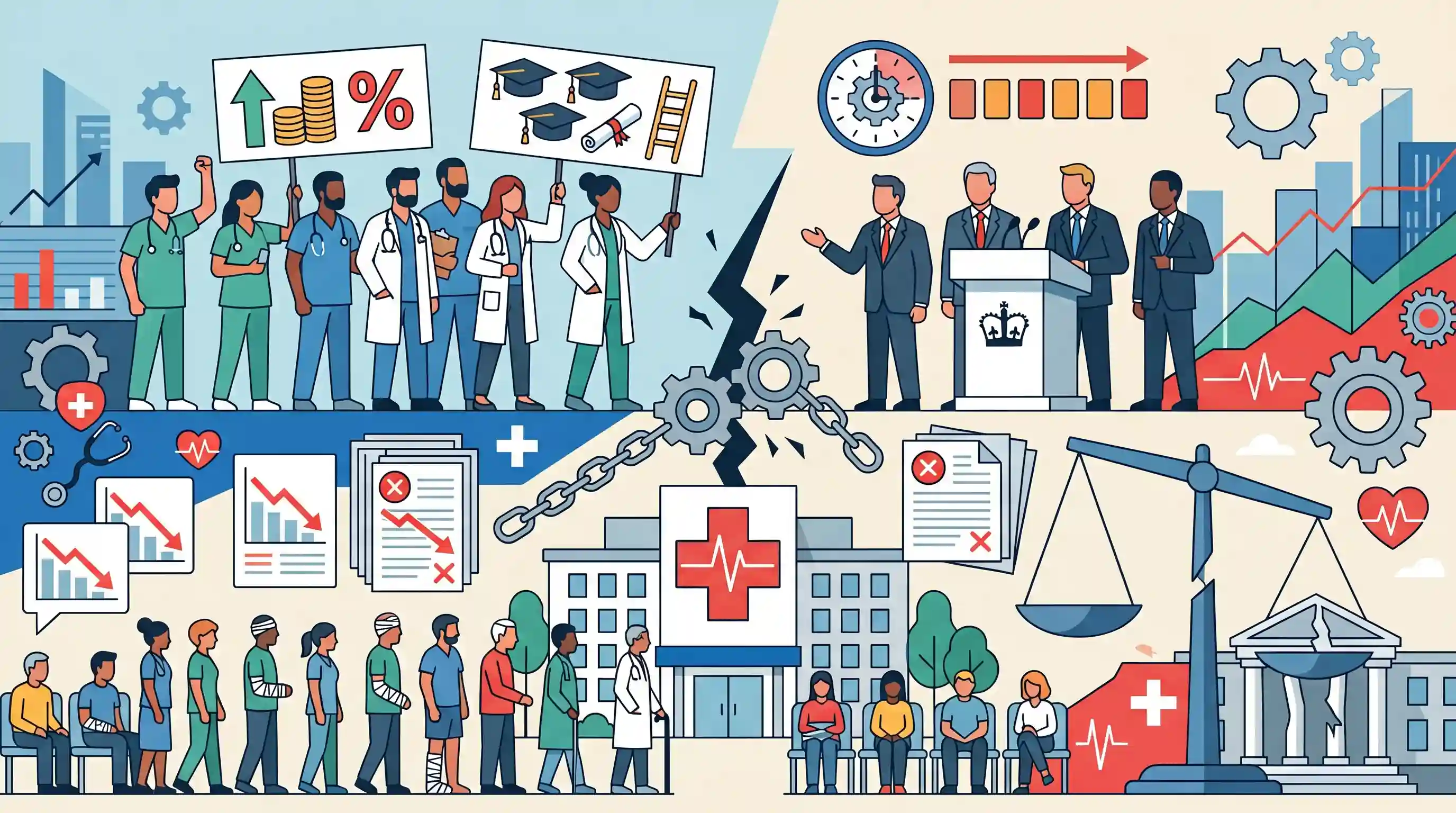
A prolonged pay and training dispute between the British Medical Association (BMA) and the UK Government has led to a major six-day strike by resident doctors, heavily disrupting the National Health Service (NHS). The deadlock over a 35% pay restoration demand and the cancellation of 1,000 specialist training posts underscores severe human resource and fiscal challenges within the UK's fully state-funded public healthcare model.
Key Points
- Resident doctors in the UK under the British Medical Association (BMA) are staging a six-day strike, their 15th since March 2023, causing severe disruptions to the National Health Service (NHS).
- The core of the dispute involves unresolved pay issues, specifically a demand for a 35% pay restoration, and the government's recent decision to scrap 1,000 specialist medical training vacancies.
- UK Health Secretary Wes Streeting criticized the union's actions, pointing to fiscal constraints that make meeting the pay demands unviable.
- The ongoing industrial action highlights systemic vulnerabilities in public healthcare funding and human resource management, sparking debates on essential service delivery and workforce retention globally.
Important Terms
National Health Service (NHS)

The UK's publicly funded healthcare system, established in 1948 to provide services free at the point of use based on clinical need.
UPSC context
GS II (Social Justice/Health): Crucial for comparative health policy analysis and studying Universal Health Coverage (UHC) models like Ayushman Bharat.
British Medical Association (BMA)
The professional association and registered trade union representing doctors and medical students in the United Kingdom, advocating for their rights and pay.
UPSC context
GS II (Governance): Tests the role of pressure groups and professional bodies in shaping public policy and sector-specific industrial relations.
Pay Restoration
A campaign to return real-terms wages to a specific historical level (e.g., 2008) to counteract years of inflation and austerity-driven pay erosion.
UPSC context
GS II (Social Sector): Relevant for discussing fiscal management in health services and balancing labor rights with public service sustainability.
Resident Doctors
The frontline medical workforce undergoing postgraduate specialty training; their strikes significantly impact secondary care and elective surgical procedures.
UPSC context
GS II (Health): Important for understanding human resource management in public hospitals and the impact of industrial action on patient safety.
Human Resources for Health (HRH)
The availability and management of skilled healthcare workers, including addressing bottlenecks in specialist training and preventing professional migration (brain drain).
UPSC context
GS II (Development & Management of Social Sector): Evaluates workforce planning, medical education reforms, and global mobility of Indian medical professionals.
Prelims Trap
The Right to Strike is a Fundamental Right guaranteed under Article 19 of the Constitution.
The Right to Strike is merely a statutory right in India. For essential services like healthcare, it can be legally banned under the Essential Services Maintenance Act (ESMA).
Static Concepts Connected
What are the core differences between the Beveridge and Bismarck healthcare models?
- Beveridge Model: Fully state-funded via general taxation; government owns most hospitals and employs healthcare staff directly (e.g., the UK's NHS).
- Bismarck Model: Funded jointly by employers and employees through payroll deductions; relies largely on private hospitals and practitioners (e.g., Germany).
How is the 'Right to Strike' legally positioned for essential workers in India?
- Statutory Right: The Supreme Court has clarified that the right to strike is a statutory right under industrial laws, not a Fundamental Right under Article 19.
- ESMA 1968: The Essential Services Maintenance Act (ESMA) allows the government to outright ban strikes in critical sectors like healthcare to protect citizens.
Cross-Topic Patterns
Medical brain drain and FTA negotiations
The NHS heavily relies on Indian doctors. Its fiscal crises and UK visa restrictions complicate the professional mobility framework (Mode 4 services) discussed in ongoing India-UK FTA negotiations.
State-funded limits vs PM-JAY
The NHS deadlock exposes fiscal vulnerabilities in fully state-operated healthcare systems, offering a comparative contrast to India's PM-JAY which increasingly relies on strategic purchasing from private sector providers.

A comparative question on healthcare models (Beveridge vs Bismarck) or the statutory nature of the Right to Strike vs ESMA is highly likely.
Linked PYQs · 3
Linked PYQs · 3
- 2024MainsGS2
In a crucial domain like the public healthcare system the Indian State should play a vital role to contain the adverse impact of marketisation of the system. Suggest some measures through which the State can enhance the reach of public healthcare at the grassroots level.
- 2015MainsGS2
Public health system has limitations in providing universal health coverage. Do you think that the private sector could help in bridging the gap? What other viable alternatives would you suggest?
- 2024MainsGS3
Discuss the merits and demerits of the four 'Labour Codes' in the context of labour market reforms in India. What has been the progress so far in this regard?
