Structural limitations of UGC regulations on caste discrimination
Source:Indian Express ↗
Why It Matters
Caste-based discrimination and student safety in elite educational institutions are recurring themes in civil services examinations. This article offers a critical analysis of regulatory loopholes, distinguishing between mere procedural compliance and actual structural reform, which is essential for writing high-scoring, multi-dimensional answers in GS1 (Society) and GS2 (Social Justice).
Summary
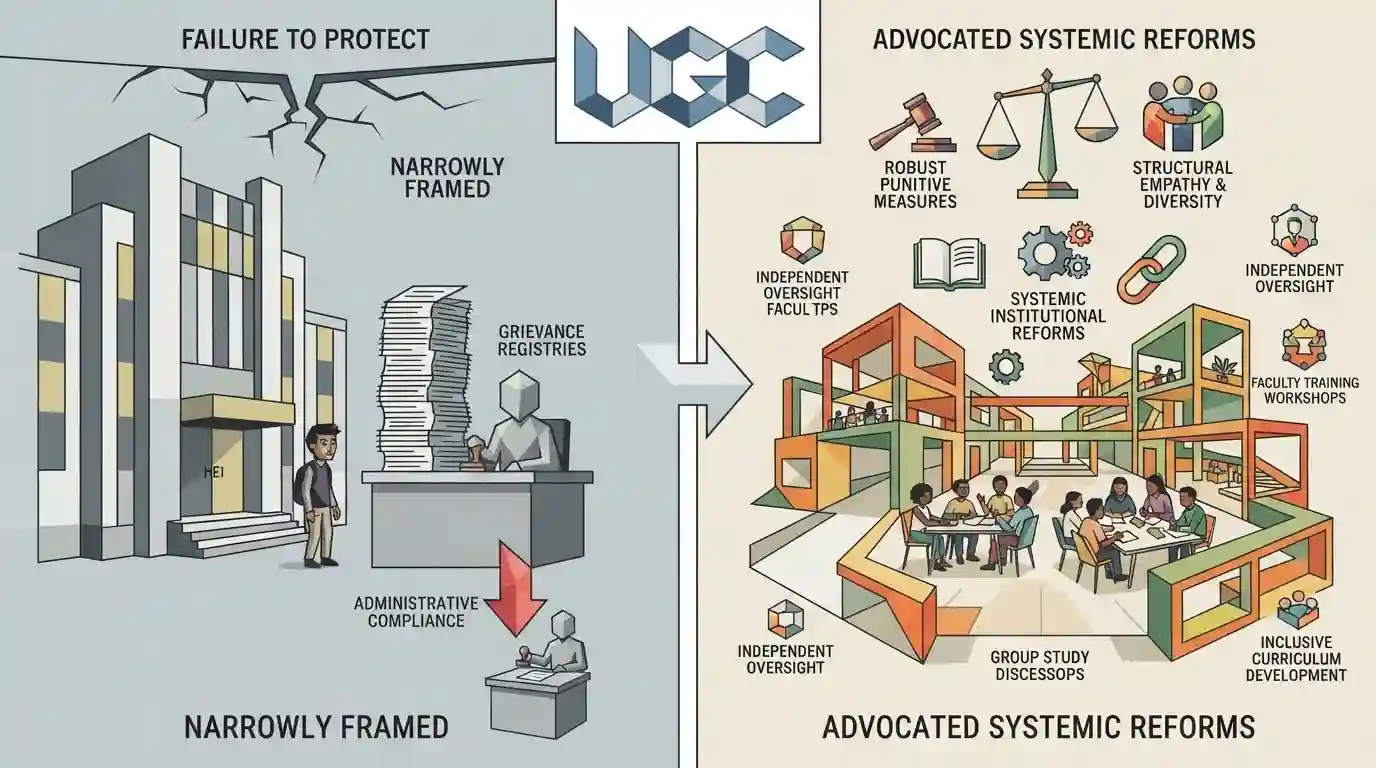
The article critiques the University Grants Commission's (UGC) approach to addressing caste-based discrimination in Higher Education Institutions (HEIs). It argues that the current regulations are 'narrowly framed' because they reduce complex, systemic, and institutional casteism into a series of bureaucratic, individual complaints. By relying on administrative compliance—such as establishing grievance registries—rather than addressing structural issues like the weaponized narrative of 'merit', implicit bias among faculty, and the lack of independent oversight, the guidelines fail to protect marginalized students. The author advocates for systemic institutional reforms, robust punitive measures, and a transition toward campus environments rooted in structural empathy and diversity.
Key Points
- Procedural vs. Structural Critique: The author argues that UGC guidelines treat caste-based discrimination as isolated, individual grievances rather than a pervasive, institutional, and systemic issue.
- Deficiencies in Redressal Bodies: Internal anti-discrimination committees lack independence, as they are headed by university administrators who often harbor implicit biases, and there is a stark lack of independent external ombudsmen or representation from marginalized communities.
- Weaponization of the Merit Narrative: Elite campuses (like IITs and medical colleges) foster a hostile culture of merit vs. quota, which is a major source of psychological trauma and alienation for SC/ST/OBC students, yet remains unaddressed by procedural regulations.
- Lack of Punitive Consequences: The regulations lack teeth, failing to impose strong financial or administrative penalties (such as cutting off grants) on institutions that fail to prevent discrimination or resolve grievances.
- Neglect of Faculty and Staff Dynamics: The guidelines heavily focus on student complaints, ignoring the subtle discrimination prevalent in faculty recruitments, grading, research guide allocation, and promotion processes.
- Call for Structural Empathy: The solution lies in shifting from bureaucratic box-ticking (e.g., maintaining complaint registers) to continuous sensitization, robust mental health support for first-generation learners, and diversity in administrative leadership.
Important Terms
UGC (Promotion of Equity in Higher Educational Institutions) Regulations

Binding regulations mandating universities to establish Equal Opportunity Centres to prevent discrimination based on caste, religion, or gender. The 2026 update explicitly includes OBC protections and prescribes time-bound complaint resolutions.
UPSC context
GS Paper 2 (Social Justice). Tests awareness of administrative and regulatory measures to combat institutional casteism.
University Grants Commission (UGC)
A statutory body established in 1956 under the Ministry of Education. It oversees the coordination, determination, and maintenance of higher education standards in India, including funding and enforcing academic regulations.
UPSC context
GS Paper 2 (Statutory Bodies). Relevant for analyzing the mandate, autonomy, and effectiveness of educational regulatory bodies.
Scheduled Castes and Scheduled Tribes (Prevention of Atrocities) Act
A 1989 law designed to prevent atrocities and hate crimes against SC and ST communities. It mandates strict penalties, establishes Special Courts, and is central to fighting caste-based discrimination.
UPSC context
GS Paper 2 (Vulnerable Sections). Essential for understanding legal protections against social injustice and caste violence in India.
Higher Education Institutions (HEIs)
Universities and colleges recognized by the UGC. They are the primary sites for implementing national academic standards, student welfare measures, and anti-discrimination frameworks like internal grievance redressal committees.
UPSC context
GS Paper 2 (Education). Relates to topics on educational reform, institutional autonomy, and structural equity in academia.
Prelims Trap
The UGC (Promotion of Equity in Higher Educational Institutions) Regulations, 2026 are currently in active force across all Indian universities.
The Supreme Court stayed the 2026 regulations in January 2026 (Mritunjay Tiwari case), directing that the older 2012 regulations temporarily remain in effect.
Static Concepts Connected
What are the constitutional provisions for safeguarding vulnerable sections in higher education?
- Article 15(5): Empowers the state to make special provisions, including reservations, for SCs, STs, and OBCs in both private and public educational institutions.
- Article 46: Directs the State to promote with special care the educational and economic interests of the weaker sections, particularly SCs and STs.
- Article 17: Abolishes 'untouchability' and forbids its practice in any form, providing a foundational civil rights protection applicable to campus environments.
How does Article 142 function in regulatory and judicial gaps?
- Complete Justice: Allows the Supreme Court to pass orders or decrees necessary for doing 'complete justice' when statutory frameworks are absent, vague, or deficient.
- Interim Stays: Enables the court to stay newly notified administrative guidelines (like the UGC 2026 regulations) to prevent immediate legal confusion or misuse.
Cross-Topic Patterns
Judicial Activism vs Policy Implementation
The shift from the 2019 Abeda Tadvi PIL to the contested 2026 UGC guidelines showcases the friction between court-mandated social justice and executive policy drafting.
Meritocracy vs Substantive Equality
Connects GS-1 social empowerment (caste) with GS-2 affirmative action, highlighting how competitive examinations and 'merit' narratives can institutionalize exclusion in professional HEIs.

The conflict between Article 14's formal equality and Article 15's protective discrimination in academic spaces will likely be tested in GS-2.
Linked PYQs · 3
Linked PYQs · 3
- 2024MainsGS1
Despite comprehensive policies for equity and social justice, underprivileged sections are not yet getting the full benefits of affirmative action envisaged by the Constitution. Comment.
- 2018MainsGS1
Caste system is assuming new identities and associational forms. Hence, caste system cannot be eradicated in India." Comment.
- 2015MainsGS1
Debate the issue of whether and how contemporary movements for assertion of Dalit identity work towards annihilation of caste.
