UGC Regulations Mandate Equity Committees in Higher Education
Source:Indian Express ↗
Why It Matters
Persistent caste discrimination in higher education has led to tragic outcomes and highlighted institutional apathy. Understanding regulatory responses like the UGC's 2026 regulations is crucial for evaluating governance mechanisms, the role of statutory bodies, and policies designed to protect and empower vulnerable sections in India.
Summary
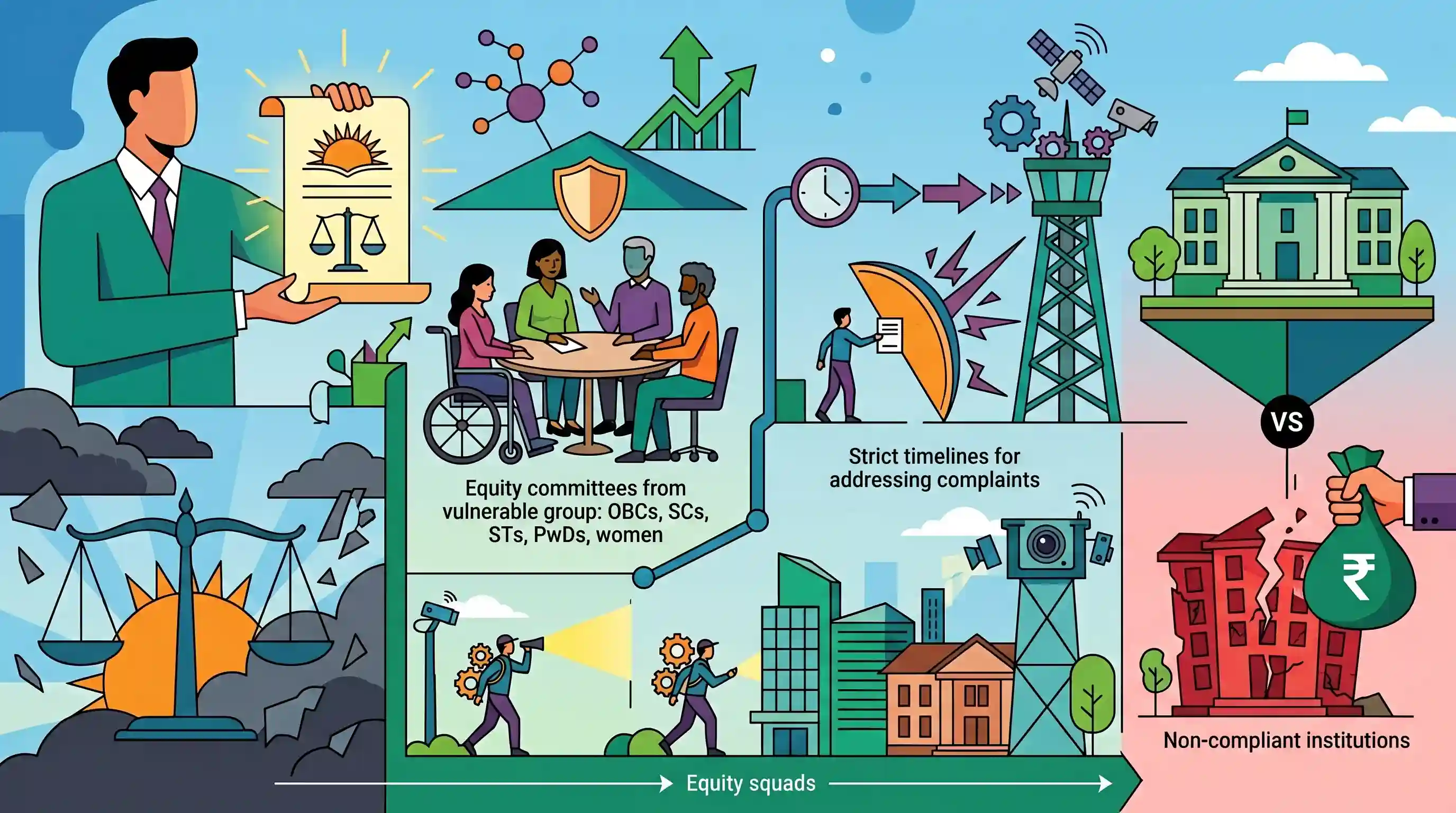
The University Grants Commission (UGC) has notified the 2026 regulations to combat caste bias and promote equity in Higher Education Institutions (HEIs). Key mandates include the formation of 'equity committees' comprising members from vulnerable groups (OBCs, SCs, STs, PwDs, and women), strict timelines for addressing discrimination complaints, and protection against retaliation. While removing a controversial draft provision that penalised 'false complaints,' the regulations introduce equity squads and a national monitoring committee. Non-compliant institutions face debarment from UGC schemes and central grants. The rules come against the backdrop of a Supreme Court hearing concerning institutional casteism following the suicides of students Rohith Vemula and Payal Tadvi.
Key Points
- The UGC notified the 2026 Promotion of Equity regulations to combat caste bias and discrimination in Higher Education Institutions (HEIs), replacing the 2012 guidelines.
- All HEIs must form 'equity committees' mandatorily comprising members from SC, ST, OBC, PwD communities, and women.
- Strict redressal timelines are established: committees must convene within 24 hours of a complaint, submit a report within 15 days, and heads of institutions must initiate action within 7 days.
- The regulations drop a controversial draft provision that penalised 'false complaints' with fines and disciplinary action, offering a safer environment for reporting discrimination.
- Institutional mechanisms such as 'equity squads' and 'equity helplines' are introduced, alongside a national-level monitoring committee constituted by the UGC.
- Institutions failing to comply face severe penalties, including debarment from UGC schemes and central grants.
Important Terms
UGC (Promotion of Equity in Higher Education Institutions) Regulations, 2026

2026 mandates replacing the 2012 framework; they explicitly include OBCs and require HEIs to establish mandatory mechanisms like Equity Committees and Squads to handle discrimination complaints within strict timelines.
UPSC context
GS Paper II: Statutory bodies and governance; GS Paper II: Mechanisms/laws for the protection of vulnerable sections.
University Grants Commission (UGC)
A statutory body established under the UGC Act, 1956, responsible for coordinating, determining, and maintaining standards of higher education in India and disbursing central grants to recognized institutions.
UPSC context
GS Paper II: Statutory, regulatory and various quasi-judicial bodies. Essential for understanding education governance.
Institutional Casteism
Systemic discrimination or exclusion based on caste within an organization's policies, culture, or administration that hinders marginalized groups (SCs/STs/OBCs) despite formal legal protections.
UPSC context
GS Paper I: Salient features of Indian Society; GS Paper II: Welfare schemes for vulnerable sections.
Equity Committees
Statutory bodies within HEIs mandated to investigate discrimination complaints; they must include representatives from SC, ST, OBC, PwD, and women categories to ensure inclusive grievance redressal.
UPSC context
GS Paper II: Social Justice and Institutional mechanisms for protecting the rights of marginalized groups.
Equity Squads
Small, mobile vigilance units mandated for HEI campuses to monitor 'vulnerable spots' and prevent real-time discriminatory practices, ensuring an inclusive environment for marginalized students.
UPSC context
GS Paper II: Mechanisms for vulnerable sections; tests understanding of practical measures for social inclusion.
Equal Opportunity Centre (EOC)
The primary institutional body required in every HEI to promote social inclusion; it coordinates equity initiatives and houses the Equity Committee to implement anti-discrimination policies.
UPSC context
GS Paper II: Issues relating to development and management of Social Sector/Services relating to Education.
Prelims Trap
"The 2026 UGC regulations mandate penalizing students who file false discrimination complaints to prevent misuse of the framework."
UGC specifically dropped this draft provision in the final 2026 rules to prevent a chilling effect that would deter marginalized students from coming forward.
Static Concepts Connected
What is the statutory mandate and power of the University Grants Commission (UGC)?
- Statutory Body: Established by the UGC Act, 1956, functioning under the Ministry of Education as a statutory organization.
- Core Mandate: Tasked with the coordination, determination, and maintenance of standards of university education across India.
- Enforcement Power: Can withhold grants and debar institutions from schemes if they fail to comply with its regulations, such as these anti-discrimination rules.
Which Constitutional provisions protect marginalized groups in the educational sphere?
- Article 15(4) & 15(5): Allows the State to make special provisions for the advancement of socially and educationally backward classes in educational institutions.
- Article 29(2): Prohibits denial of admission into any State-maintained or State-aided educational institution on grounds only of religion, race, caste, or language.
- Article 46: A Directive Principle obligating the State to promote the educational and economic interests of SCs, STs, and other weaker sections.
Cross-Topic Patterns
Mental Health + Marginalization on Campuses
Institutional casteism links directly to mental health crises among marginalized students, tying 'Equity Committees' to both GS-2 (Social Justice) and GS-4 (Empathy/Tolerance for weaker sections).
Reservation + Institutional Dropouts
High dropout rates of SC/ST/OBC students in premier institutes are often driven by hostile peer environments, necessitating post-admission safeguards beyond mere entry-level reservations.

UGC 2026 Equity Regulations, Article 15(4), and statutory body mandates on campus discrimination will likely form a GS-2 question in 2026.
Linked PYQs · 3
Linked PYQs · 3
- 2024MainsGS1
Despite comprehensive policies for equity and social justice, underprivileged sections are not yet getting the full benefits of affirmative action envisaged by the Constitution. Comment.
- 2018MainsGS2
Whether National Commission for Scheduled Castes (NCSC) can enforce the implementation of constitutional reservation for the Scheduled Castes in the religious minority institutions? Examine.
- 2024MainsGS1
Critically analyse the proposition that there is a high correlation between India's cultural diversities and socio-economic marginalities.
