UGC Regulations on Deemed Universities and State Role
Source:The Hindu ↗
Why It Matters
Education falls under the Concurrent List, making regulatory control a frequent point of friction between the Centre and States. These UGC amendments are crucial for understanding evolving Centre-State dynamics in higher education governance, emphasizing cooperative federalism and institutional accountability.
Summary
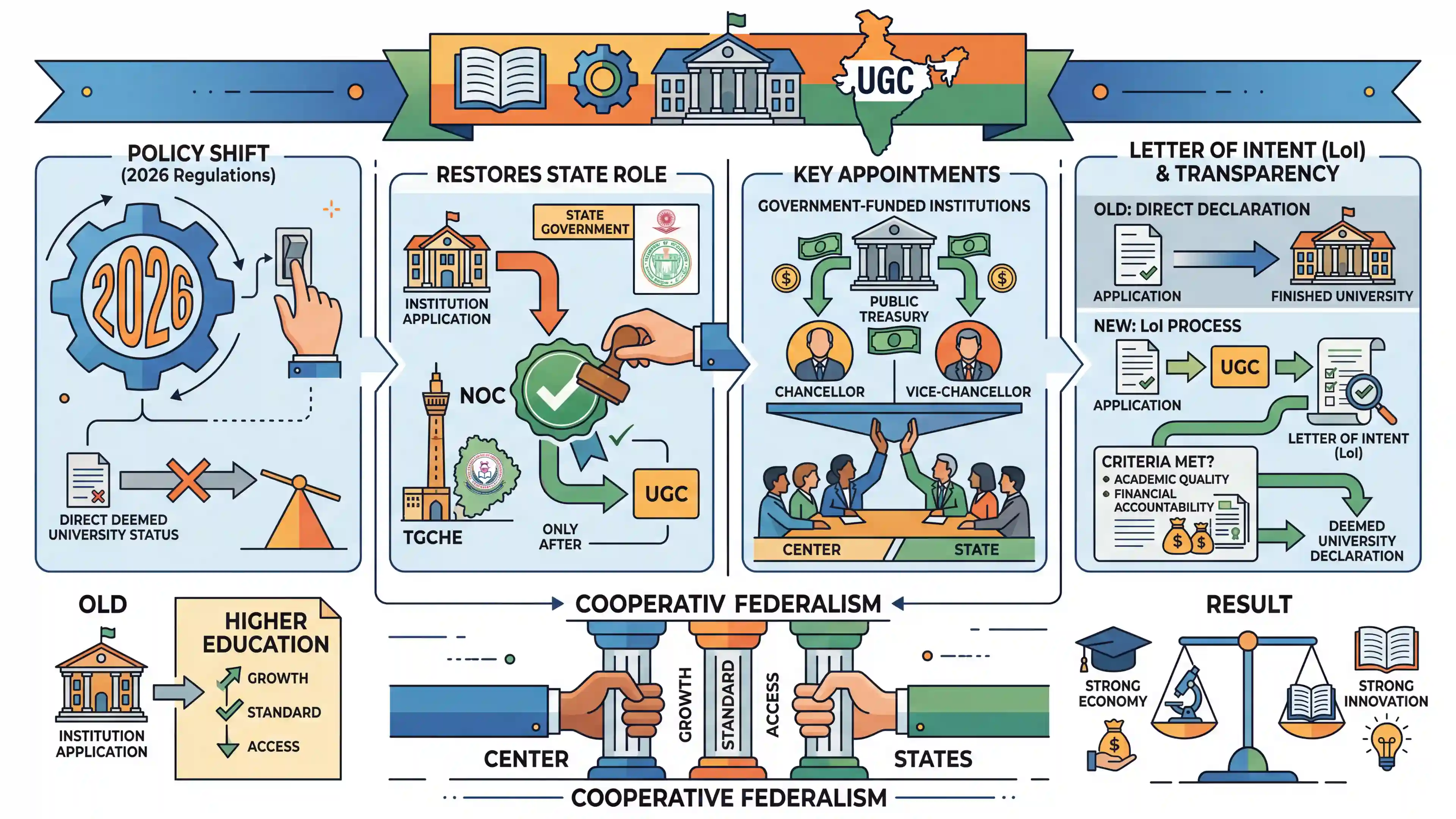
The University Grants Commission (UGC) has notified the Institutions Deemed to be Universities Amendment Regulations 2026, marking a significant policy shift that restores the role of State governments in the governance of deemed universities. According to the Telangana Council of Higher Education (TGCHE), the new rules require institutions to obtain a No Objection Certificate (NOC) from the government before being declared deemed universities. The regulations also involve States in key appointments, such as Chancellors and Vice-Chancellors, for government-funded institutions, and introduce a Letter of Intent (LoI) mechanism to enhance transparency and financial accountability.
Key Points
- The UGC notified the Institutions Deemed to be Universities Amendment Regulations 2026 on April 21, shifting towards restoring State government roles in overseeing deemed-to-be universities.
- Institutions require a No Objection Certificate (NOC) from the State government to be formally denotified and declared as deemed-to-be universities or off-campus centres.
- The regulations recognize the State's role in appointing key functionaries like the Chancellor and participating in Vice-Chancellor Search-cum-Selection Committees for institutions with substantial government funding.
- Procedural transparency is enhanced by issuing a Letter of Intent (LoI) before a direct declaration, ensuring financial and operational criteria are met.
Important Terms
University Grants Commission (UGC)

Statutory body established by the UGC Act, 1956, responsible for coordinating, determining, and maintaining standards of higher education in India.
UPSC context
GS Paper II: Statutory Bodies; crucial for understanding the regulatory framework of India's higher education sector.
Deemed to be University
An accreditation granted to higher education institutions by the Ministry of Education under Section 3 of the UGC Act, 1956, providing them university-level academic status and autonomy.
UPSC context
GS Paper II: Education; tests knowledge of different institutional categories and their governance models in India.
UGC (Institutions Deemed to be Universities) Amendment Regulations 2026
2026 rules mandating state government No Objection Certificates (NOC) and formal denotification before colleges can attain deemed status, enhancing state oversight and cooperative federalism.
UPSC context
GS Paper II: Centre-State Relations; relevant for questions on federalism and educational policy shifts.
Telangana Council of Higher Education (TGCHE)
A state-level statutory body (formerly TSCHE) responsible for planning and coordinating higher education in Telangana and acting as a link between the State, Universities, and UGC.
UPSC context
GS Paper II: State-level bodies; relevant for understanding regional administrative mechanisms in higher education governance.
Letter of Intent (LoI)
A procedural document introduced in the 2026 regulations to replace direct declarations, setting defined timelines and criteria for institutions to meet before receiving formal deemed status.
UPSC context
GS Paper II: Governance; illustrates mechanisms for enhancing transparency and administrative accountability in regulatory processes.
Concurrent List (Education)
List III of the Seventh Schedule of the Constitution, which includes 'Education,' allowing both Union and State governments to legislate and cooperate on higher education matters.
UPSC context
GS Paper II: Indian Constitution; fundamental for discussing the division of powers and cooperative federalism in education.
Prelims Trap
"State Governments are now empowered to declare institutions as deemed-to-be universities under the 2026 rules."
The Central Government still officially grants deemed status on UGC's advice. The new rules merely make a State government NOC a mandatory prerequisite.
Static Concepts Connected
How is legislative power over higher education divided constitutionally?
- Entry 25 (Concurrent List): Moved by the 42nd Amendment, it allows both Centre and States to legislate on education, including universities.
- Entry 66 (Union List): Covers 'coordination and determination of standards' in higher education and research. It is exclusively a Central domain.
- Rule of Repugnancy: Supreme Court rulings affirm that Entry 66 overrides Entry 25 in case of conflict; States cannot dilute minimum UGC standards.
What is a 'Deemed-to-be University' under the UGC framework?
- Statutory Origin: It is not established by a specific Act of Parliament or State Legislature, but conferred via an executive notification by the Central Government.
- Section 3: Conferred by the Ministry of Education on the advice of UGC under Section 3 of the UGC Act, 1956.
- High Autonomy: They enjoy full academic and administrative autonomy to design their own syllabi, admission guidelines, and fee structures, unlike affiliated colleges.
Cross-Topic Patterns
Governor vs. State over VC appointments
The new NOC rule intersects with the ongoing political and legal tussles in Kerala and Tamil Nadu regarding whether the Governor (Chancellor) or State Government controls Vice-Chancellor appointments.
NEP 2020's 'Light but Tight' regulation
This shift aligns with the National Education Policy's push to phase out fragmented affiliations and grant graded autonomy, transitioning toward a system of multidisciplinary research and teaching universities.

Expect a 2026 Prelims question mixing Entry 66 (Union List), UGC's advisory role, and the new state NOC powers in university governance.
Linked PYQs · 3
Linked PYQs · 3
- 2015MainsGS2
The quality of higher education in India requires major improvements to make it internationally competitive. Do you think that the entry of foreign educational institutions would help improve the quality of higher and technical education in the country? Discuss.
- 2014MainsGS2
Should the premier institutes like IITs/IIMs. be allowed to retain premier status, allowed more academic independence in designing courses and also decide mode/criteria of selection of students. Discuss in light of the growing challenges.
- 2024MainsGS2
What changes has the Union Government recently introduced in the domain of Centre-State relations ? Suggest measures to be adopted to build the trust between the Centre and the States and for strengthening federalism.
