UGC Equity Regulations and Higher Education Discrimination Reforms
Source:Indian Express ↗
Why It Matters
This development touches upon crucial issues of social justice, equity, inclusion of marginalized groups in higher education, and the legal-administrative mechanisms necessary to prevent discrimination under constitutional mandates.
Summary
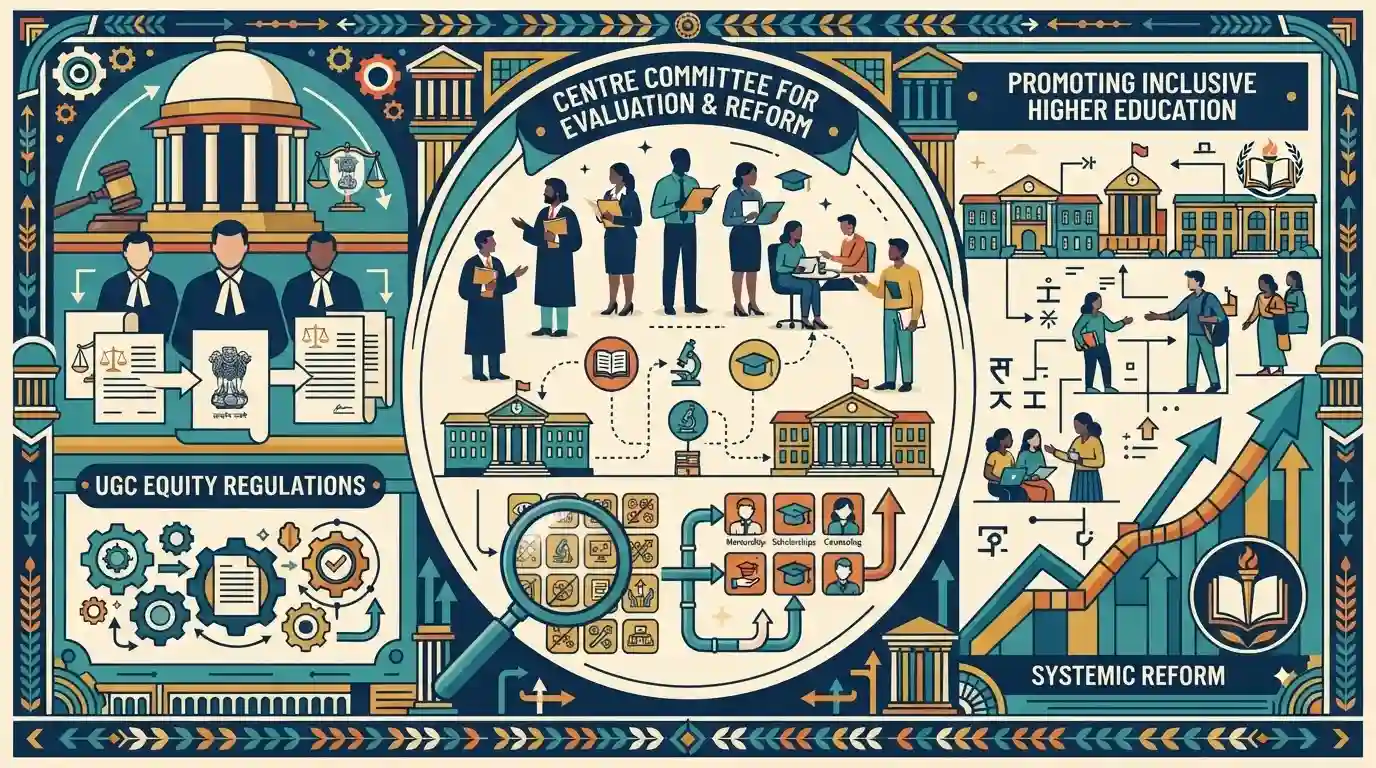
The Supreme Court addressed issues surrounding the UGC equity regulations and the setting up of a Centre committee to evaluate caste-based discrimination and promote equity in higher educational institutions, highlighting systemic reforms required in the Indian education sector.
Key Points
- The Supreme Court considered matters related to the UGC equity regulations and the constitution of a Centre committee to examine caste discrimination and equity in higher educational institutions.
- The regulatory framework aims to curb discrimination and harassment based on caste, gender, or religion in universities and colleges.
- Debates center on balancing administrative autonomy of higher education institutions with enforceable statutory safeguards for marginalized students.
- The judicial intervention highlights systemic institutional mechanisms needed to implement anti-discrimination guidelines effectively.
Important Terms
UGC Equity Regulations

Guidelines framed by the University Grants Commission to prevent caste-based discrimination, mandate anti-discrimination cells, and promote inclusive environments in higher educational institutions across India.
UPSC context
GS Paper II (Social Justice, Vulnerable Sections): Tests policies, legal frameworks, and institutional mechanisms for protecting marginalized groups against discrimination in education.
University Grants Commission (UGC)
A statutory body established under the UGC Act, 1956, responsible for coordinating, determining, and maintaining standards of university education in India.
UPSC context
GS Paper II (Statutory Bodies / Education Policy): Tests knowledge of regulatory bodies governing higher education and their mandates.
Centre Committee
An expert committee proposed by the Union Government before the Supreme Court to re-examine and review the contested equity regulations in higher education.
UPSC context
GS Paper II (Governance): Tests executive actions, policy formulation, and judicial-executive dynamics in addressing systemic social issues.
Prelims Trap
The UGC (Promotion of Equity in Higher Educational Institutions) Regulations, 2026 are currently fully operational across all central and state universities in India.
Aspirants might assume the 2026 UGC Equity Regulations are currently fully in force, ignoring that the Supreme Court stayed their operation and restored the 2012 regulations.
Static Concepts Connected
What are the constitutional provisions and statutory mandate empowering the UGC to regulate higher education in India?
- UGC Act 1956: Statutory Body: Established under the UGC Act, 1956, to coordinate, determine, and maintain standards of university education in India.
- Union List Entry 66: Constitutional Entry: Entry 66 of List I (Union List) empowers Parliament to legislate on coordination and determination of standards in institutions for higher education.
- Equity Mandate: Anti-Discrimination Mandate: Empowered to frame regulations ensuring inclusive spaces, protecting marginalized groups, and preventing caste, gender, or religious discrimination.
Cross-Topic Patterns
Higher Education Autonomy vs Statutory Equity Mandates
Higher education autonomy vs state regulation has been a recurring flashpoint across UGC guidelines, national institutional ranking frameworks, and minority institution rights under Article 30.
Judicial Review and Subordinate Legislation Oversight
Judicial intervention in university governance mirrors broader debates on judicial review of administrative subordinate legislation versus executive policy-making in social justice.

UGC equity regulations and institutional accountability mechanisms for caste discrimination will feature in Polity mains or Prelims statutory bodies.
Linked PYQs · 2
Linked PYQs · 2
- 2021MainsGS2
Discuss the desirability of greater representation to women in the higher judiciary to ensure diversity, equity and inclusiveness.
- 2018MainsGS2
Whether National Commission for Scheduled Castes (NCSC) can enforce the implementation of constitutional reservation for the Scheduled Castes in the religious minority institutions? Examine.
