UGC Equity Regulations 2026 under reconsideration before Supreme Court
Source:Indian Express ↗
हे का महत्त्वाचे आहे
It highlights the delicate balance required in higher education governance between statutory anti-discrimination mandates, institutional autonomy, and inclusive campus policies for marginalized communities.
सारांश
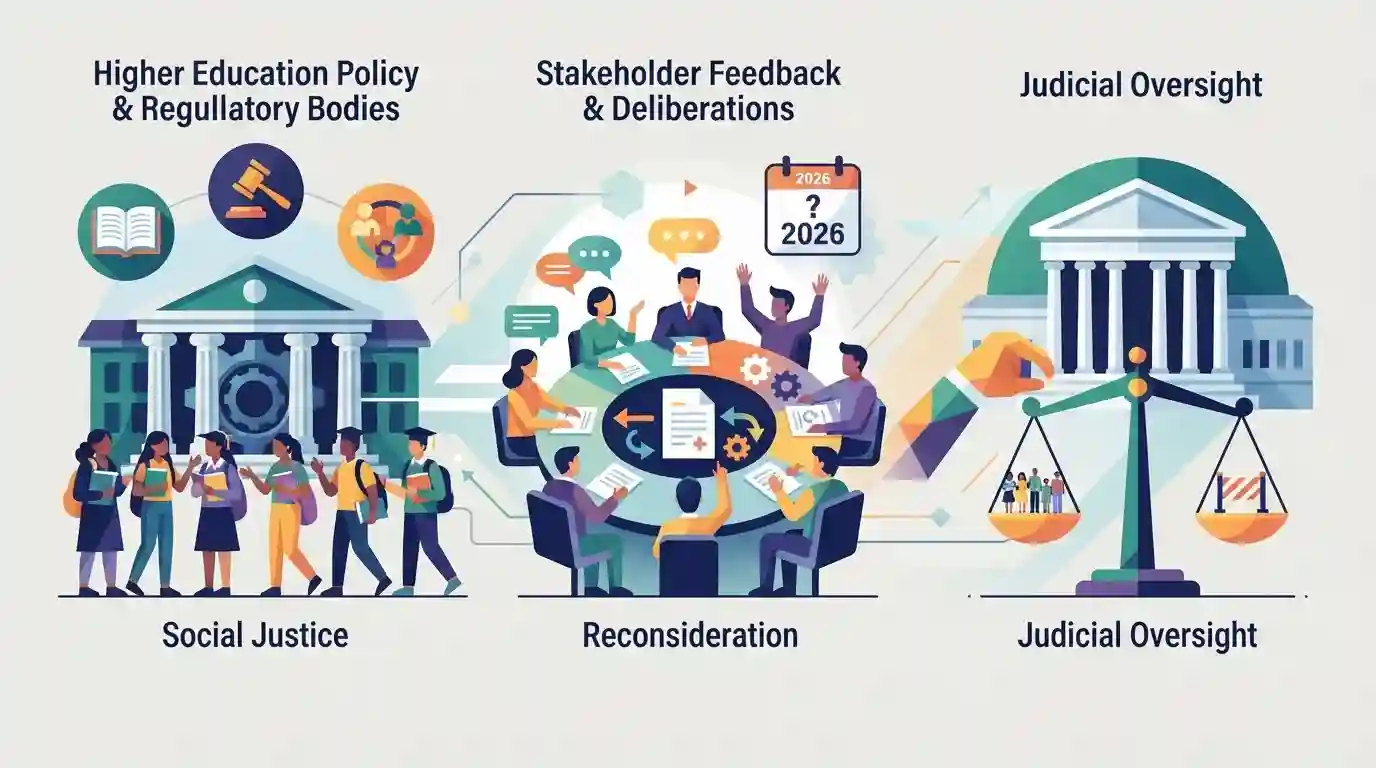
The Centre has informed the Supreme Court that the University Grants Commission (UGC) Equity Regulations, 2026 are currently under reconsideration following feedback and stakeholder deliberations regarding equity and anti-discrimination frameworks in higher education.
मुख्य मुद्दे
- The Centre informed the Supreme Court that the proposed UGC Equity Regulations, 2026 are currently under reconsideration.
- The regulations deal with addressing discrimination, ensuring equity, and promoting inclusivity within higher educational institutions across India.
- The reconsideration follows diverse feedback, institutional challenges, and legal scrutiny concerning campus governance and structural equity measures.
महत्त्वाच्या संज्ञा
UGC Equity Regulations 2026

Regulatory guidelines designed to address caste-based discrimination and promote social justice and equity within higher education institutions across India.
UPSC context
GS Paper II (Social Justice & Vulnerable Sections); tests policies, anti-discrimination frameworks, and institutional equity in higher education.
University Grants Commission (UGC)
Statutory body established under an Act of Parliament in 1956 for the coordination, determination, and maintenance of standards of university education in India.
UPSC context
GS Paper II (Governance & Regulatory Bodies); tests the role, autonomy, and functioning of higher education regulators in India.
Supreme Court
The apex judicial court of India under Article 124, possessing powers of judicial review to examine the constitutionality of legislative and executive actions.
UPSC context
GS Paper II (Indian Constitution & Judiciary); tests judicial review, public interest litigation, and oversight of executive rule-making.
पूर्वपरीक्षा सापळा
The UGC Equity Regulations, 2026 immediately replaced all older anti-discrimination frameworks upon drafting.
Aspirants often assume proposed draft regulations have statutory force immediately; however, the Supreme Court stayed the 2026 rules and kept the 2012 regulations active.
संबंधित स्थिर संकल्पना
What are the constitutional provisions and statutory mandates governing the University Grants Commission (UGC)?
- Statutory Origin: Statutory body established under the University Grants Commission Act, 1956 for coordination and determination of standards in universities.
- Regulatory Power: Empowered to frame regulations on minimum standards of education, faculty appointments, and maintenance of equity and inclusivity.
- Judicial Oversight: Subject to central government directions and judicial review under Articles 32 and 226 of the Constitution.
आंतर-विषय नमुने
Equity Regulations vs. Article 14 Standards
The UGC Equity Regulations intersect with Article 14 equal protection debates and institutional accountability under the SC/ST (Prevention of Atrocities) Act.
Subordinate Legislation and Judicial Review
Judicial scrutiny of executive rulemaking via subordinate legislation tests the boundaries of administrative discretion in higher education.

UGC equity norms + Article 14 equality tests + subordinate legislation oversight likely to appear in a statement-based prelims Q.
संबंधित PYQ · 5
संबंधित PYQ · 5
- 2021PrelimsGS1
Under the Indian Constitution, concentration of wealth violates
- 2026PrelimsGS1
In a multi-ethnic district where both economic competition and historical grievances frequently led to community tensions, a flashpoint has arisen with a Government decision to allocate land for a waste management facility near a tribal hamlet, sparking protests by the tribal community, which claimed that the land was sacred and critical to their cultural identity. At the same time, urban residents and local industries supported the project, citing severe solid waste challenges and health concerns due to lack of a proper disposal site. The conflict has escalated with road blockades, social media campaigns, and allegations of police excesses. As a responsible Government official, you are tasked with resolving the situation through mediation, ensuring a sustainable outcome that balances environmental needs, tribal rights, and urban public health. Consider the following statements with reference to the above : 1. A successful conflict resolution process must begin with acknowledging the cultural concerns of the protesting tribal community before discussing technical alternatives. 2. The Government should move ahead with the project without delay to address urban health concerns, which outweigh the sentiments of a small group. 3. Creating a multi-stakeholder dialogue platform — including tribal leaders, environmental experts, and municipal representatives — to build mutual understanding and help de-escalate tensions. 4. Conducting an independent Environmental and Social Impact Assessment (ESIA) and sharing findings transparently with both sides to facilitate evidence-based decision-making. Which of the statements given above would contribute to the resolution process ?
- 2024MainsGS2
What are the aims and objects of recently passed and enforced, The Public Examination (Prevention of Unfair Means) Act, 2024? Whether University/State Education Board examinations, too, are covered under the Act ?
- 2021MainsGS2
Discuss the desirability of greater representation to women in the higher judiciary to ensure diversity, equity and inclusiveness.
- 2015MainsGS2
For achieving the desired objectives, it is necessary to ensure that the regulatory institutions remain independent and autonomous. Discuss in the light of the experiences in recent past.
