Centre Informs Supreme Court UGC Equity Regulations Under Review
Source:Indian Express ↗
কেন এটি গুরুত্বপূর্ণ
This development highlights the delicate balance between ensuring equity and inclusion in higher education institutions and avoiding legally ambiguous frameworks that could cause polarization. It touches upon UGC's regulatory powers, social justice mandates, and judicial oversight via Article 142.
সারসংক্ষেপ
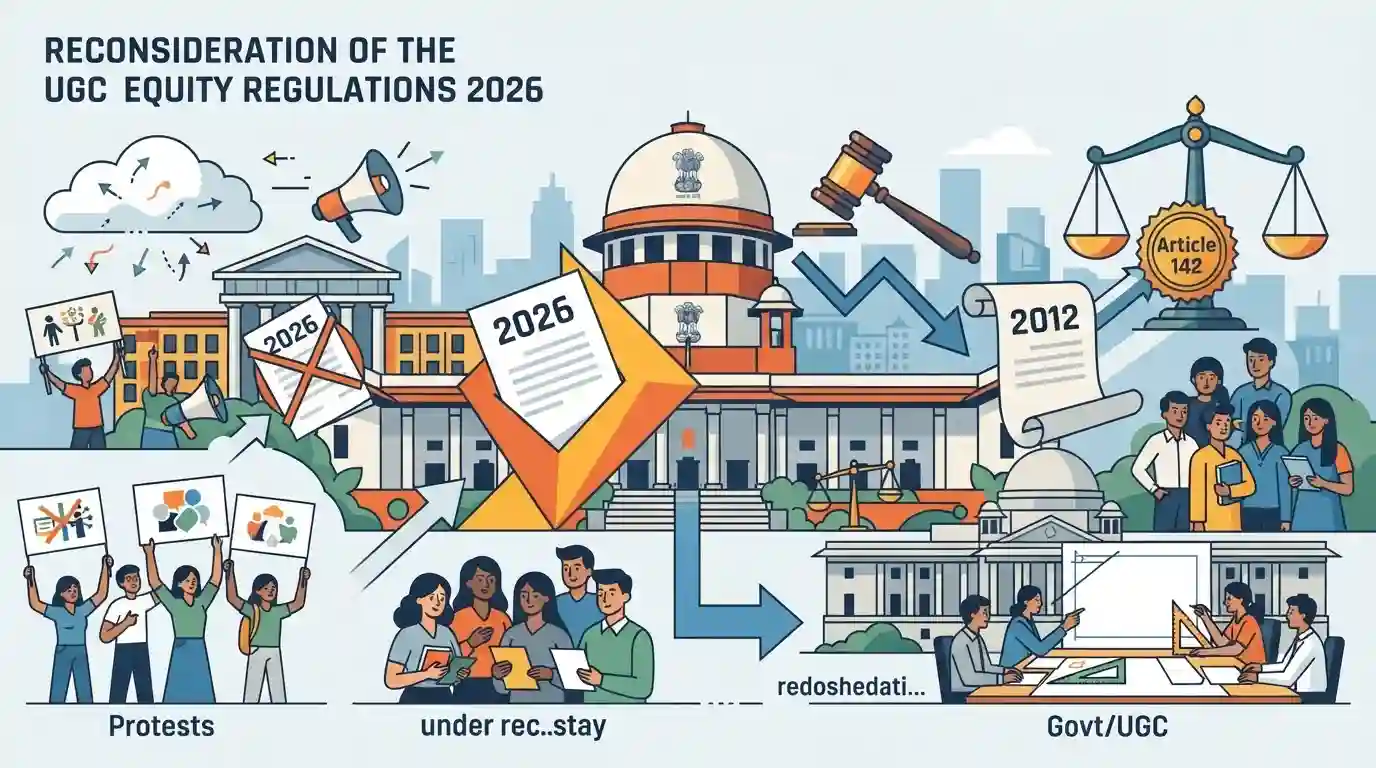
The Centre informed the Supreme Court that the University Grants Commission (UGC) Equity Regulations 2026 are under reconsideration following intense protests and a Supreme Court stay. The apex court had earlier put the 2026 rules in abeyance, citing vagueness and potential for societal division, while reinstating the 2012 regulations under Article 142.
মূল বিষয়
- The Centre informed the Supreme Court that the UGC Equity Regulations 2026, aimed at preventing caste-based discrimination on campuses, are under reconsideration.
- The Supreme Court had earlier stayed the 2026 regulations on January 29, 2026, terming the framework 'prima facie vague' with potential sweeping and divisive consequences.
- Under Article 142, the Supreme Court directed that the older 2012 UGC equity regulations will continue to operate until further orders.
- The apex court questioned specific provisions, including the narrow definition of caste-based discrimination and the exclusion of ragging from the 2026 regulations scope.
গুরুত্বপূর্ণ শব্দ
University Grants Commission (Promotion of Equity in Higher Education Institutions) Regulations, 2026

Regulations notified by the UGC in January 2026 to legally enforce anti-discrimination and equity measures in higher education institutions, which were subsequently stayed by the Supreme Court over concerns of vagueness and potential misuse.
UPSC context
Crucial for GS Paper II (Social Justice - Vulnerable Sections & Higher Education Policy), testing equity governance and campus discrimination frameworks.
University Grants Commission (Promotion of Equity in Higher Education Institutions) Regulations, 2012
The earlier advisory guidelines issued by the UGC in 2012 to address discrimination in higher education, which were reinstated by the Supreme Court via Article 142 after staying the 2026 framework.
UPSC context
Important for GS Paper II (Higher Education & Governance), highlighting baseline regulatory standards preceding the contested 2026 rules.
Article 142
An extraordinary constitutional provision empowering the Supreme Court to pass any decree or order necessary for doing 'complete justice' in any pending cause or matter across India.
UPSC context
Important for GS Paper II (Indian Polity - Judiciary), testing the scope of judicial powers, judicial activism, and the doctrine of separation of powers.
University Grants Commission (UGC)
A statutory body established by an Act of Parliament in 1956 under the Ministry of Education, responsible for coordinating, determining, and maintaining standards of university education in India.
UPSC context
Important for GS Paper II (Governance & Education), testing regulatory frameworks and institutional oversight in higher education.
প্রিলিমস ফাঁদ
The Supreme Court struck down all UGC equity regulations and permanently barred the framing of anti-discrimination rules.
The Supreme Court did not strike down the concept of equity regulations entirely; it stayed the 2026 draft rules and restored the 2012 regulations under Article 142.
সংযুক্ত স্থির ধারণা
What are the constitutional dimensions of Article 142 and its application by the Supreme Court?
- Scope: Complete Justice: Empowers the Supreme Court to pass any decree or order necessary for doing complete justice in any pending case.
- Enforceability: Binding Nature: Orders under Article 142 are enforceable across the territory of India as law declared by the Supreme Court.
- Limitations: Judicial Restraint: The court has clarified that Article 142 cannot be used to bypass statutory provisions or fundamental rights.
আন্তঃবিষয় প্যাটার্ন
Higher Education Governance + Article 14 & 15
Higher education governance reforms intersect directly with fundamental rights under Part III, testing the judicial balance between institutional autonomy and affirmative action mandates.
Article 142 + Executive Regulatory Overreach
The invocation of Article 142 to reinstate 2012 rules highlights the judiciary's role in filling legislative/regulatory vacuums during executive policy overhauls.

UGC equity frameworks, Article 142 powers, and campus caste-discrimination oversight could feature in mains GS-2 governance/social justice.
সংযুক্ত PYQ · 2
সংযুক্ত PYQ · 2
- 2024MainsGS2
What are the aims and objects of recently passed and enforced, The Public Examination (Prevention of Unfair Means) Act, 2024? Whether University/State Education Board examinations, too, are covered under the Act ?
- 2021MainsGS2
Discuss the desirability of greater representation to women in the higher judiciary to ensure diversity, equity and inclusiveness.
