Higher Education Regulation and Distance Learning Restrictions
Source:Indian Express ↗
Why It Matters
Highlights the evolving regulatory framework for higher education in India, demonstrating the UGC's focus on maintaining educational quality by restricting distance learning in fields requiring practical skills and cracking down on unregulated foreign academic partnerships.
Summary
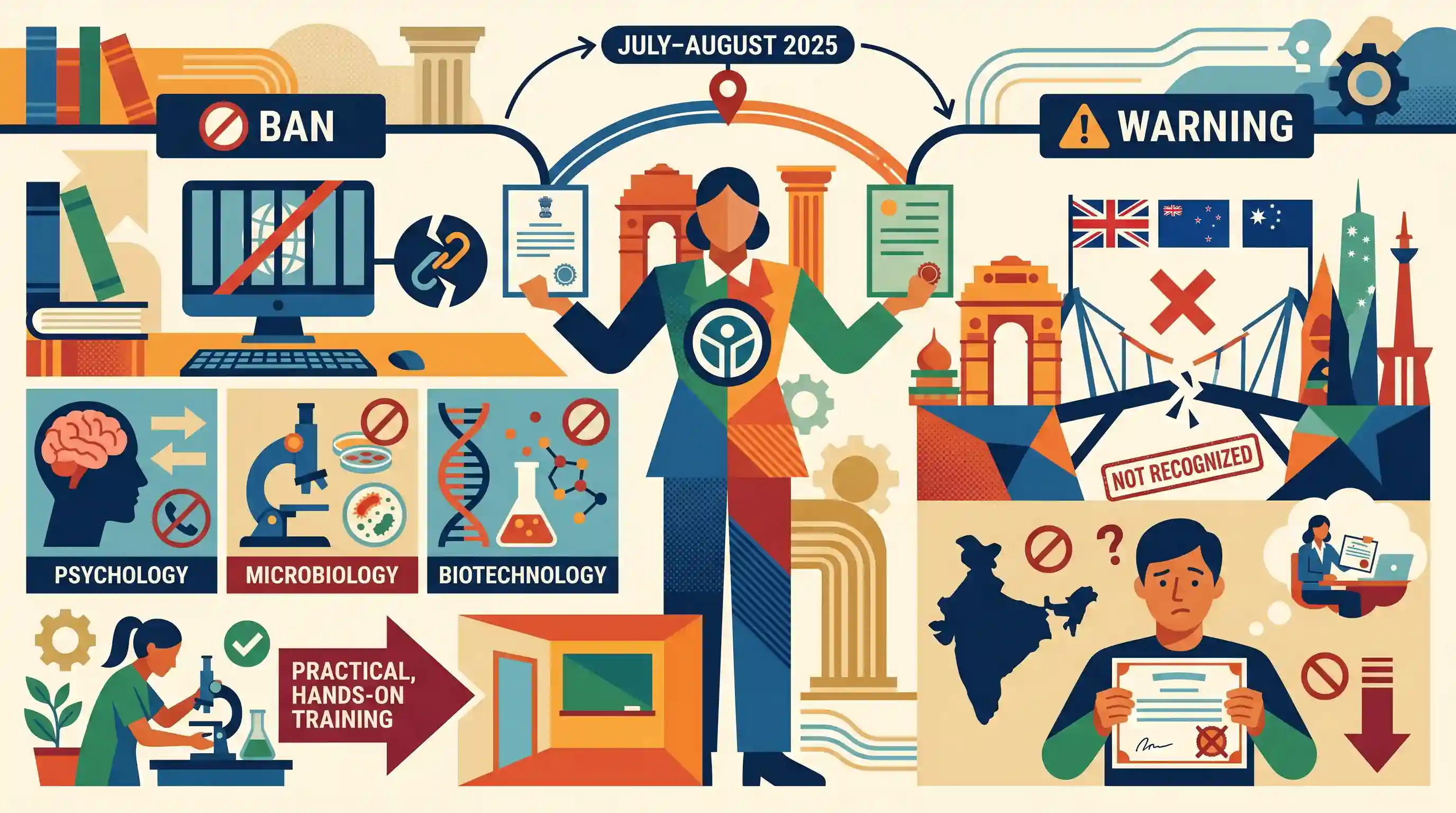
The University Grants Commission (UGC) has issued a directive prohibiting higher education institutions from offering healthcare and allied programs via Open and Distance Learning (ODL) and online modes, effective from the July-August 2025 academic session. The ban covers disciplines regulated by the National Commission for Allied and Healthcare Professions (NCAHP) Act, 2021, such as Psychology, Microbiology, and Biotechnology, emphasizing the necessity of practical, hands-on training. Additionally, the UGC issued a fresh warning against unapproved degree collaborations with foreign educational providers, stating that such qualifications will not be recognized in India.
Key Points
- The UGC has directed Higher Education Institutions (HEIs) to stop offering allied healthcare programs via ODL or online modes starting the July-August 2025 academic session.
- The ban applies to disciplines covered under the NCAHP Act, 2021, including Psychology, Microbiology, Biotechnology, and Clinical Nutrition and Dietetics, recognizing that such fields require practical, in-person training.
- For general degree programs offering multiple specializations, only the healthcare-related specialization will have its ODL/Online recognition withdrawn.
- The UGC also reiterated its warning against unauthorized collaborations with foreign educational institutions, declaring degrees from unapproved joint or dual arrangements invalid in India.
Important Terms
University Grants Commission (UGC)

A statutory body under the UGC Act, 1956, responsible for coordinating, determining, and maintaining standards of higher education and providing grants to recognized universities.
UPSC context
GS Paper 2: Statutory bodies and Governance. Essential for topics on education reforms and regulatory frameworks in India.
National Commission for Allied and Healthcare Professions (NCAHP) Act, 2021
Legislation enacted to regulate and standardize the education and practice of 56 allied and healthcare professions, ensuring uniform qualifications and professional conduct across India.
UPSC context
GS Paper 2: Social Justice and Health. Tests knowledge of regulatory measures to improve healthcare workforce quality.
National Commission for Allied and Healthcare Professions (NCAHP)
A statutory body created by the 2021 Act to maintain a central register, frame education policies, and oversee professional standards for allied and healthcare workers.
UPSC context
GS Paper 2: Statutory bodies. Relevant for healthcare governance and human resource development in the medical sector.
Distance Education Bureau (DEB)
An administrative unit of the UGC that regulates Open and Distance Learning (ODL) and online education to maintain academic quality in remote learning formats.
UPSC context
GS Paper 2: Education. Important for understanding the shift towards and regulation of digital and distance education.
Open and Distance Learning (ODL)
A flexible education mode combining remote study with occasional face-to-face interaction, often used to expand access to education beyond traditional physical campuses.
UPSC context
GS Paper 2: Education. Relevant for discussions on digital divide, educational access, and quality assurance in vocational training.
Prelims Trap
"The NCAHP Act 2021 regulates doctors, nurses, and pharmacists in India."
It only regulates allied professions (like physiotherapy). Doctors (NMC), nurses (INC), and pharmacists (PCI) are governed by their own separate statutory bodies.
Static Concepts Connected
What is the scope of the NCAHP Act 2021?
- Target professions: Standardizes education and practice for over 50 allied and healthcare professions, including lab technologists, physiotherapists, and clinical dietitians.
- Notable exclusions: Does not regulate doctors, nurses, or pharmacists, as they are governed by separate statutory bodies like the NMC, INC, and PCI.
- Statutory structure: Establishes a National Commission and State Councils, mandating central and state registers for qualified allied healthcare professionals.
How are foreign university collaborations regulated in India?
- Permitted modes: UGC regulations officially allow twinning, joint degree, and dual degree programmes between Indian and recognized foreign higher education institutions.
- Delivery restrictions: Collaborative degree programmes must be delivered in conventional offline modes; fully online or ODL formats are strictly prohibited for such degrees.
Cross-Topic Patterns
NEP 2020 GER vs Quality Control
While NEP 2020 promotes ODL to achieve a 50% Gross Enrolment Ratio by 2035, this ban highlights the enduring necessity of offline infrastructure for medical and scientific quality.
Internationalization of Higher Education
The warning against unapproved foreign degrees underscores a dual policy approach: inviting top foreign universities via GIFT City while cracking down on predatory or unrecognized degree collaborations.

NEP 2020's online GER push vs professional council mandates (like NCAHP) may feature as an analytical Mains question on higher education.
Linked PYQs · 3
Linked PYQs · 3
- 2015MainsGS2
The quality of higher education in India requires major improvements to make it internationally competitive. Do you think that the entry of foreign educational institutions would help improve the quality of higher and technical education in the country? Discuss.
- 2015MainsGS2
For achieving the desired objectives, it is necessary to ensure that the regulatory institutions remain independent and autonomous. Discuss in the light of the experiences in recent past.
- 2023MainsGS2
Skill development programmes have succeeded in increasing human resources supply to various sectors. In the context of the statement analyse the linkages between education, skill and employment.
