UGC Anti Discrimination Guidelines for Higher Education Campuses
Source:Indian Express ↗
આ શા માટે મહત્વનું છે
It directly addresses equity, inclusion, and the protection of marginalized students in higher education institutions, aligning with India's constitutional framework of social justice and statutory mandates for non-discrimination.
સારાંશ
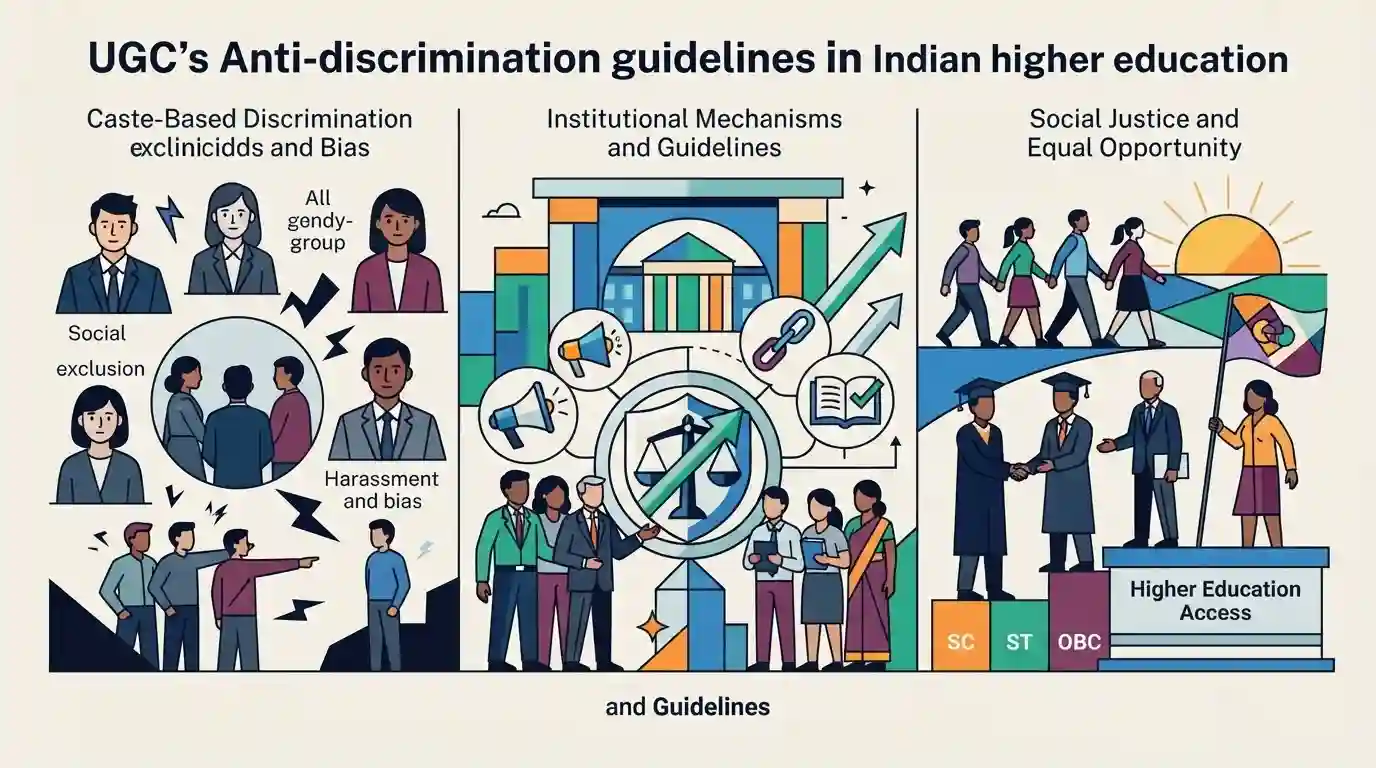
The article discusses the UGC's anti-discrimination guidelines and rules aimed at curbing caste-based bias, discrimination, and harassment on higher education campuses across India, emphasizing institutional mechanisms for social justice and protection of vulnerable groups.
મુખ્ય મુદ્દા
- The University Grants Commission (UGC) frames anti-discrimination rules to address caste-based discrimination, bias, and harassment on university and college campuses in India.
- These regulations aim to strengthen institutional accountability, provide robust grievance redressal mechanisms, and safeguard students from marginalized communities including SC, ST, and OBC.
- Implementation challenges include under-reporting of cases, lack of awareness, and the social dynamics within higher education institutions.
- Such policies are crucial for upholding constitutional ideals of equality, social justice, and non-discrimination under Articles 14, 15, and 17 of the Constitution.
મહત્વપૂર્ણ શબ્દો
UGC Anti-Discrimination Regulations

Regulations issued by the University Grants Commission to eradicate caste-based bias, harassment, and discrimination in higher education institutions, mandating institutional grievance redressal mechanisms and equal opportunity cells.
UPSC context
GS Paper II (Social Justice, Vulnerable Sections): Tests policies, institutional mechanisms, and legal frameworks for protecting marginalized communities against discrimination.
University Grants Commission
A statutory body established by an Act of Parliament in 1956 for the coordination, determination, and maintenance of standards of university education in India.
UPSC context
GS Paper II (Polity & Governance / Education): Tests the role, statutory powers, and regulatory oversight of apex bodies in higher education.
પ્રિલિમ્સ ટ્રેપ
UGC anti-discrimination rules are voluntary advisory guidelines without statutory backing or punitive enforcement mechanisms.
Aspirants often assume UGC equity guidelines are mere non-binding advisories, whereas the 2026 regulations mandate legally binding institutional mechanisms with punitive action provisions.
સંલગ્ન સ્થિર ખ્યાલો
What are the key constitutional provisions protecting SC, ST, and OBC communities against discrimination in India?
- Article 14:: Guarantees equality before law and equal protection of laws within the territory of India for all persons.
- Article 15:: Prohibits discrimination on grounds of religion, race, caste, sex, or place of birth; Article 15(5) enables special provisions for educational advancement of socially and educationally backward classes, SCs, and STs.
- Article 17:: Abolishes untouchability and makes its practice in any form a punishable offense under law.
- Article 16(4):: Empowers the state to make provisions for the reservation of appointments or posts in favor of any backward class of citizens inadequately represented.
આંતર-વિષય પેટર્ન
Higher Education Policy + Centre-State Grants
Caste-based discrimination policies intersect with federal funding conditionalities, as central universities depend heavily on UGC grants tied to equity compliance.
Social Justice + Constitutional Law Jurisprudence
Equal Opportunity Centres link educational inclusion to affirmative action debates under Articles 15(5) and 16(4).

UGC equity regulations + Article 15/17 + Institutional grievance mechanisms likely to feature in Mains GS-2 (Social Justice).
સંલગ્ન PYQ · 2
સંલગ્ન PYQ · 2
- 2023MainsGS2
“Development and welfare schemes for the vulnerable, by its nature, are discriminatory in approach.” Do you agree? Give reasons for your answer.
- 2018MainsGS2
Whether National Commission for Scheduled Castes (NCSC) can enforce the implementation of constitutional reservation for the Scheduled Castes in the religious minority institutions? Examine.
