UGC Anti Discrimination Rules and Campus Equity Challenges
Source:Indian Express ↗
Why It Matters
Understanding the institutional mechanisms to safeguard vulnerable sections is crucial for GS-2. Issues of caste discrimination in education intersect with broader themes of social justice, equity, and the effectiveness of statutory bodies like the UGC.
Summary
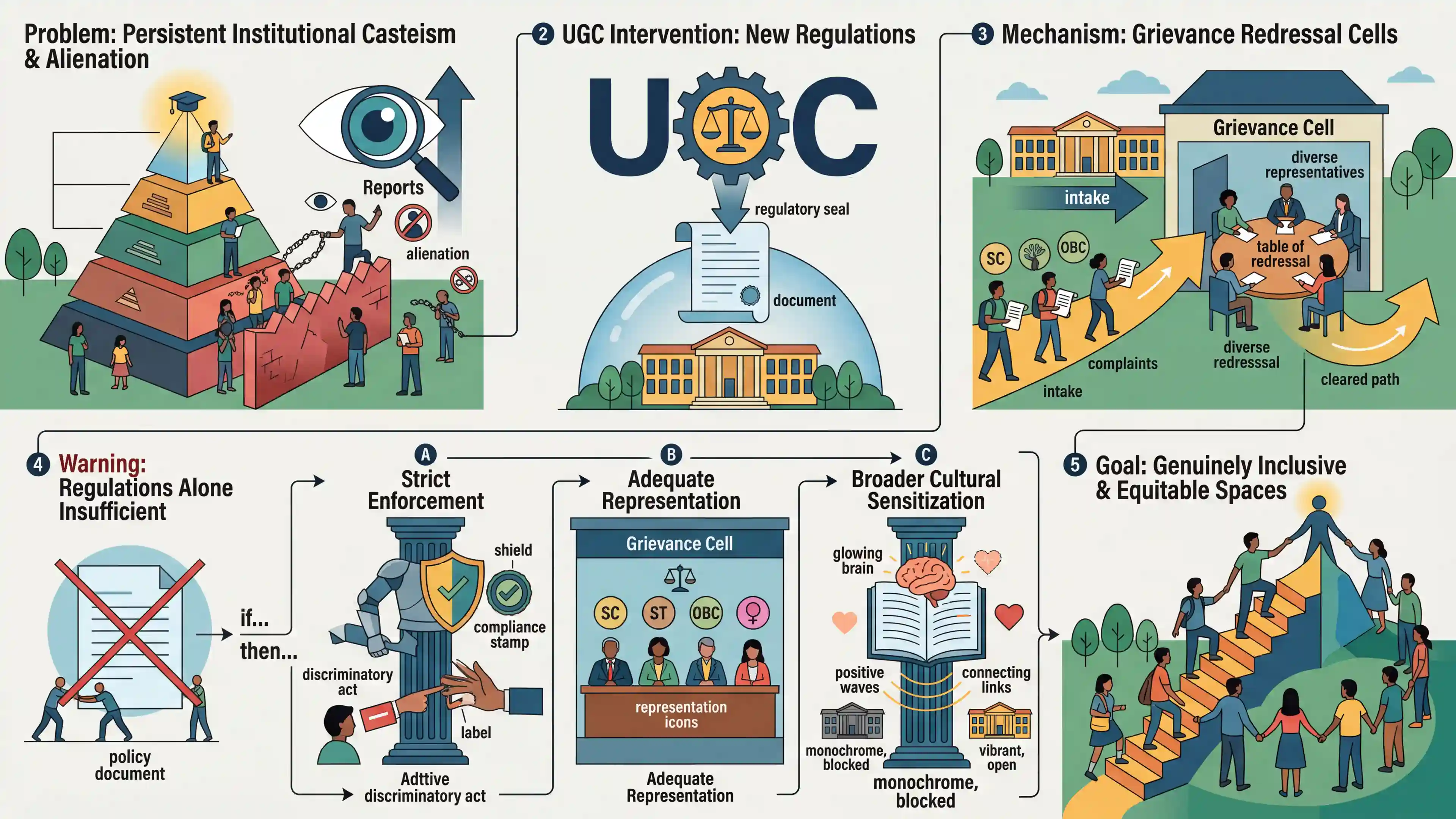
The article discusses the University Grants Commission's (UGC) updated anti-discrimination regulations intended to combat caste prejudice in Higher Educational Institutions. Driven by persistent reports of institutional casteism and systemic alienation faced by SC, ST, and OBC students, the new rules seek to establish robust grievance redressal mechanisms. However, the analysis highlights that regulatory frameworks alone may be insufficient unless backed by strict enforcement, adequate representation of marginalized communities within grievance cells, and broader cultural sensitization to ensure campuses become genuinely inclusive and equitable spaces.
Key Points
- The UGC's new anti-discrimination rules are aimed at addressing institutional casteism and ensuring equity for marginalized students (SC, ST, OBC) in Higher Educational Institutions (HEIs).
- The regulations mandate stricter grievance redressal mechanisms to handle complaints of caste-based prejudice and harassment on college campuses.
- Historically, anti-discrimination guidelines have suffered from poor implementation, lack of punitive teeth, and inadequate representation of marginalized groups in grievance cells.
- Experts emphasize that creating safe and inclusive campuses requires not just statutory regulations, but comprehensive sensitization, behavioral change, and institutional accountability.
Important Terms
UGC (Promotion of Equity in Higher Educational Institutions) Regulations, 2026

Statutory framework notified in 2026 to eliminate caste-based discrimination in universities. It mandates Equal Opportunity Centres and specifically includes OBCs, replacing the advisory 2012 guidelines with legally binding, enforceable mechanisms.
UPSC context
GS Paper II: Government Policies & Interventions. Tests understanding of regulatory shifts from advisory to mandatory social justice frameworks.
University Grants Commission (UGC)
A statutory body established under the UGC Act, 1956, responsible for coordinating, determining, and maintaining standards of higher education in India while overseeing funding for universities.
UPSC context
GS Paper II: Statutory/Regulatory Bodies. Evaluates knowledge of the institutional architecture governing Indian higher education and social equity.
Equal Opportunity Centre (EOC)
An institutional mechanism mandated under the 2026 Regulations to promote inclusion, provide counseling, and handle discrimination complaints through an Equity Committee representing SC, ST, OBC, women, and PwD.
UPSC context
GS Paper II: Issues related to vulnerable sections. Tests understanding of decentralized grievance redressal mechanisms in public institutions.
National Commission for Scheduled Castes (NCSC)
A constitutional body under Article 338 tasked with monitoring safeguards for Scheduled Castes, investigating rights violations, and inquiring into specific complaints of discrimination in sectors including education.
UPSC context
GS Paper II: Constitutional Bodies. Focuses on the role of oversight bodies in protecting the rights of marginalized communities.
Substantive Equality
A legal concept moving beyond identical treatment (formal equality) to proactively addressing systemic disadvantages and providing reasonable accommodations to ensure truly equitable outcomes for marginalized groups.
UPSC context
GS Paper II: Social Justice/Polity. Tests the ability to distinguish between procedural fairness and transformative justice in constitutional law.
Higher Educational Institutions (HEIs)
Encompasses universities, colleges, and deemed universities. Under the 2026 rules, HEIs are legally accountable for campus culture, facing penalties like de-listing or fund withdrawal for non-compliance.
UPSC context
GS Paper II: Issues relating to Education. Relates to the responsibilities of public/private institutions in ensuring social inclusion.
Prelims Trap
"UGC 2026 anti-discrimination rules are advisory, and OBCs were protected under the 2012 guidelines."
The 2026 rules shift from an advisory model to a legally binding mandate. Crucially, they explicitly protect OBCs for the first time, addressing a major gap in the 2012 framework.
Static Concepts Connected
What are the statutory powers of the UGC regarding university compliance?
- Statutory Origin: Established under the UGC Act, 1956 to coordinate, determine, and maintain standards of higher education across India.
- Punitive Powers: Can withhold financial grants or recommend the de-recognition of non-compliant universities to enforce binding regulations.
Which Constitutional provisions protect marginalized groups in education?
- Article 15: Clauses (4) and (5) allow the State to make special provisions for the educational advancement of SCs, STs, and socially/educationally backward classes.
- Article 46: Directs the State to promote with special care the educational and economic interests of the weaker sections, particularly SCs/STs.
Cross-Topic Patterns
Statutory vs Constitutional mandates
How the UGC's campus-level Equal Opportunity Centres interact with the broader constitutional oversight powers of the National Commission for Scheduled Castes (Article 338) regarding discrimination.
Institutional casteism & mental health
The intersection of systemic alienation (noted since the 2007 Thorat Committee) and the rising crisis of student suicides in premier higher educational institutions.

Expect a GS2 Mains question linking institutional casteism (Thorat Committee) with the efficacy of the new legally-binding UGC 2026 regulations.
Linked PYQs · 4
Linked PYQs · 4
- 2024MainsGS1
Despite comprehensive policies for equity and social justice, underprivileged sections are not yet getting the full benefits of affirmative action envisaged by the Constitution. Comment.
- 2018MainsGS1
Caste system is assuming new identities and associational forms. Hence, caste system cannot be eradicated in India." Comment.
- 2018MainsGS2
Whether National Commission for Scheduled Castes (NCSC) can enforce the implementation of constitutional reservation for the Scheduled Castes in the religious minority institutions? Examine.
- 2015MainsGS2
The quality of higher education in India requires major improvements to make it internationally competitive. Do you think that the entry of foreign educational institutions would help improve the quality of higher and technical education in the country? Discuss.
