Uttarakhand Electricity Regulatory Commission proposes DSM rules
Source:solarquarter ↗
Why It Matters
Provides crucial insight into how states (Uttarakhand) are modernizing their regulatory frameworks to integrate intermittent renewable energy while maintaining grid stability, relevant for GS-3 Infrastructure and State-specific current affairs.
Summary
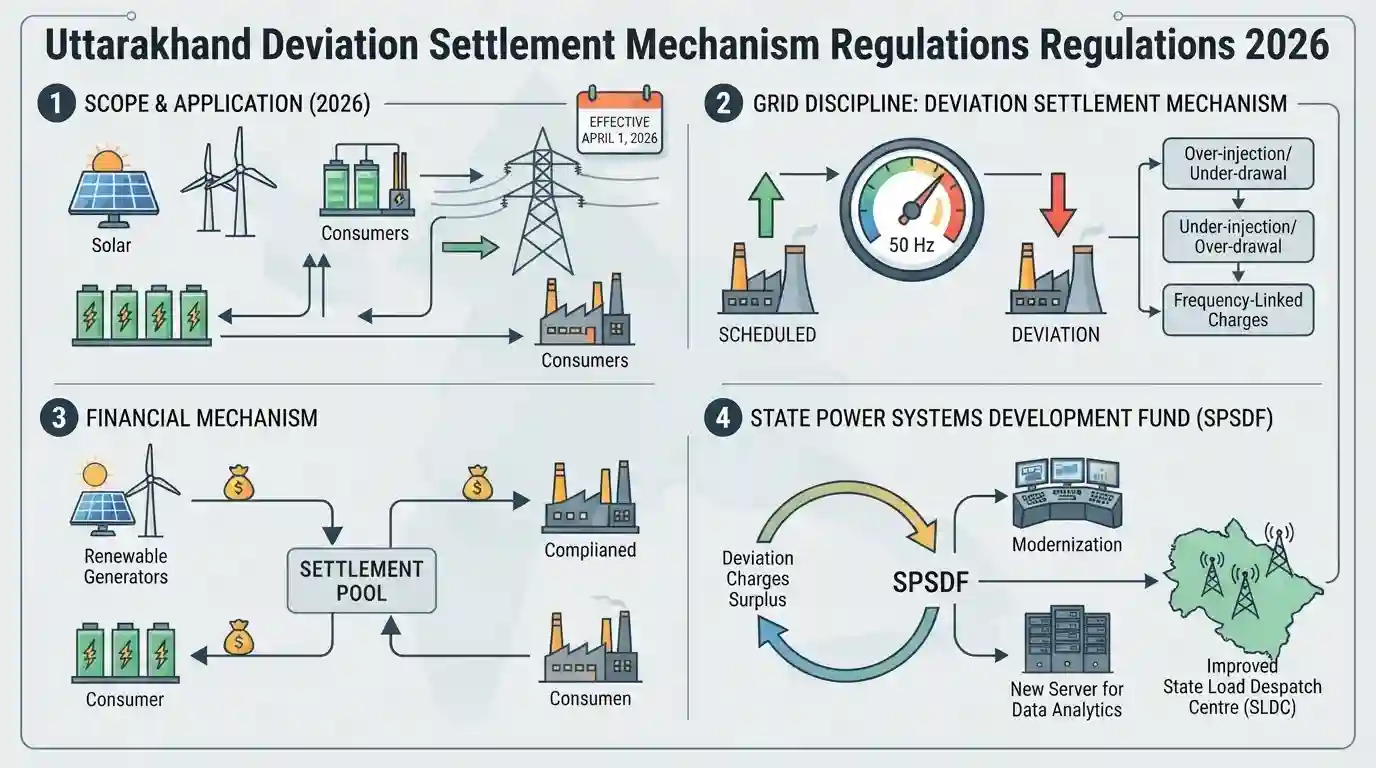
The Uttarakhand Electricity Regulatory Commission (UERC) has unveiled the draft UERC (Deviation Settlement Mechanism and Related Matters) Regulations, 2026, aimed at bolstering grid discipline and streamlining financial settlements for power supply deviations. Scheduled to become effective on April 1, 2026, the framework aligns with the Electricity Act of 2003 and explicitly applies to renewable energy generators (including solar and wind), energy storage systems, and large-scale consumers. By imposing frequency-linked charges on deviations from scheduled power generation or drawal, the policy ensures grid stability. Furthermore, surplus funds generated from these charges will be channeled into a newly instituted State Power Systems Development Fund, dedicated to improving the infrastructure and analytics capabilities of the State Load Despatch Centre (SLDC).
Key Points
- The UERC has introduced draft Deviation Settlement Mechanism (DSM) regulations to enhance grid discipline and establish robust financial settlements for power deviations.
- Set to take effect from April 1, 2026, the rules apply to all grid-connected entities, including renewable energy (solar and wind) generators and energy storage systems.
- The regulations cap power deviations tightly—imposing strict financial penalties linked directly to grid frequency to prevent hazardous grid imbalances.
- A new State Power Systems Development Fund will be created to manage surplus revenues collected through deviation charges, which will be reinvested into upgrading the SLDC's infrastructure.
Important Terms
UERC (Deviation Settlement Mechanism and Related Matters) Regulations, 2026

Draft regulations by UERC to strengthen grid discipline by tracking scheduled versus actual power generation and drawal, imposing financial charges for deviations to ensure Uttarakhand's grid stability.
UPSC context
Essential for UKPSC Paper-III (State Economy) and Paper-II (Governance) regarding Uttarakhand's energy sector reforms and grid management.
Electricity Act, 2003
A landmark central law that consolidated India's power sector regulations, unbundled state electricity boards, delicensed power generation, and introduced competition in transmission and distribution.
UPSC context
Vital for UKPSC Paper-II (Polity/Laws) as the foundational statute governing India's energy sector and establishing regulatory bodies.
Uttarakhand Electricity Regulatory Commission (UERC)
The statutory authority established under the Electricity Act, 2003, responsible for regulating Uttarakhand's electricity sector, determining power tariffs, and promoting sector efficiency and grid stability.
UPSC context
Crucial for UKPSC Paper-II (State Administration) and Paper-III (Economy) questions on key state regulatory institutions and infrastructure management.
State Load Despatch Centre (SLDC)
The apex state-level body responsible for the integrated real-time operation, monitoring, and control of Uttarakhand's power grid, ensuring optimum scheduling and despatch of electricity.
UPSC context
Important for UKPSC Paper-III (Infrastructure) to understand the mechanisms of state-level power distribution, stability, and operational management.
National Load Despatch Centre (NLDC)
The apex national body under Grid-India responsible for ensuring the integrated operation of the national power grid and coordinating electricity scheduling among Regional Load Despatch Centres.
UPSC context
Relevant for UKPSC Paper-III (Economy/Infrastructure) as it relates to national power grid security and coordination mechanisms.
Prelims Trap
"Solar and wind generators are exempt from grid deviation penalties to promote green energy in Uttarakhand."
The new 2026 DSM framework explicitly removes historical exemptions, bringing both renewable generators and modern energy storage into the strict financial penalty regime.
Static Concepts Connected
What is the role of a State Load Despatch Centre (SLDC)?
- Apex State Body: It ensures the integrated operation of the power system within a specific state.
- Scheduling & Dispatch: Responsible for optimum scheduling and dispatch of electricity within the state grid.
- Grid Discipline: Monitors grid operations and exercises real-time control to maintain frequency and stability.
What are the core functions of State Electricity Regulatory Commissions (SERCs)?
- Tariff Determination: Determines wholesale, transmission, and retail electricity tariffs within the state.
- Procurement Regulation: Regulates power purchase and procurement processes of distribution licensees.
- Dispute Resolution: Adjudicates disputes between licensees and generating companies.
Cross-Topic Patterns
RE Intermittency vs. Grid Stability
High solar and wind penetration causes supply fluctuations. This DSM framework connects Uttarakhand's renewable energy capacity targets directly with the infrastructural necessity of real-time grid balancing.
Extra-budgetary state infrastructure funds
The State Power Systems Development Fund mirrors a growing trend of creating dedicated, extra-budgetary state funds (sourced from penalties/cess) to upgrade technical and analytical infrastructure independently.

Expect a UKPSC statement question linking the new 'State Power Systems Development Fund' to its actual source: grid deviation penalties.
Linked PYQs · 2
Linked PYQs · 2
- 2025UKPSC_PRELIMSGS1
Consider the following statements and select the correct answer from the options given below : Statement 1 : The State Council for Climate Change (SCCC) of Uttarakhand was established in the year 2011. Statement 2 : The responsibility of preparing Uttarakhand Action Plan on Climate Change (UAPCC) was given to the State Revenue Department.
- 2024UKPSC_PRELIMSGS1
UTDB is established in Uttarakhand to promote:
