Gujarat Government Appoints Uday Kotak as New Chairman of GIFT City
Source:Indian Express ↗
Why It Matters
GIFT City is a critical component of India's strategy to capture global financial services and develop world-class urban infrastructure. Its performance metrics, status as an IFSC, and its categorization as a smart city are highly relevant for questions on economic zones, urban development, and India's financial globalization in GS Paper 3.
Summary
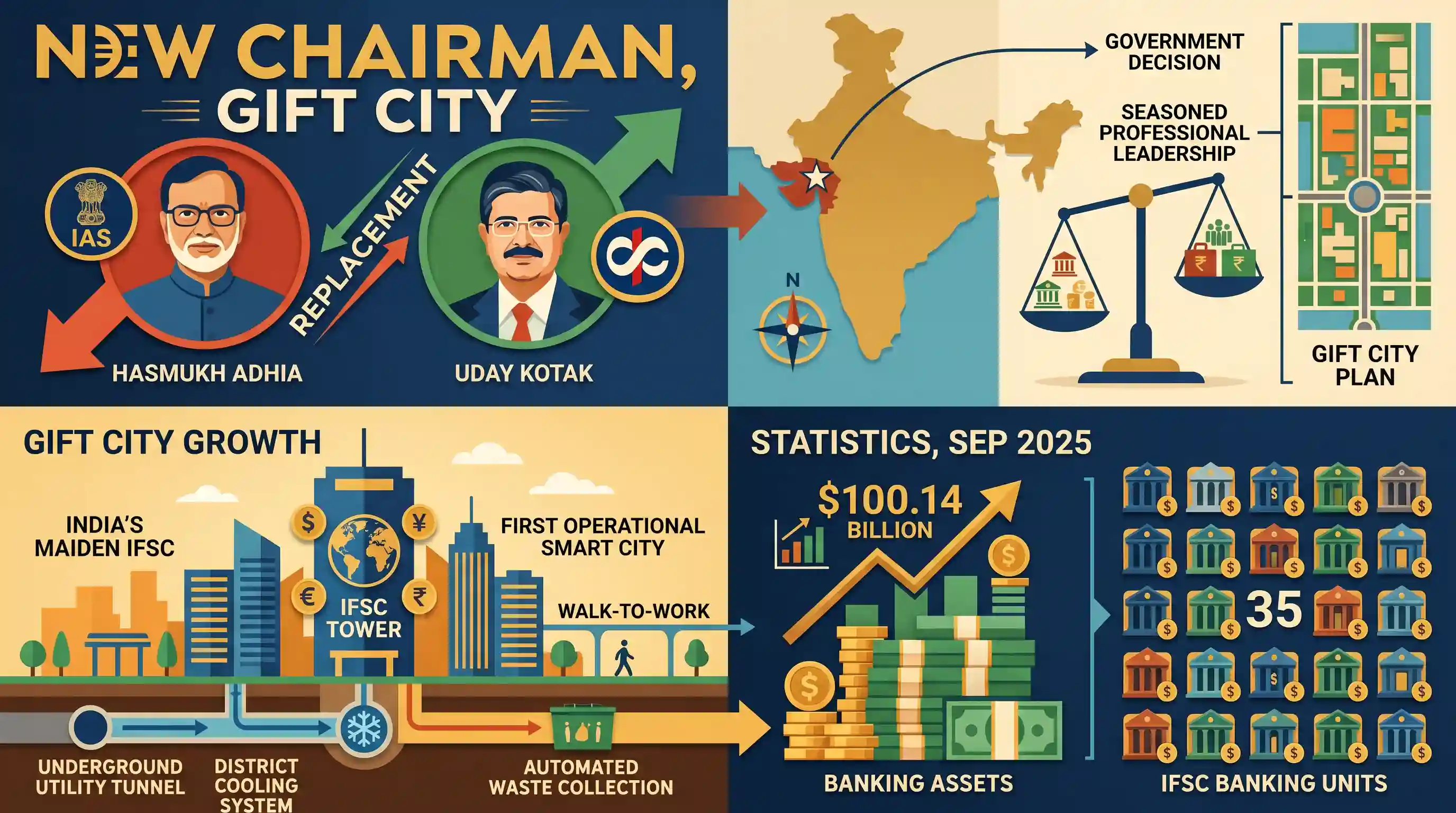
The Gujarat government has appointed Uday Kotak, the founder of Kotak Mahindra Bank, as the new Chairman of the Gujarat International Finance-Tec (GIFT) City, replacing Hasmukh Adhia. The decision aligns with the government's view that a seasoned industry professional is better equipped to lead India's maiden International Financial Services Centre (IFSC) and first operational smart city. GIFT City has seen significant growth, boasting banking assets of $100.14 billion and 35 operational IFSC Banking Units as of September 2025.
Key Points
- Uday Kotak, founder of Kotak Mahindra Bank, has been appointed as the new Chairman of GIFT City by the Gujarat government.
- Kotak replaces Hasmukh Adhia, as the government deemed an industry expert more suitable for the role.
- GIFT City holds the distinction of being India's first operational smart city and its maiden International Financial Services Centre (IFSC).
- As of September 2025, GIFT City's banking assets reached $100.14 billion, with cumulative banking transactions worth $142.98 billion.
- Currently, 35 IFSC Banking Units are operational within GIFT City.
Important Terms
International Financial Services Centre (IFSC)

A jurisdiction providing world-class financial services to non-residents and residents in foreign currencies, treated as a foreign territory for financial regulations to facilitate cross-border capital flows.
UPSC context
GS-III (Economy); tests knowledge of offshore hubs, capital flows, and India's integration with global financial markets.
Gujarat International Finance-Tec (GIFT) City
India’s first operational smart city and maiden IFSC, located in Gandhinagar, Gujarat. It functions as a vertical, multi-service Special Economic Zone (SEZ) for global financial and IT services.
UPSC context
GS-III (Economy/Infrastructure); relevant for smart urban planning, financial sector reforms, and special economic hubs.
International Financial Services Centres Authority (IFSCA)
The unified statutory regulator established in 2020 to develop and regulate financial products, services, and institutions within Indian IFSCs, replacing multiple domestic regulators like RBI and SEBI.
UPSC context
GS-III (Economy) and GS-II (Statutory Bodies); tests understanding of unified regulation and ease of doing business.
Smart Cities Mission
A Centrally Sponsored Scheme launched in 2015 to transform 100 cities by upgrading core infrastructure and improving quality of life through technology-driven "smart solutions."
UPSC context
GS-I (Urbanization) and GS-II (Policies); examines urban development models, digital governance, and infrastructure sustainability.
Special Economic Zone (SEZ)
A specifically delineated duty-free enclave treated as a foreign territory for trade operations, duties, and tariffs, aimed at promoting exports and attracting foreign investment.
UPSC context
GS-III (Economy/Industrial Policy); focuses on export-led growth, the SEZ Act 2005, and tax incentives.
IFSC Banking Units (IBUs)
Banking branches established within an IFSC that operate as offshore units, conducting transactions primarily in foreign currencies with non-residents and eligible resident entities.
UPSC context
GS-III (Banking Sector); relevant for the internationalization of Indian banking and specific offshore regulatory frameworks.
Prelims Trap
Regulators like RBI and SEBI individually govern the banking and capital market operations within the GIFT City IFSC.
IFSCA is a statutory unified regulator created in 2020 that absorbed the IFSC-related powers of RBI, SEBI, IRDAI, and PFRDA. Domestic regulators no longer govern IFSC units directly.
Static Concepts Connected
What are the core features of the International Financial Services Centres Authority (IFSCA)?
- Unified Regulator: It absorbed regulatory powers from RBI, SEBI, IRDAI, and PFRDA for all financial activities within the IFSC, avoiding regulatory overlap.
- Statutory Status: Created under the IFSCA Act, 2019, it functions as a legally backed, independent authority headquartered in GIFT City, Gandhinagar.
How does an IFSC function differently from domestic Indian financial markets?
- Foreign Currency Dealing: It primarily caters to customers outside the domestic economy's jurisdiction, facilitating cross-border finance in specified freely convertible foreign currencies, not INR.
- Deemed Foreign Territory: It operates as a non-resident zone under FEMA regulations, legally anchored by Section 18 of the Special Economic Zones (SEZ) Act, 2005.
- Tax Incentives: Units enjoy major incentives like a 100% income tax exemption for 10 consecutive years (out of a 15-year block) and zero Securities Transaction Tax (STT).
Cross-Topic Patterns
Onshoring offshore finance via SEZs
GIFT City counters capital flight by offering tax exemptions (like zero STT) historically sought in jurisdictions like Mauritius or Singapore, linking SEZ frameworks with India's external sector management.
Smart Cities merging with Financial Hubs
GIFT blends the urban infrastructure mandate of the Smart Cities Mission with the financial deregulation of an IFSC, representing a unique convergence of urban development and macroeconomics.

Expect a multi-statement Prelims question comparing IFSCA's unified regulatory powers against RBI/SEBI's domestic jurisdictions.
Linked PYQs · 2
Linked PYQs · 2
- 2016MainsGS3
What are 'Smart Cities'? Examine their relevance for urban development in India. Will it increase rural-urban differences? Give arguments for 'Smart Villages' in the light of PURA and RURBAN Mission.
- 2015MainsGS3
There is a clear acknowledgement that Special Economic Zones (SEZs) are a tool of industrial development, manufacturing and exports. Recognizing this potential, the whole instrumentality of SEZs requires augmentation. Discuss the issues plaguing the success of SEZs with respect to taxation, governing laws and administration.
