Global Deglobalisation Trends and Indian Macroeconomic Resilience
Source:Indian Express ↗
Why It Matters
The article provides critical insights into India's economic resilience in the face of geopolitical shocks. It connects global trends (deglobalisation, asset concentration) with domestic policy needs (current account prudence, creative destruction, and corporate ethics), offering strong fodder for GS3 (Economy) and GS2 (IR) answers.
Summary
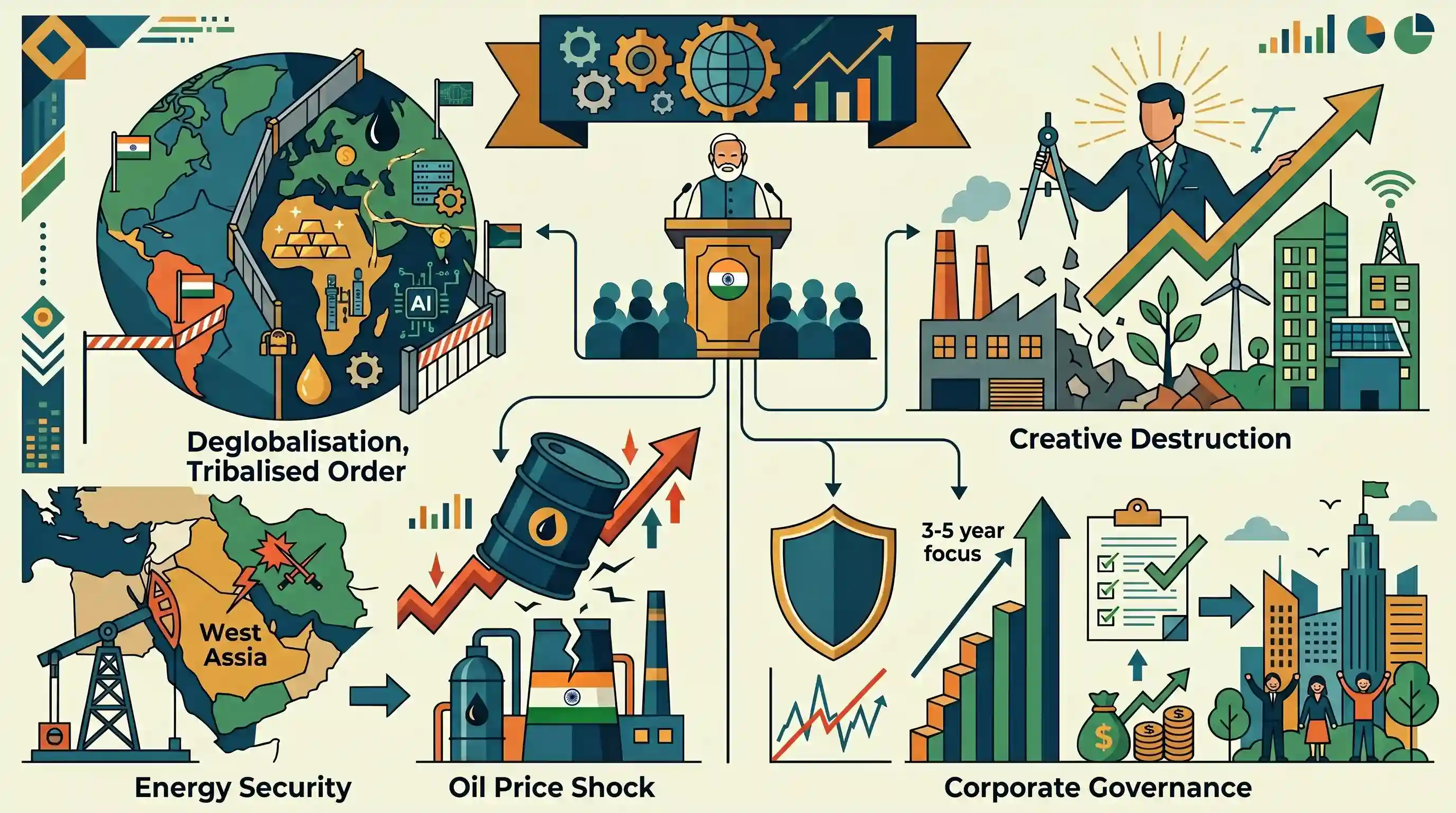
At the annual Confederation of Indian Industry (CII) summit, Uday Kotak cautioned that India must brace for a major oil price shock as domestic oil companies can no longer absorb the energy costs stemming from the US-Iran conflict in West Asia. He outlined a profound structural shift in geopolitics, noting that the world is moving away from globalization and reverting to a 'tribalized' order focused on territorial control and the concentration of tangible and intangible assets (like AI). To navigate this, Kotak advised the government to embrace "creative destruction" rather than perpetually protecting failing businesses. Furthermore, he challenged India Inc. to discard its short-term obsession with quarterly profits and stock prices, urging a strategic 3-5 year focus on building strong corporate balance sheets that contribute to the long-term economic betterment of the nation.
Key Points
- Uday Kotak warned of a significant impending 'oil price shock' for Indian consumers as the financial buffer provided by oil companies during the Middle East conflict wears thin.
- The global economy is structurally shifting away from globalization toward a 'tribalized' order resembling the pre-1945 era, focusing on territory, asset ownership, and monetization.
- Power is increasingly defined by the concentrated control of both tangible resources and intangible assets, such as Artificial Intelligence (AI).
- Kotak suggested that the government must allow for 'creative destruction' to let unviable businesses die naturally, framing it as a catalyst for future opportunity.
- He urged Corporate India to abandon its premature financialization and short-term focus on quarterly profits and ESOPs, advocating instead for a 3-to-5-year horizon aligned with national betterment.
Important Terms
Confederation of Indian Industry (CII)

A non-government, not-for-profit, industry-led organization founded in 1895 that serves as a bridge between the Indian government and the private sector for policy advocacy and economic growth.
UPSC context
GS Paper III: Indian Economy; relevant for understanding industry-government relations, Ease of Doing Business, and industrial policy formulation.
Creative Destruction
An economic concept, popularized by Joseph Schumpeter, where innovative products and processes incessantly replace outdated ones, driving long-term growth despite short-term disruptions to established firms.
UPSC context
GS Paper III: Economic Development; tests understanding of market dynamism, innovation-led growth, and the necessity of structural reforms.
Deglobalisation
The process of diminishing interdependence and integration between nations, characterized by rising protectionism, trade barriers, and a shift toward national self-sufficiency and regional 'tribalized' alliances.
UPSC context
GS Paper II & III: International Relations and Economy; critical for analyzing global trade shifts, supply chain resilience, and Atmanirbhar Bharat.
Energy Security
The uninterrupted availability of energy sources at an affordable price, particularly vulnerable in India due to nearly 90% dependence on crude oil imports and West Asian geopolitical shocks.
UPSC context
GS Paper III: Infrastructure and Energy; vital for evaluating India's strategic petroleum reserves and transition to renewable energy.
Corporate Governance
The system of rules and practices by which companies are directed, ensuring transparency, accountability, and ethical management to protect the interests of all stakeholders, not just short-term profits.
UPSC context
GS Paper III & IV: Economy and Ethics; relevant for studying business ethics, financial transparency, and corporate social responsibility (CSR).
Strait of Hormuz
A strategic chokepoint between the Persian Gulf and the Gulf of Oman through which approximately one-fifth of global oil and a large share of India's energy imports transit.
UPSC context
GS Paper I & II: Geography and International Relations; essential for understanding maritime trade routes and geopolitical vulnerabilities in West Asia.
Prelims Trap
Retail prices of petrol and diesel in India are determined by the government's Administered Pricing Mechanism (APM).
Retail petrol and diesel prices were deregulated in 2010 and 2014. They are linked to global crude, though Oil Marketing Companies (OMCs) sometimes informally absorb shocks.
Static Concepts Connected
What is the economic concept of 'Creative Destruction'?
- Origin: Coined by Joseph Schumpeter, it describes the process of industrial mutation that incessantly revolutionizes the economic structure from within.
- Mechanism: Old, inefficient industries and firms fail and are replaced by innovative, efficient ones, which drives long-term macroeconomic growth.
- Indian Context: The Insolvency and Bankruptcy Code (IBC) of 2016 is a prime policy tool enabling creative destruction by allowing unviable firms to exit efficiently.
How does a crude oil price shock impact India's macroeconomic indicators?
- Current Account Deficit: Widens the CAD as India imports over 80% of its crude oil requirements, significantly increasing the import bill.
- Inflation: Triggers cost-push inflation by raising transportation, logistics, and manufacturing production costs across virtually all sectors.
- Currency Depreciation: High dollar demand for oil imports depreciates the Rupee, which in turn worsens imported inflation.
Cross-Topic Patterns
Deglobalisation and India's 'Atmanirbhar' Push
The shift towards a 'tribalized' global order validates India's Atmanirbhar Bharat strategy, which seeks to reduce import dependence and build domestic supply chains amidst weaponized global inter-dependence.
AI compute as geopolitical strategic assets
The hoarding of AI models and compute power mirrors historical resource hoarding. The 'IndiaAI Mission' directly addresses this shift by investing in sovereign compute capabilities.

Expect a GS3 Mains question linking 'creative destruction' via the IBC framework to India's macroeconomic resilience against global shocks.
Linked PYQs · 4
Linked PYQs · 4
- 2025MainsGS2
"With the waning of globalization, post-Cold War world is becoming a site of sovereign nationalism.” Elucidate.
- 2018MainsGS3
How would the recent phenomena of protectionism and currency manipulations in world trade affect macroeconomic stability of India?
- 2022MainsGS4
In contemporary world, corporate sector's contribution in generating wealth and employment is increasing. In doing so, they are bringing in unprecedented onslaught on the climate, environmental sustainability and living conditions of human beings. In this background, do you find that Corporate Social Responsibility (CSR) is efficient and sufficient enough to fulfill the social roles and responsibilities needed in the corporate world for which the CSR is mandated? Critically examine.
- 2018MainsGS3
“Access to affordable, reliable, sustainable and modern energy is the sine qua non to achieve Sustainable Development Goals (SDGs).” Comment on the progress made in India in this regard.
