Udaipur Police Artificial Intelligence Tourist Helpline
Source:times-of-india ↗
Why It Matters
This is the first district-level policing initiative in Rajasthan to leverage AI-powered WhatsApp chatbots for tourist safety and convenience, highlighting an important intersection of IT, governance, and tourism economic management in the state.
Summary
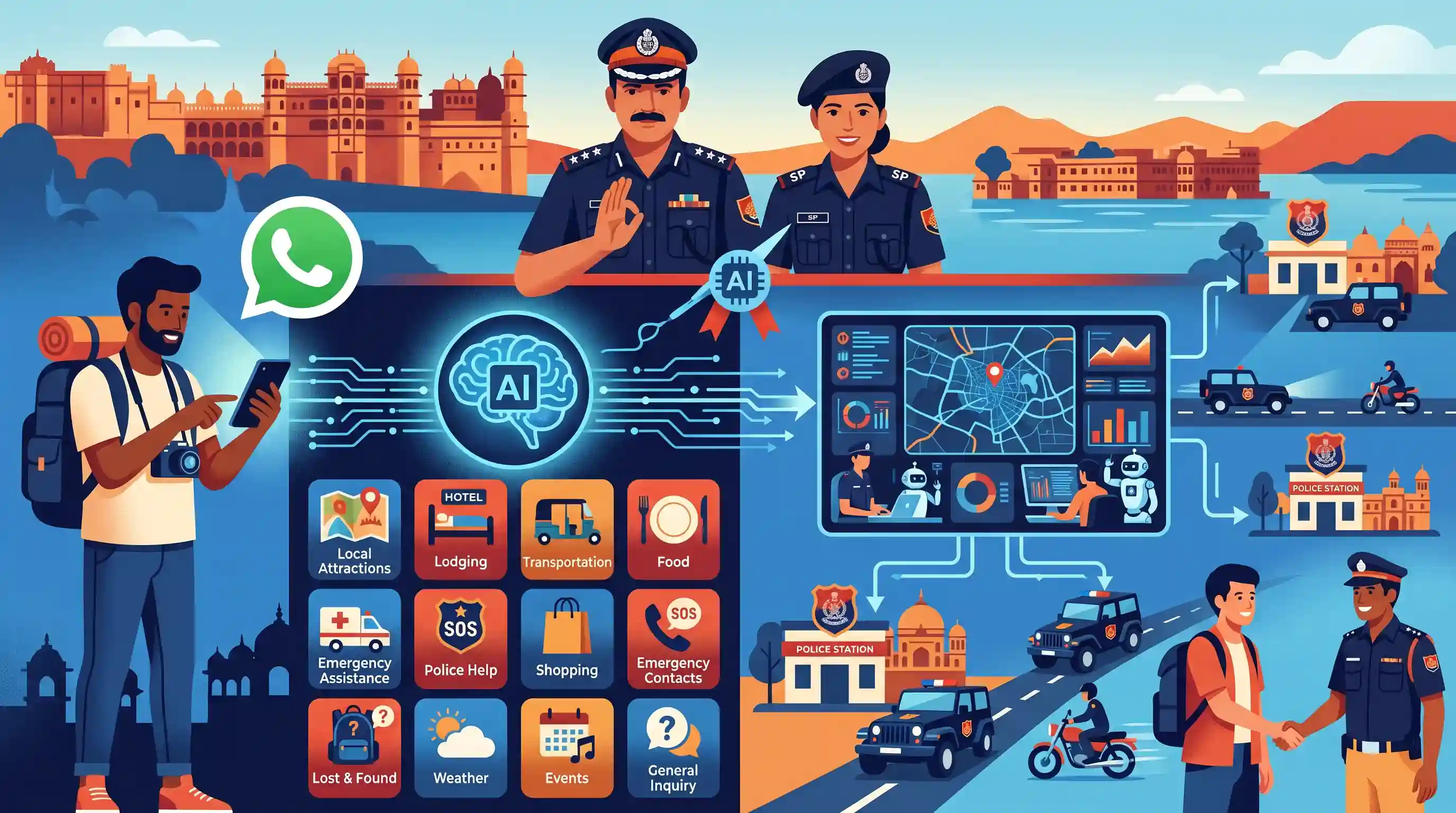
The Udaipur Police has introduced Rajasthan's first AI-based WhatsApp chatbot helpline (7300059984) to bolster tourist convenience and safety in the city. Launched by Udaipur Range IG Gaurav Shrivastava and SP Amrita Duhan, the digital service categorizes tourist needs into 12 segments—ranging from general guidance on local attractions and lodging to emergency assistance. Crucially, the system links directly to a centralized control room dashboard, ensuring that complaints are instantly routed to relevant local police stations, demonstrating an innovative integration of artificial intelligence in smart policing and state tourism management.
Key Points
- Udaipur Police has launched Rajasthan's first AI-based WhatsApp chatbot helpline (7300059984) dedicated to assisting tourists.
- The AI chatbot was inaugurated by Udaipur Range IG Gaurav Shrivastava and Superintendent of Police (SP) Amrita Duhan.
- The helpline offers automated information across 12 pre-determined categories, including tourist attractions, hotels, hospitals, and police details.
- In case of an emergency or complaint, the chatbot immediately relays the information to a dashboard in the Udaipur Police Control Room, which then routes it to the concerned police station for swift intervention.
- This is a pioneer smart-policing initiative aimed at safeguarding national and international visitors in Udaipur, a major global tourist destination in Rajasthan.
Important Terms
Smart Policing

A strategic administrative framework focused on systemic police modernization through technology (AI, data analytics), enhanced accountability, mobility, and community-oriented services to improve law enforcement's responsiveness and public trust.
UPSC context
GS Paper III (Internal Security). Tests knowledge of police modernization, security administration reforms, and application of technology in crime prevention.
E-governance
The application of Information and Communication Technology (ICT) by government agencies to deliver public services, enhance transparency, improve operational efficiency, and empower civic participation in public administration.
UPSC context
GS Paper II (Governance). Evaluates understanding of digital service delivery models, transparency, and administrative reforms in modern public governance.
Rajasthan Tourism Department
The administrative body established in 1956 to systematically develop, promote, and regulate Rajasthan's tourism industry, which contributes significantly to the state's economy and preservation of cultural heritage.
UPSC context
GS Paper III (Infrastructure & Economy). Tests understanding of tourism policies, regional development models, and economic contributions of service sectors.
Rajasthan Police
The law enforcement agency responsible for maintaining public order, border security, and crime prevention across Rajasthan, operating under the state's Home Department with a commitment to public service.
UPSC context
GS Paper III (Internal Security). Examines state police structure, public safety, and state-level challenges in policing and federal jurisdiction.
Udaipur Police
A district-level division of the Rajasthan Police responsible for maintaining law and order, tourist safety, and administering localized crime control and modern e-policing platforms in Udaipur.
UPSC context
GS Paper II & III. Analyzes district-level administration, execution of modern e-governance policies, and grassroots citizen-safety initiatives.
Prelims Trap
The Tourist Police force of Rajasthan was first established under the provisions of the Rajasthan Tourism Trade (Facilitation and Regulation) Act, 2010.
The dedicated Tourist Police force was deployed in Rajasthan in 2000, a full decade before the enacting of the 2010 Tourism Trade Act, which instead formalized the legal Tourist Assistance Force.
Static Concepts Connected
What is the national 'SMART Policing' framework?
- Origin and Goal: Introduced by the Prime Minister during the 2014 Conference of DGPs to reform the working culture of Indian police forces.
- SMART Acronym: Stands for Strict but Sensitive; Modern and Mobile; Alert and Accountable; Reliable and Responsive; Techno-savvy and Trained.
- Technological Pillar: Emphasizes the deployment of modern ICT, GIS mapping, AI tools, and cyber-crime monitoring alongside human resource upskilling.
What are the implications of granting 'Industry Status' to Tourism?
- Pioneering Milestone: Rajasthan was the first Indian state to accord 'industry status' to tourism on March 4, 1989, based on the Mohammad Yunus Committee recommendations.
- Key Benefits: Allows tourism units to access industrial tariffs for electricity and water, enjoy lower land tax rates, and secure simplified institutional credit.
- Structural Impact: Aids states in transitioning from unorganized hospitality setups to highly standardized, regulated, and foreign-direct-investment-friendly sectors.
Cross-Topic Patterns
E-Governance + Internal Security Reforms
Leveraging AI conversational agents shifts police departments from reactive enforcement to service-oriented units, bridging the trust gap between citizens and state internal security apparatuses.
AI Integration + Services Sector Regulation
Automated digital helpdesks mitigate information asymmetry in regional tourism, protecting the local hospitality economy from predatory pricing and unlicensed intermediaries.

State-level e-governance innovations in tourist safety are likely to be evaluated under the mains lens of 'SMART' policing reforms.
Linked PYQs · 2
Linked PYQs · 2
- 2018RPSC_PRELIMSGS1
Which of the following is NOT a unique selling proposition (USP) in Rajasthan's tourism sector?
- 2016RPSC_PRELIMSGS1
The phrase included in the 'logo' of the Rajasthan Tourism is:
