Delhi High Court Stays Film Release Amid Public Order Concerns
Source:Indian Express ↗
Why It Matters
The controversy surrounding film releases based on sensitive sociopolitical events is a core Constitutional Law issue for UPSC. It tests the application of Article 19 (Freedom of Speech and Expression), the concept of 'reasonable restrictions' (Article 19(2)), and the differential treatment of cinema compared to other mediums of expression.
Summary
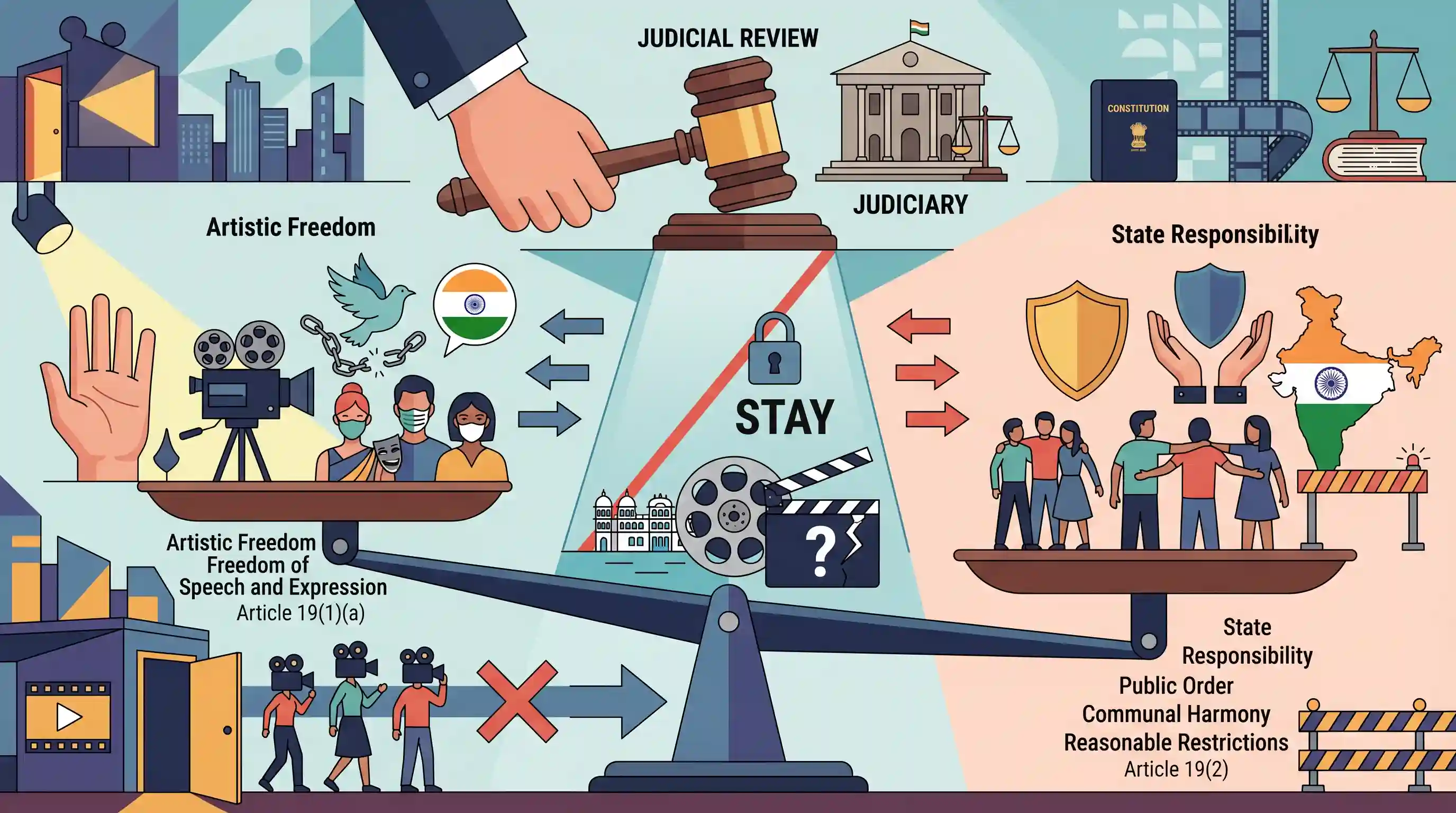
The Delhi High Court has temporarily stayed the release of the film 'Udaipur Files'. This judicial intervention brings into focus the recurring debate over artistic freedom of expression under Article 19(1)(a) of the Indian Constitution versus the state's responsibility to maintain public order and communal harmony through reasonable restrictions.
Key Points
- The Delhi High Court has issued a temporary stay on the release of the film 'Udaipur Files'.
- The film's release faces legal scrutiny, raising questions on the balance between artistic freedom of expression and the potential threat to public order or communal harmony.
- Judicial interventions in film releases highlight the constitutional framework of 'reasonable restrictions' under Article 19(2) on the freedom of speech and expression.
Important Terms
Article 19(1)(a)

Constitutional provision guaranteeing citizens the right to express thoughts, opinions, and beliefs freely through speech, writing, printing, or visual media.
UPSC context
GS Paper II: Fundamental Rights. Tests the understanding of democratic liberties and judicial protection of free expression.
Reasonable Restrictions
Provisions under Article 19(2) allowing the State to legally limit free speech for specific grounds like sovereignty, national security, or communal harmony.
UPSC context
GS Paper II: Fundamental Rights. Evaluates the balance between individual freedom and the State's duty to maintain order.
Cinematograph Act
Primary legislation (1952, amended 2023) governing film certification, exhibition, and piracy in India; it establishes the Central Board of Film Certification (CBFC).
UPSC context
GS Paper II: Statutory Bodies and Laws. Focuses on the regulatory framework for media and artistic censorship.
Public Order
A constitutional ground under Article 19(2) enabling the government to restrict rights to prevent riots, violence, or general communal disharmony.
UPSC context
GS Paper II/III: Governance and Internal Security. Tests the state's role in preserving tranquility versus individual rights.
Judicial Review
The judiciary's power to examine the legality and constitutionality of legislative or executive acts, including decisions on film bans or certifications.
UPSC context
GS Paper II: Judiciary. Fundamental for understanding checks and balances and the separation of powers.
Central Board of Film Certification (CBFC)
The statutory body under the Ministry of Information and Broadcasting responsible for certifying films for public exhibition in India.
UPSC context
GS Paper II: Regulatory Bodies. Tests knowledge of institutional mechanisms governing media content.
Prelims Trap
Pre-censorship of cinematic films in India is unconstitutional and violates Article 19(1)(a).
Pre-censorship of films is valid. In K.A. Abbas v. UoI (1970), the Supreme Court upheld it due to the unique mass impact of cinema, classifying it under Article 19(2) restrictions.
Static Concepts Connected
What are the explicit grounds for restricting Freedom of Speech under Article 19(2)?
- State Security: Sovereignty and integrity of India, and the security of the State.
- Public Order & Morals: Public order, decency, or morality.
- Other Grounds: Friendly relations with foreign states, contempt of court, defamation, and incitement to an offence.
How does film censorship differ from press freedom under Indian constitutional law?
- Press Freedom: Pre-censorship of the press is generally unconstitutional (established in Brij Bhushan case), as it stifles democratic expression.
- Film Censorship: Pre-censorship (CBFC certification) is constitutionally valid due to the powerful audiovisual impact of cinema on the public mind.
Cross-Topic Patterns
OTT regulation vs Cinematograph Act
While films undergo pre-censorship by the statutory CBFC, OTT platforms are regulated through a soft-touch, three-tier grievance redressal mechanism under the Information Technology Rules, 2021.
Hate Speech and Public Order machinery
Judicial stays on films to protect public order overlap with recent Supreme Court directives requiring preemptive police action against hate speech to maintain communal harmony.

Expect a multi-statement question contrasting pre-censorship validity between print media (unconstitutional) and cinematic films (valid).
Linked PYQs · 1
Linked PYQs · 1
- 2014MainsGS2
What do you understand by the concept "freedom of speech and expression"? Does it cover hate speech also ? Why do the films in India stand on a slightly different plane from other forms of expression ? Discuss.
