UCIL Strategy to Double Domestic Uranium Output for Nuclear Security
Source:The Hindu ↗
Why It Matters
Understanding domestic uranium production bottlenecks and technological innovations like extracting minerals from industrial tailings is vital for India's energy security and clean energy goals under GS3.
Summary
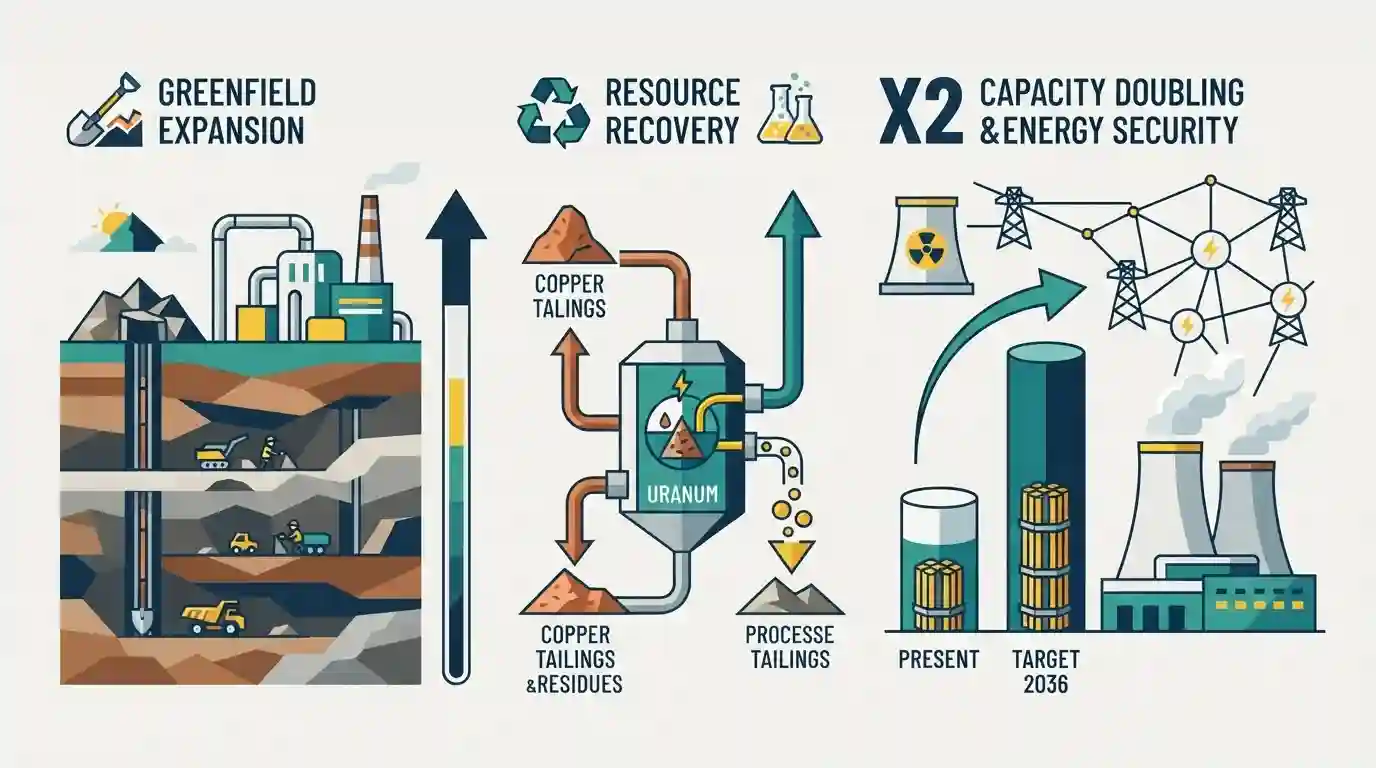
Uranium Corporation of India Limited (UCIL) is pursuing an aggressive expansion strategy via greenfield mines and recovering uranium from copper residues to double its uranium production capacity by 2036, supporting India's nuclear energy roadmap.
Key Points
- Uranium Corporation of India Limited (UCIL) aims to double its domestic uranium output by 2036.
- Strategy involves opening new greenfield mines and extracting uranium residue from copper tailings.
- Crucial for augmenting India's domestic fuel cycle to support nuclear energy expansion and clean energy transition.
- Addresses supply bottlenecks in indigenous uranium sourcing for the first stage of India's nuclear power programme.
Important Terms
Uranium Corporation of India Limited (UCIL)

A public sector enterprise under the Department of Atomic Energy responsible for uranium mining and processing in India, playing a critical role in supplying fuel for the nation's nuclear power plants.
UPSC context
GS Paper III (Energy Security & Mineral Resources): Tests understanding of public sector undertakings in strategic minerals and atomic energy supply chains.
India's Three-Stage Nuclear Power Programme
India's long-term nuclear strategy conceived by Homi Bhabha to utilize limited domestic uranium and vast thorium reserves through a closed fuel cycle involving PHWRs, FBRs, and thorium reactors.
UPSC context
GS Paper III (Nuclear Energy & Science and Technology): Core topic testing India's energy roadmap, technology stages, and resource security.
Department of Atomic Energy (DAE)
A central government department under the direct charge of the Prime Minister, responsible for research, development, and operational oversight of nuclear power and atomic energy applications in India.
UPSC context
GS Paper II / III (Governance & Science and Technology): Important for institutional frameworks governing India's strategic nuclear and space programs.
Atomic Minerals Directorate for Exploration and Research (AMD)
A constituent unit of the DAE tasked with the survey, exploration, and discovery of atomic minerals like uranium, thorium, and rare earth elements across India.
UPSC context
GS Paper III (Mineral Resources): Tests knowledge of agencies involved in prospecting critical raw materials for India's energy transition.
Static Concepts Connected
What are the key institutional bodies and mechanisms governing India's atomic energy and uranium sector?
- UCIL Mandate: UCIL is a Central PSU under the Department of Atomic Energy (DAE), solely responsible for uranium mining and processing in India.
- AMD Role: AMD (Atomic Minerals Directorate for Exploration and Research) is tasked with identifying and prospecting uranium and thorium reserves nationwide.
- AEC Policy: AEC (Atomic Energy Commission) formulates policies for nuclear power development under direct charge of the Prime Minister's Office.
Cross-Topic Patterns
Uranium mining + IAEA Safeguards & Energy Security
Domestic uranium extraction bottlenecks directly impact India's clean energy targets and adherence to IAEA safeguards for imported civil nuclear fuel.
Circular economy + Mineral conservation & Mining laws
Extracting valuable minerals from industrial waste (copper tailings) bridges the mining sector with circular economy mandates.

UCIL's monopoly status, DAE administrative control, and geographic diversification (Rajasthan/Rohil) make it prime for a statement-based prelims question.
Linked PYQs · 2
Linked PYQs · 2
- 2025MainsGS3
The fusion energy programme in India has steadily evolved over the past few decades. Mention India's contributions to the international fusion energy project International Thermonuclear Experimental Reactor (ITER). What will be the implications of the success of this project for the future of global energy?
- 2020PrelimsGS1
In India, why are some nuclear reactors kept under "IAEA Safeguards" while others are not?
