Uttarakhand Uniform Civil Code Implementation and State Outreach
Source:aninews ↗
Why It Matters
Uttarakhand's pioneering role in enacting the Uniform Civil Code (UCC) represents a landmark legal and constitutional development under Article 44 of the Directive Principles of State Policy. Understanding the federal scope of state-level personal law reforms, the mechanics of UCC implementation, and the balance of personal laws with uniform civil rights is a crucial area of enquiry for civil services aspirants, especially in UKPSC.
Summary
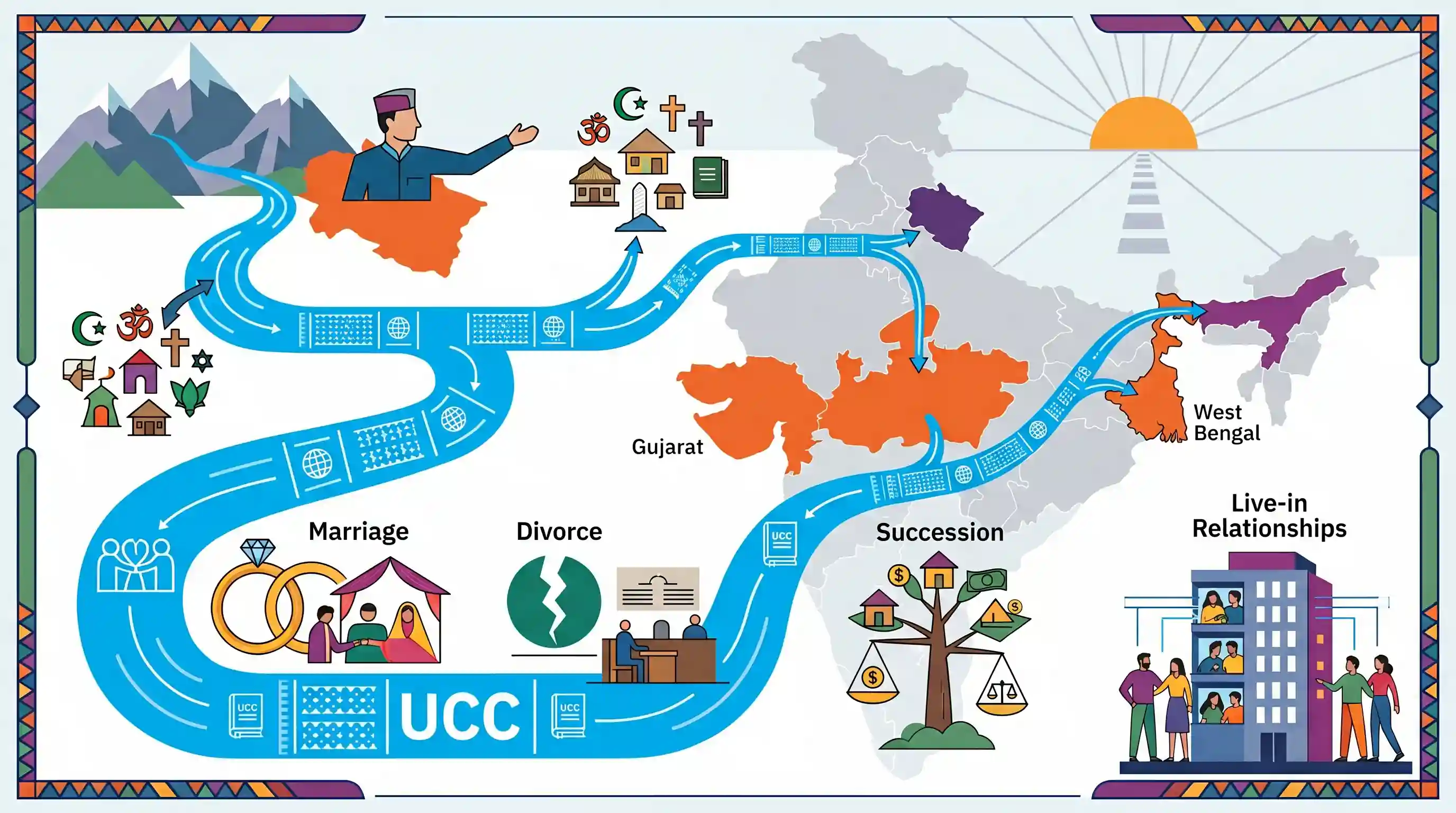
Uttarakhand CM Pushkar Singh Dhami commended the growing national momentum toward implementing the Uniform Civil Code (UCC), describing Uttarakhand's legislation as the 'Gangotri of UCC' [1.1]. He noted that states like Madhya Pradesh (which has requested Uttarakhand's draft), Gujarat, Assam, and West Bengal (where Leader of the Opposition Suvendu Adhikari announced plans) are looking to replicate this legal model [1.1]. The UCC aims to create a standardized legal framework for marriage, divorce, succession, and live-in relationships across all religious groups [1.1].
Key Points
- Uttarakhand Chief Minister Pushkar Singh Dhami highlighted Uttarakhand as the pioneering state or the 'Gangotri' of the Uniform Civil Code (UCC) in India, which is now inspiring other states to adopt similar frameworks [1.1].
- Madhya Pradesh has officially requested the UCC draft from Uttarakhand to work towards its own legal framework [1.1].
- Other states, including Gujarat, Assam, and West Bengal (as declared by West Bengal BJP leader Suvendu Adhikari), are actively discussing and moving towards UCC implementation through similar procedures [1.1].
- The Uniform Civil Code aims to establish a uniform, common civil legal framework governing critical matters such as marriage, divorce, succession, and live-in relationships, irrespective of religious affiliations [1.1].
- CM Dhami clarified that UCC is not intended to target any specific community but is designed to establish equality and justice for all, aligning with frameworks observed globally [1.1].
Important Terms
Uniform Civil Code (UCC)

A proposed common set of civil laws governing personal matters such as marriage, divorce, inheritance, and adoption for all citizens, irrespective of their religion.
UPSC context
GS Paper II (Polity & Constitution); tests understanding of secularism, gender justice, and equality.
Article 44 of the Indian Constitution
A Directive Principle under Part IV of the Indian Constitution directing the State to endeavour to secure a Uniform Civil Code for all citizens.
UPSC context
GS Paper II (Indian Polity); tests knowledge of Directive Principles of State Policy and constitutional objectives.
Directive Principles of State Policy (DPSP)
Non-justiciable guidelines in Part IV (Articles 36-51) of the Indian Constitution that guide the state in enacting laws to establish social and economic democracy.
UPSC context
GS Paper II (Indian Polity); tests understanding of constitutional ideals, welfare state concepts, and fundamental governance.
Personal Laws
Laws governing marriage, divorce, maintenance, inheritance, and adoption, which are typically based on religious texts, customs, and community-specific traditions.
UPSC context
GS Paper II (Polity/Social Justice); tests understanding of pluralism, religious freedom, and legal reform.
Uttarakhand Government
The executive and legislative authority of the state of Uttarakhand, which enacted India's first post-Independence Uniform Civil Code under Entry 5 of the Concurrent List.
UPSC context
GS Paper II (Federalism); tests concepts of state legislative power, concurrent list subjects, and center-state dynamics.
Bharatiya Janata Party (BJP)
A major national political party in India that has historically advocated for and initiated the implementation of a Uniform Civil Code as a core policy agenda.
UPSC context
GS Paper II (Polity & Governance); tests political party dynamics, ideology, and legislative policy agendas.
Prelims Trap
Goa was the first post-independence Indian state to draft and legislate its own Uniform Civil Code.
Goa did not legislate its own UCC post-independence; it simply retained the 1867 Portuguese Civil Code. Uttarakhand is the first post-independence state to actually draft and pass its own UCC legislation. Additionally, Uttarakhand's UCC explicitly exempts Scheduled Tribes.
Static Concepts Connected
How is the Uniform Civil Code governed by Article 44 and the Concurrent List?
- DPSP Mandate: Article 44 directs the State to secure a UCC. Under Article 37, DPSPs are non-justiciable but fundamental to governance.
- Concurrent List: Marriage, divorce, and succession fall under Entry 5 of List III, granting both Parliament and State Assemblies authority to legislate.
What landmark Supreme Court cases have shaped the judicial position on UCC?
- Shah Bano (1985): The Supreme Court noted that a UCC would facilitate national integration and eliminate contradictory personal laws.
- Sarla Mudgal (1995): The Court urged the Union to secure a UCC to prevent fraudulent conversions used to bypass bigamy laws.
Cross-Topic Patterns
Concurrent List & Fragmented Federalism
States passing independent UCCs highlights concurrent legislative friction, potentially creating a patchwork of state-level 'uniform' codes rather than a single national framework.
Tribal Autonomy & Assimilation
Exempting Scheduled Tribes from state UCCs underlines the constitutional tension between Article 44's uniformity and the customary rights protected under Article 371 and the Fifth Schedule.

UCC questions in 2026 will likely test the concurrent legislative powers of states, tribal exemptions, and the historical Goa vs. Uttarakhand legal distinction.
Linked PYQs · 1
Linked PYQs · 1
- 2024UKPSC_PRELIMSGS1
Regarding the Directive Principles of State Policy, which one of the following statements is not correct ?
