Madhya Pradesh Assembly Passes Uniform Civil Code Bill
Source:dailypioneer ↗
Why It Matters
The passage of a state-level Uniform Civil Code touches upon constitutional debates regarding Article 44 (DPSP) and personal laws, which is a high-priority topic for polity and governance sections. It also marks a significant milestone in Madhya Pradesh's state legislative current affairs.
Summary
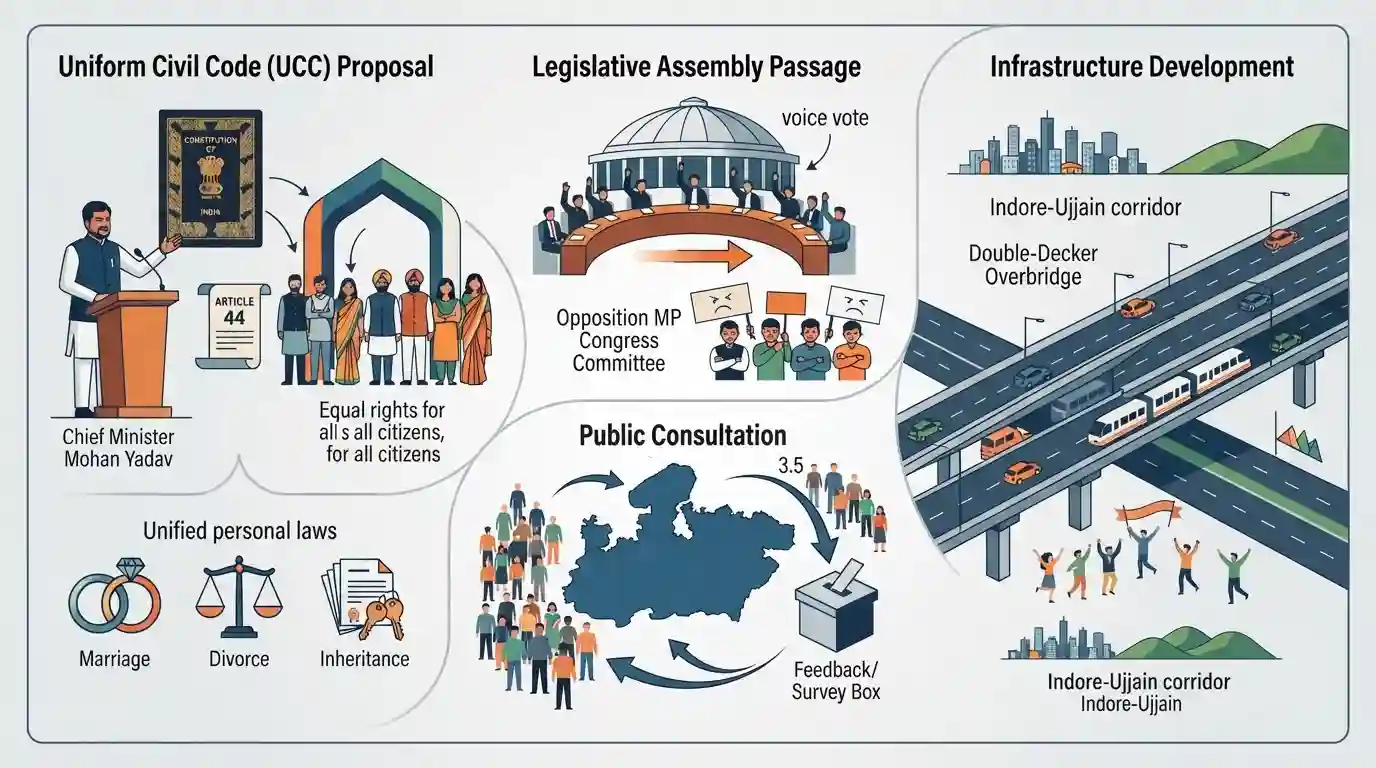
Madhya Pradesh Chief Minister Mohan Yadav announced that the newly proposed Uniform Civil Code (UCC) will safeguard the rights of all citizens regardless of their religion. The Madhya Pradesh Legislative Assembly passed the MP Uniform Civil Code Bill, 2026 by a voice vote on July 21, 2026, making MP part of a select group of states enacting a common civil framework. Despite protests from the MP Congress Committee, the CM highlighted that the bill was shaped by extensive public consultation involving 3.5 crore people. The UCC introduces unified laws on personal matters like marriage, divorce, and inheritance. Additionally, CM Yadav inaugurated a new double-decker overbridge on the Indore-Ujjain road to boost local infrastructure.
Key Points
- The Madhya Pradesh Legislative Assembly passed the MP Uniform Civil Code Bill, 2026 on July 21, 2026, through a voice vote despite opposition protests.
- Chief Minister Mohan Yadav asserted that the UCC will protect the rights of all citizens, introducing uniform laws for marriage, divorce, and inheritance across religions.
- The drafting of the bill involved extensive public consultation, reaching over 3.5 crore people in MP and receiving around 10 lakh suggestions over two months.
- In a secondary development, the CM inaugurated a double-decker overbridge at Lav Kush Square on the Indore-Ujjain road to enhance regional infrastructure.
Important Terms
MP Uniform Civil Code Bill, 2026

A state bill passed on July 21, 2026, implementing common personal laws on marriage, divorce, inheritance, and live-in relationships, while exempting tribal communities.
UPSC context
GS Paper II: Governance. Tests federal dynamics, state-level social reforms, and standardizing personal laws.
Uniform Civil Code (UCC)
A proposed common set of civil laws governing personal matters like marriage, divorce, succession, and adoption for all citizens, irrespective of their religion.
UPSC context
GS Paper II: Indian Constitution. Tests understanding of secularism, gender justice, and balancing individual rights with religious freedom.
Article 44 of the Indian Constitution
A directive under the Constitution of India mandate that the State shall endeavour to secure a Uniform Civil Code for all citizens throughout India.
UPSC context
GS Paper II: Constitutional Provisions. Key area for prelims/mains on Directive Principles of State Policy.
Madhya Pradesh Legislative Assembly
The unicameral state legislature of Madhya Pradesh, responsible for debating, scrutinizing, and enacting state-level laws, comprising elected representatives.
UPSC context
GS Paper II: State Legislature. Tests knowledge of the structure, powers, and legislative functioning of state assemblies.
Select Committee
An ad hoc legislative committee constituted for a specific duration to scrutinize and review the clauses of a particular bill in detail.
UPSC context
GS Paper II: Parliament & State Legislatures. Tests understanding of committee systems and detailed legislative scrutiny.
Voice Vote
A quick legislative voting method where members respond orally with "Aye" or "No", and the presiding officer decides the outcome based on vocal volume.
UPSC context
GS Paper II: Parliamentary Procedures. Important for questions on legislative voting mechanisms and procedural accountability.
Prelims Trap
Because Article 44 mandates a common code throughout India, only the Union Parliament has the legislative competence to enact a UCC.
Marriage, succession, and personal laws fall under Entry 5 of the Concurrent List, giving states concurrent power to legislate, subject to Presidential assent under Article 254(2) if they conflict with Union laws.
Static Concepts Connected
What is the constitutional framework governing a state-enacted Uniform Civil Code?
- Article 44 DPSP: Under Article 44 (DPSP), the State is directed to secure a common civil code for all citizens.
- Concurrent Jurisdiction: Personal laws (marriage, divorce, inheritance) fall under Entry 5 of the Concurrent List (List III, Seventh Schedule), giving both Parliament and States legislative powers.
- Presidential Assent: Under Article 254(2), a state law on a Concurrent subject that conflicts with a Central law requires Presidential assent to be valid in that state.
How does the Constitution protect traditional customs from uniform personal laws?
- Article 371 Special Provisions: Articles 371A (Nagaland) and 371G (Mizoram) protect tribal social and religious practices from central/state laws unless approved by their state assemblies.
- Sixth Schedule Autonomy: Paragraph 3 of the Sixth Schedule gives Autonomous District Councils the power to make laws on marriage, inheritance, and social customs, shielding them from uniform codes.
Cross-Topic Patterns
Federalism vs. Legal Uniformity
State-level UCCs create a patchwork of civil laws, testing the balance between localized state legislative powers under the Concurrent List and the constitutional ideal of national uniformity.
Tribal Autonomy vs. Article 44
Exempting Scheduled Tribes from state UCCs highlights the deep-seated tension between Article 44 (UCC) and Fifth/Sixth Schedule protections safeguarding tribal customary laws.

Questions will likely test state legislative competence under Entry 5 of Concurrent List vs Presidential assent requirements under Article 254.
Linked PYQs · 2
Linked PYQs · 2
- 2023MPPSC_PRELIMSGS1
The Directive Principles of State Policy are explained in Part IV of the Indian Constitution. This system has been taken from the Constitution of which country ?
- 2024MPPSC_PRELIMSGS1
In which district of Madhya Pradesh was the production of soybean initially started?
