Executive Timelines and State Consultations for Uniform Civil Code
Source:Indian Express ↗
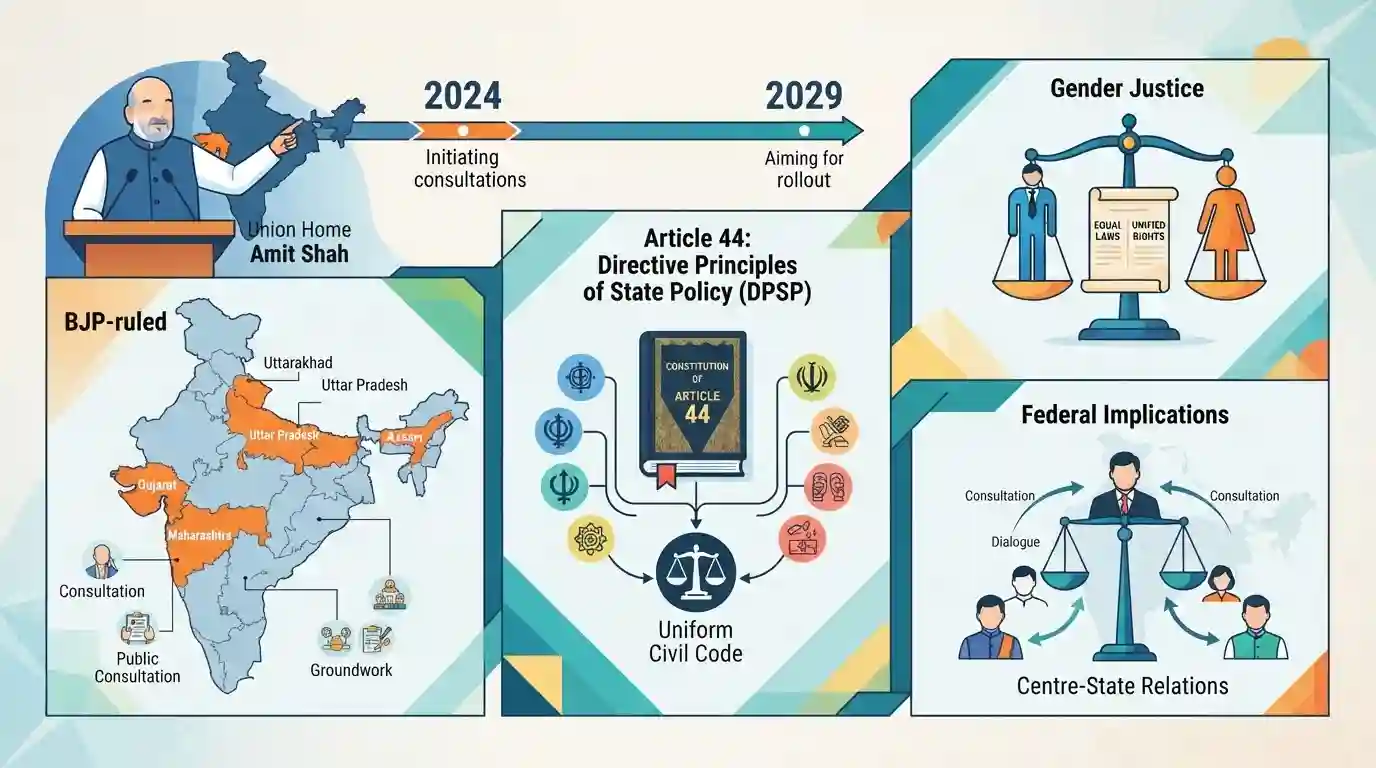
Why It Matters
It highlights executive initiatives and state-level actions toward fulfilling the constitutional mandate under Article 44 (UCC), raising critical questions about federal polity, secularism, and gender equality in India.
Summary
Union Home Minister Amit Shah has outlined a timeline aiming for the rollout of the Uniform Civil Code (UCC) across BJP-ruled states by 2029, with states like Maharashtra initiating consultations and groundwork. The move brings back focus to Article 44 of the DPSP, gender justice, and federal implications.
Key Points
- Union Home Minister Amit Shah has set a deadline for BJP-ruled states to implement the Uniform Civil Code (UCC) by 2029.
- Consultations and groundwork for the UCC rollout are actively progressing in states like Maharashtra.
- UCC falls under Article 44 of the Directive Principles of State Policy (DPSP), aiming to secure a uniform civil code for citizens throughout the territory of India.
- The implementation faces intense debate regarding federalism, minority rights, and cultural diversity in a pluralistic society.
Important Terms
Uniform Civil Code (UCC)

A proposal to formulate and implement personal laws that apply equally to all citizens of India irrespective of their religion, covering areas like marriage, divorce, inheritance, and adoption.
UPSC context
GS Paper II (Polity and Constitution) - Tests understanding of fundamental rights, secularism, gender justice, and federalism.
Article 44 of the Constitution
A Directive Principle of State Policy (Part IV) which states that the State shall endeavour to secure for the citizens a Uniform Civil Code throughout the territory of India.
UPSC context
GS Paper II (Indian Constitution and Polity) - Tests understanding of non-justiciable directive principles and state policy formulation.
Prelims Trap
UCC is a justiciable fundamental right enforceable by the Supreme Court under Article 32, and personal laws fall exclusively under the Union List.
Aspirants often assume Article 44 is a Fundamental Right or that the Union Parliament alone possesses exclusive legislative competence over personal laws.
Static Concepts Connected
What is the constitutional and legislative status of the Uniform Civil Code (UCC) in India?
- Article 44: Directive Principle: Enshrined in Article 44 of the DPSP, stating the State shall endeavor to secure a UCC throughout India's territory.
- Non-justiciable: Non-justiciable: DPSPs are legally non-enforceable by courts, but represent moral and political guidelines for governance.
- Concurrent List: Legislative Jurisdiction: Marriage, divorce, adoption, and succession fall under the Concurrent List (List III, Entry 5) of the Seventh Schedule.
Cross-Topic Patterns
UCC Rollout vs. Cooperative Federalism
UCC implementation by states tests the boundaries of concurrent list legislation and executive federalism in India's pluralistic democracy.
DPSP Enforceability vs. Fundamental Rights
Article 44 sits in the DPSP, creating a fascinating tension with fundamental rights relating to freedom of religion (Article 25) and cultural rights (Article 29).

UCC state rollouts + Article 44 + Concurrent List distribution of legislative powers likely to be tested in a multi-statement prelims question.
Linked PYQs · 2
Linked PYQs · 2
- 2015MainsGS2
Discuss the possible factors that inhibit India from enacting for its citizens a uniform civil code as provided for in the Directive Principles of State Policy.
- 2023MainsGS2
Explain the constitutional perspectives of Gender Justice with the help of relevant Constitutional Provisions and case laws.
