Uniform Civil Code Rollout Deadlines and State Consultations
Source:Indian Express ↗
Why It Matters
The implementation of the Uniform Civil Code (UCC) touches upon foundational constitutional principles such as secularism, federalism, gender justice, and the scope of Directive Principles of State Policy (Article 44). Tracking state-level rollouts and deadlines provides key insights into executive policy priorities and centre-state dynamics.
Summary
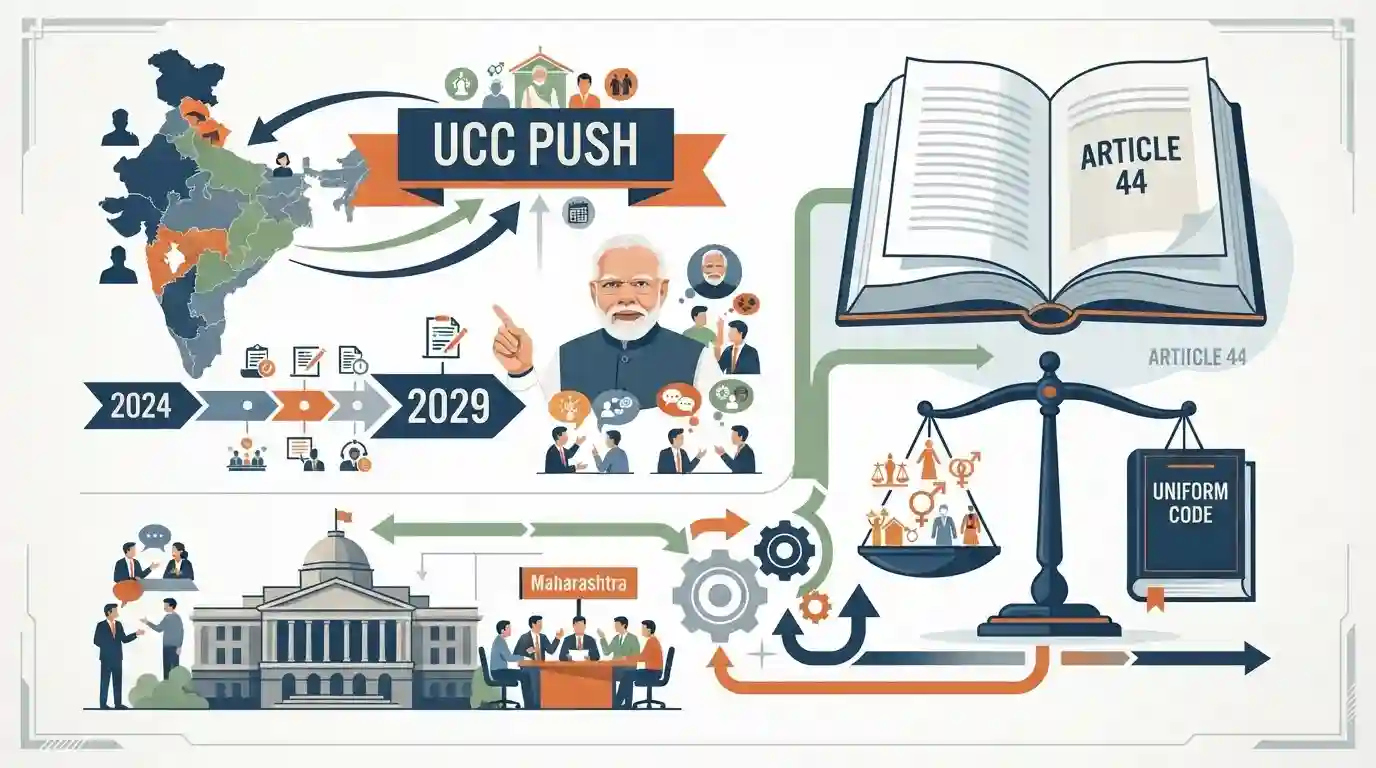
Union Home Minister Amit Shah's reported push for a 2029 deadline for BJP-ruled states to implement the Uniform Civil Code (UCC) brings the debate over uniform personal laws back to the forefront of Indian politics. States like Maharashtra have begun consultations, raising significant constitutional, federal, and social questions regarding secularism, diversity, and state-level policy execution under Article 44 of the Constitution.
Key Points
- Union Home Minister Amit Shah has set a deadline of 2029 for BJP-ruled states to roll out the Uniform Civil Code (UCC).
- Maharashtra has initiated consultations and administrative steps under state leadership to review and formulate its stance or implementation roadmap regarding the UCC.
- The move highlights the broader national push by the ruling party to enact uniform personal laws across states, bridging debates around federalism, secularism, and personal law reforms.
Important Terms
Uniform Civil Code (UCC)

A proposed law aiming to replace personal laws based on religious scriptures with a common set of governing rules for all citizens regarding marriage, divorce, inheritance, and adoption, as envisaged under Article 44.
UPSC context
Crucial for GS Paper II (Indian Polity - DPSP, Fundamental Rights, Federalism, Secularism, and Constitutional Provisions).
Prelims Trap
Goa is the only state to have successfully implemented the Uniform Civil Code mandated by Article 44 of the Constitution.
Aspirants often assume Goa's Portuguese Civil Code is a direct product of the Indian Parliament implementing Article 44, whereas it is a pre-existing colonial civil code continuing under adaptation laws.
Static Concepts Connected
What are the constitutional provisions and judicial precedents regarding the Uniform Civil Code (UCC) in India?
- Constitutional Basis: Enshrined in Part IV (Directive Principles of State Policy) under Article 44, mandating the State to endeavour to secure a UCC throughout India.
- Justiciability Status: Non-justiciable under Article 37, meaning it cannot be enforced by any court, but is fundamental in the governance of the country.
- Legislative Competence: Personal laws (marriage, divorce, inheritance) fall under Entry 5 of the Concurrent List (List III) of the Seventh Schedule.
- Judicial Precedents: Landmark cases like Shah Bano (1985) and Sarla Mudgal (1995) urged Parliament to frame a UCC to reduce gender discrimination and promote national integration.
Cross-Topic Patterns
UCC Rollout vs. Seventh Schedule Division of Powers
UCC implementation by states tests the boundaries of concurrent/state legislative competence under the Seventh Schedule, especially since 'Personal Law' sits in the Concurrent List (List III).
Article 44 DPSPs and Federal Implementation Challenges
The push for UCC in BJP-ruled states before 2029 intersects with debates on cooperative federalism and the role of DPSPs (Art 44) versus Fundamental Rights (Art 25).

Expect a statement-based question combining Article 44 (DPSP non-justiciability), Entry 5 of Concurrent List, and Goa's unique civil code history.
Linked PYQs · 2
Linked PYQs · 2
- 2024MainsGS2
Discuss India as a secular state and compare with the secular principles of the US constitution.
- 2020PrelimsGS1
Which part of the Constitution of India declares the ideal of Welfare State?
