Uniform Civil Code Bill Formulation and MP Assembly Schedule
Source:The Hindu ↗
Why It Matters
The Uniform Civil Code and Directive Principles of State Policy (Article 44) are crucial high-yield areas for MPPSC State Service Prelims. The appointment of state-level committees (like the one headed by Justice Ranjana Prasad Desai) and changes in state legislative sessions (such as the Monsoon session) directly impact both constitutional law and state-specific governance modules.
Summary
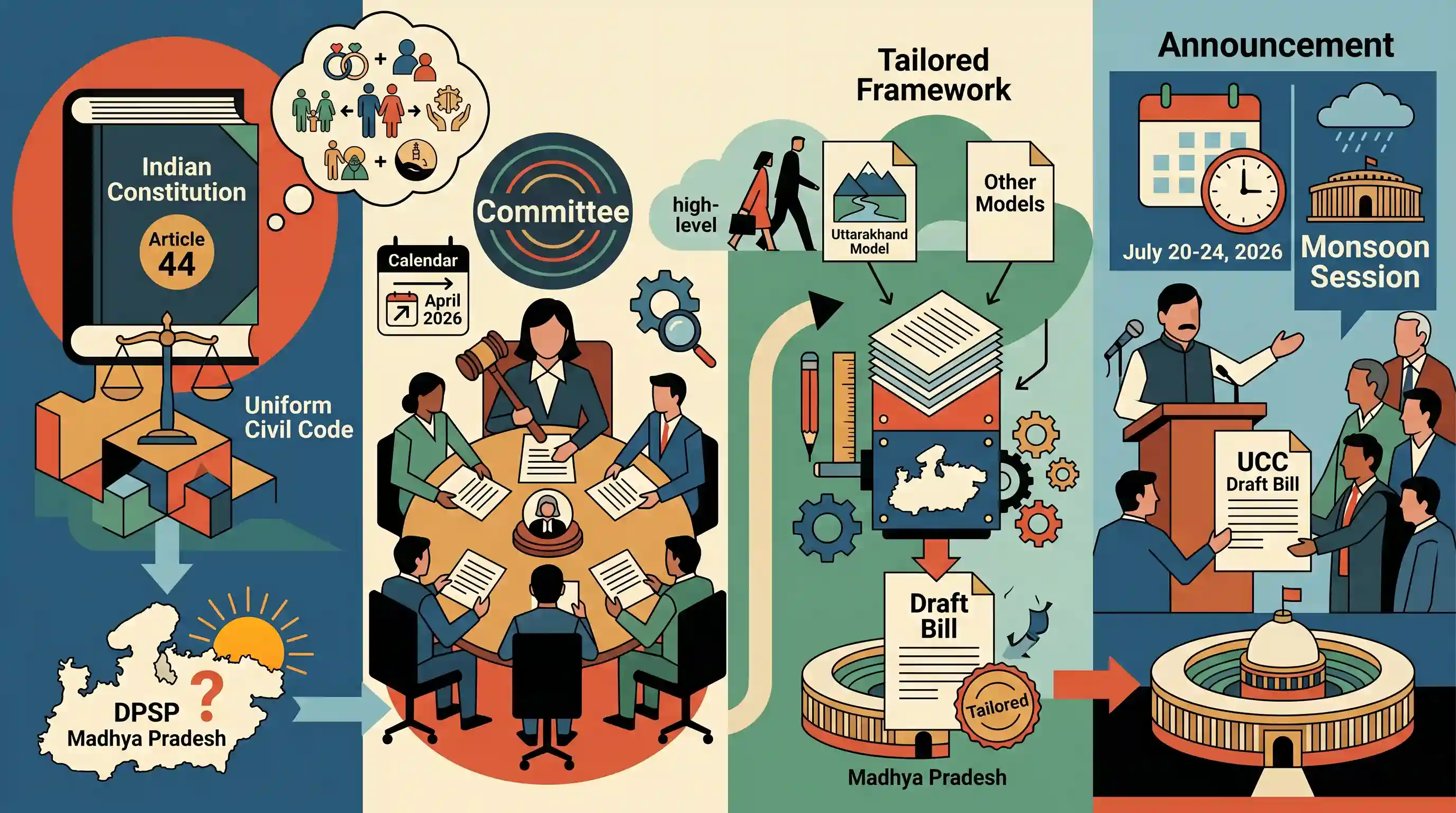
Madhya Pradesh Chief Minister Mohan Yadav announced that a draft Bill for the Uniform Civil Code (UCC) will be tabled during the State Legislative Assembly's Monsoon Session (July 20–24, 2026). The draft is being prepared by a six-member high-level committee headed by retired Supreme Court Judge Justice Ranjana Prasad Desai, which was formed in April 2026 to study existing models like Uttarakhand and draft a tailored framework.
Key Points
- Madhya Pradesh Chief Minister Mohan Yadav announced that a Bill on the Uniform Civil Code (UCC) will be introduced in the Monsoon Session of the State Legislative Assembly (slated for July 20 to 24, 2026).
- A six-member high-level committee formed in April 2026, headed by retired Supreme Court Judge Justice Ranjana Prasad Desai, has been tasked with drafting the Bill and submitting its report within 60 days.
- Justice Ranjana Prasad Desai also headed the Uttarakhand UCC drafting committee.
- The government launched a public consultation portal to invite suggestions on the proposed UCC.
- Other states taking steps towards UCC include Uttarakhand, Gujarat (studying models), and Assam (which passed a UCC Bill in May 2026).
- Constitutional context: The UCC is governed by Article 44 under Part IV of the Indian Constitution (Directive Principles of State Policy), which was borrowed from Ireland.
Important Terms
Uniform Civil Code (UCC) Bill

A legislative proposal to replace religion-based personal laws governing marriage, divorce, inheritance, and adoption with a common set of secular civil laws for all citizens, as envisioned under Article 44 of the Indian Constitution.
UPSC context
GS Paper II: Directive Principles of State Policy, federalism, and balancing fundamental rights with religious freedoms.
Madhya Pradesh Legislative Assembly
The unicameral state legislature of Madhya Pradesh, responsible for enacting state-specific laws, approving budgets, and exercising democratic oversight over the state executive under the Indian Constitution.
UPSC context
GS Paper II: Structure, functioning, and conduct of business of state legislatures, and federal legislative dynamics.
Supreme Court of India
The apex judicial body in India, serving as the ultimate interpreter and custodian of the Constitution, final court of appeal, and arbiter of legislative validity.
UPSC context
GS Paper II: Structure, organization, and functioning of the Judiciary; central to judicial review.
Assam Legislative Assembly
The unicameral legislative body of Assam, which passed the Uniform Civil Code (UCC) Bill in May 2026 while exempting the state's Scheduled Tribes to protect customary practices.
UPSC context
GS Paper II: State legislatures, Sixth Schedule exemptions, and balancing tribal autonomy with uniform codes.
Prelims Trap
Goa is the first state in independent India to draft and pass its own Uniform Civil Code legislation.
Goa did not draft a new UCC post-1947; it merely retained the pre-existing 1867 Portuguese Civil Code. Uttarakhand is the first state to freshly legislate and implement its own UCC.
Static Concepts Connected
What constitutional provisions allow State Legislatures to draft and enact a Uniform Civil Code?
- Entry 5, List III: The Concurrent List (Entry 5) grants joint jurisdiction to Parliament and State Assemblies over marriage, divorce, adoption, wills, and succession.
- Definition of State: Article 36 extends the definition of 'State' under Part IV (Article 44) to include state governments and assemblies, empowering them to pursue UCC.
- Presidential Assent: State-level UCCs that conflict with existing Central personal laws require the President of India's assent under Article 254(2) to become valid.
Cross-Topic Patterns
Asymmetric Federalism vs. Uniformity
State-specific UCCs (like Uttarakhand's inclusion vs. Assam's exclusion of Scheduled Tribes) challenge the ideal of a single national civil code, showcasing legislative asymmetry.
Sixth Schedule vs. Article 44
The legal tension between realizing Article 44 (UCC) and preserving customary laws protected under Article 371 and the Sixth Schedule remains a critical federal debate.

The conflict between state UCCs, Sixth Schedule exemptions, and Article 25/26 rights is likely to be framed as a major 2026 GS-2 question.
Linked PYQs · 3
Linked PYQs · 3
- 2023MPPSC_PRELIMSGS1
The Directive Principles of State Policy are explained in Part IV of the Indian Constitution. This system has been taken from the Constitution of which country ?
- 2022MPPSC_PRELIMSGS1
Who among the following shall preside the meeting of Council of Ministers in Madhya Pradesh in the absence of the Chief Minister?
- 2023MPPSC_PRELIMSGS1
Who amongst the following was the first Speaker of the Madhya Pradesh Legislative Assembly ?
