UAE reports unlocking frozen Iranian assets to ease regional tension
Source:The Hindu ↗
Why It Matters
Geopolitical stability in the Middle East and the security of maritime choke points like the Strait of Hormuz are crucial for global energy markets and India's energy security. The use of financial asset freezes and unfreezing as a diplomatic tool illustrates modern geopolitical strategies.
Summary
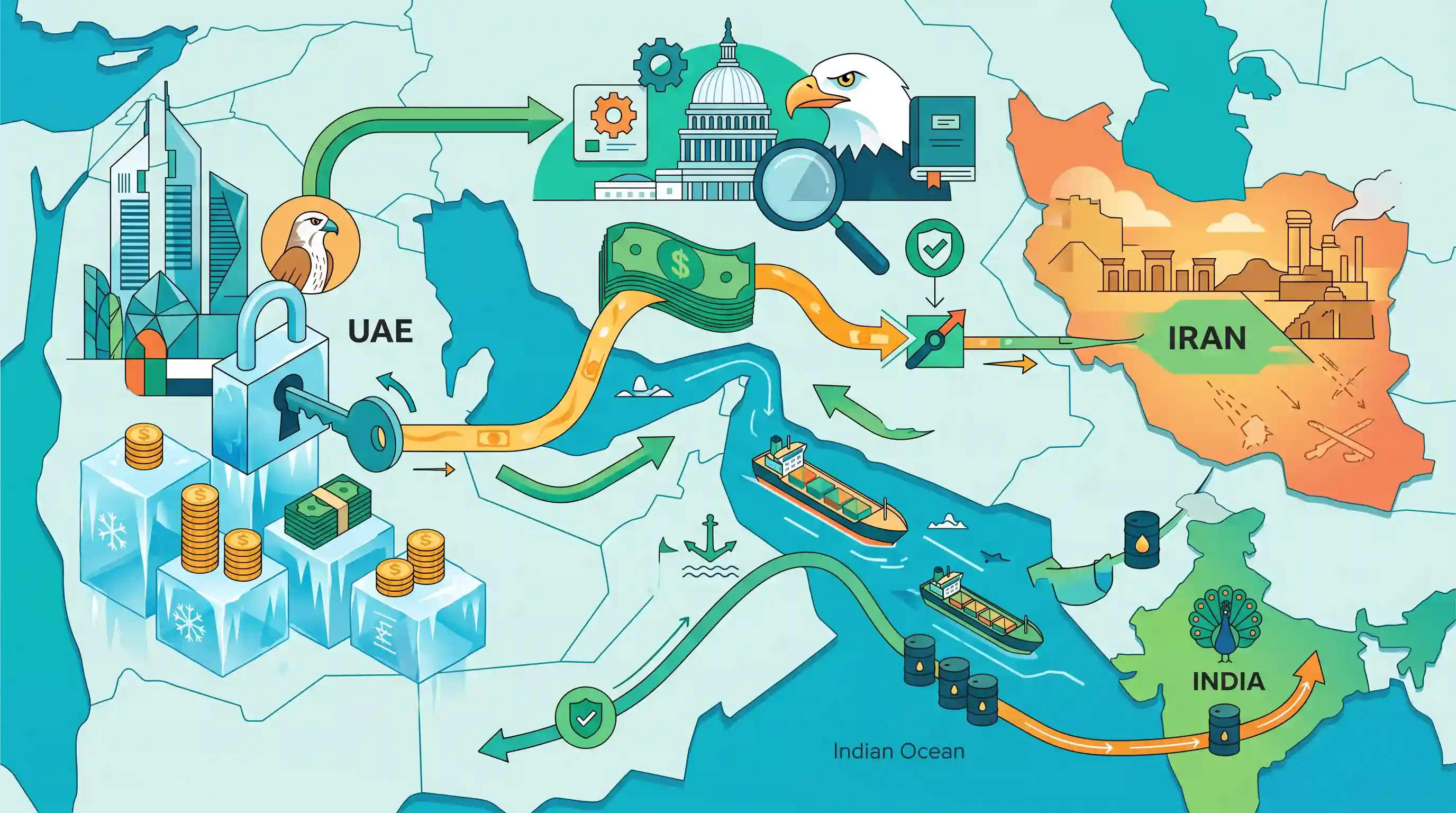
The UAE has reportedly agreed to unlock billions of dollars in frozen Iranian assets, potentially up to $20 billion, to encourage de-escalation in the Middle East and ensure safe maritime passage through the Strait of Hormuz. Although UAE officials officially deny the transfer, Iranian sources claim an initial $3 billion has already been delivered. The U.S. has signaled cautious oversight, with Vice President JD Vance stating that economic benefits would only be permitted if Iran complies with its obligations under any potential deal. This potential release of funds highlights the delicate geopolitics of the region, where financial levers and sanctions relief are utilized to mitigate conflicts and secure vital global energy supply routes.
Key Points
- The UAE has reportedly agreed to release between $10 billion to $20 billion in frozen Iranian funds, with $3 billion allegedly already delivered, though officially denied by the UAE.
- The financial unfreezing is aimed at encouraging Iran to de-escalate regional hostilities and guarantee safe maritime passage through the strategic Strait of Hormuz and Gulf of Oman.
- U.S. Vice President JD Vance emphasized that any economic benefits flowing to Tehran would be contingent upon Iran strictly meeting its obligations under potential diplomatic agreements.
- This development underscores the complex interplay of economic sanctions, diplomatic negotiations, and the critical need to secure global energy transit routes in the Middle East.
Important Terms
Strait of Hormuz

A strategic maritime chokepoint connecting the Persian Gulf and the Gulf of Oman, through which approximately one-fifth of global oil consumption passes.
UPSC context
GS Paper I (Geography) and II (International Relations); critical for India’s energy security and maritime trade routes in West Asia.
U.S. Economic Sanctions
Financial and commercial penalties imposed by the United States to influence the behavior of foreign governments, typically targeting their financial, energy, and military sectors.
UPSC context
GS Paper II (IR); tests understanding of how policies of developed nations impact India’s bilateral ties and strategic autonomy.
Secondary Sanctions
Penalties applied to non-U.S. entities (like UAE banks) for engaging in business with a sanctioned country, forcing third parties to comply with U.S. foreign policy.
UPSC context
GS Paper II (IR); vital for analyzing the extraterritorial reach of U.S. laws on India’s trade with Iran and Russia.
Frozen Assets
Financial holdings or property restricted from use or transfer by a government or international body, often as a non-military tool to leverage diplomatic negotiations.
UPSC context
GS Paper II (IR) and III (Economy); relevant for diplomatic standoffs and financial de-escalation strategies in conflict zones.
Energy Security
Ensuring the uninterrupted availability of energy sources at an affordable price, particularly critical for India due to its 85%+ dependency on crude oil imports.
UPSC context
GS Paper III (Economy/Energy); a core national interest impacted by regional instability and maritime disruptions in the Middle East.
West Asia Geopolitics
The study of strategic relations and power dynamics in the Middle East, driven by energy resources, religious rivalries, and the influence of global powers.
UPSC context
GS Paper II (IR); central to India's 'Link West' policy, diaspora safety, and regional stability.
Prelims Trap
"The Strait of Hormuz acts as a maritime chokepoint connecting the Persian Gulf to the Red Sea."
UPSC often swaps bordering water bodies. The Strait of Hormuz connects the Persian Gulf to the Gulf of Oman, whereas Bab el-Mandeb connects the Red Sea to the Gulf of Aden.
Static Concepts Connected
What is the geographical and strategic significance of the Strait of Hormuz?
- Location: It is a narrow maritime chokepoint connecting the Persian Gulf to the Gulf of Oman and the Arabian Sea.
- Bordering Nations: It is bounded by Iran to the north, and Oman (Musandam Peninsula) and the UAE to the south.
- Strategic Value: It is a crucial global energy transit route; roughly 50% of India's crude oil imports pass through this strait.
What is CAATSA and how does it impact India's foreign policy?
- Scope: Countering America's Adversaries Through Sanctions Act (CAATSA) is a US federal law imposing sanctions on Iran, North Korea, and Russia.
- Mechanism: It imposes secondary sanctions on entities doing significant trade with these nations, acting as an extraterritorial financial lever.
- Indian Context: It complicates India's S-400 missile purchase from Russia and its energy/infrastructure ties with Iran, though India secured a carve-out for Chabahar.
Cross-Topic Patterns
Sanctions and alternative payment mechanisms
Frequent freezing of dollar assets accelerates the push for bilateral currency mechanisms and de-dollarization strategies, linking this geopolitical event to macro-economic shifts in the Global South.
I2U2 alongside INSTC balancing act
UAE's pragmatic engagement with Iran mirrors India's own West Asia balancing act: deepening ties with UAE/Israel via I2U2 while expanding the Chabahar/INSTC corridor with Iran.

Expect a 2026 Prelims map question matching Middle East chokepoints (Hormuz, Bab el-Mandeb) with bordering states or recent regional crises.
Linked PYQs · 2
Linked PYQs · 2
- 2025MainsGS2
"Energy security constitutes the dominant kingpin of India's foreign policy, and is linked with India's overarching influence in Middle Eastern countries.” How would you integrate energy security with India's foreign policy trajectories in the coming years?
- 2024PrelimsGS1
Consider the following statements : Statement-I : Sumed pipeline is a strategic route for Persian Gulf oil and natural gas shipments to Europe. Statement-II : Sumed pipeline connects the Red Sea with the Mediterranean Sea. Which one of the following is correct in respect of the above statements?
