India and UAE Deepen Strategic Defense and Energy Ties
Source:The Hindu ↗
Why It Matters
The Middle East is crucial for India's energy security, diaspora remittances, and maritime trade. The strategic evolution of India-UAE ties from energy dependency to defense, space, and emerging tech (like digital embassies) illustrates India's multi-aligned foreign policy and efforts to secure its geopolitical interests amidst regional volatility.
Summary
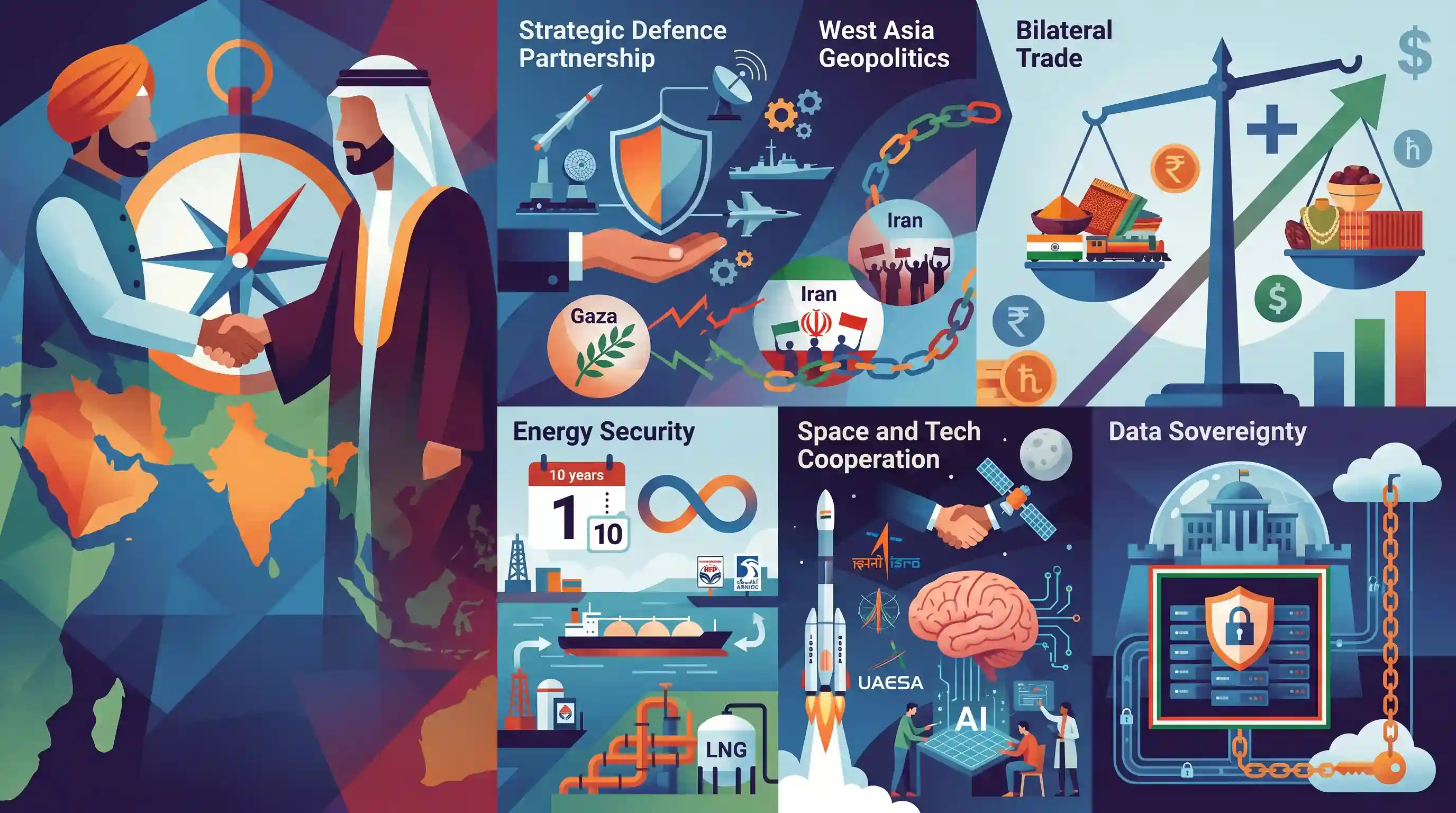
UAE President Sheikh Mohamed bin Zayed Al Nahyan's visit to India resulted in significant strategic and economic milestones, most notably a Letter of Intent for a bilateral Strategic Defence Partnership and a commitment to double bilateral trade to $200 billion by 2032. Against the complex geopolitical backdrop of the Middle East—marked by the Gaza conflict, protests in Iran, and shifting regional alliances—India is deepening its diplomatic and defense footprint. The visit also bolstered India's energy security with a 10-year LNG supply agreement between HPCL and ADNOC, and expanded technological cooperation through agreements on space industry development, artificial intelligence, and pioneering 'digital embassies' for data sovereignty.
Key Points
- India and the UAE signed a Letter of Intent for a Strategic Defence Partnership to formalize their growing defense cooperation.
- The two nations set an ambitious target to double their bilateral trade to $200 billion by 2032.
- Geopolitical discussions featured the Gaza conflict, protests in Iran, and the regional implications of the Saudi-UAE rift and Saudi-Pakistan defense ties.
- A 10-year energy deal was inked between India's HPCL and UAE's ADNOC for the supply of 0.5 MMPTA LNG starting in 2028.
- Agreements were made to enhance collaboration in the space sector (via IN-SPACe), artificial intelligence, and the establishment of 'digital embassies' to protect sovereign data.
Important Terms
Letter of Intent for a Strategic Defence Partnership

A non-binding 2026 diplomatic agreement elevating India-UAE ties from economic to military cooperation. It focuses on defense manufacturing, counter-terrorism, and cybersecurity, aiming for a formal Framework Agreement.
UPSC context
GS Paper II: International Relations. Tests understanding of West Asia's strategic shift and India's growing security footprint beyond energy.
Digital Embassies
Secure offshore data storage centers hosted in a foreign nation but governed by home-country laws and diplomatic immunity. They ensure digital continuity and data sovereignty during cyber warfare or natural disasters.
UPSC context
GS Paper III: Cybersecurity & GS Paper II: Diplomacy. Tests knowledge of data sovereignty and innovative technological diplomacy.
ADNOC (Abu Dhabi National Oil Company)
The UAE’s state-owned energy giant. In 2026, it signed a 10-year deal to supply 0.5 million tonnes of LNG annually to India, reinforcing India's long-term energy security and transition to gas.
UPSC context
GS Paper III: Economy/Energy. Important for energy security, bilateral investment, and India’s 'Gas-based Economy' target.
IN-SPACe
An autonomous agency under India’s Department of Space that promotes and regulates private sector participation in the space industry. It coordinates bilateral space industry development with entities like the UAE.
UPSC context
GS Paper III: Science and Tech. Relevant for space sector reforms and international technology commercialization.
Data Sovereignty
The principle that data collected within a nation's borders is subject to its laws. It underpins the India-UAE "Digital Embassy" deal to protect national strategic data from foreign jurisdiction.
UPSC context
GS Paper III: Internal Security/Cybersecurity. Tests concepts of digital rights, governance, and national interest in the cyber domain.
Saudi-Pakistan Mutual Defence Agreement
A 2025 security pact between Riyadh and Islamabad. In the India-UAE context, New Delhi's deepened strategic ties with Abu Dhabi act as a diplomatic counter-balance to this regional alignment.
UPSC context
GS Paper II: International Relations. Tests ability to analyze shifting regional alliances and India’s strategic "balancing act" in West Asia.
Prelims Trap
"'Digital Embassies' between India and UAE refer to fully automated consular and e-visa processing centers."
This is a trap. 'Digital Embassies' are actually secure cross-border cloud computing data centers enjoying diplomatic immunity to protect sovereign state data from threats.
Static Concepts Connected
What distinguishes a CEPA from a standard Free Trade Agreement (FTA)?
- Broader Scope: CEPAs are more comprehensive, covering trade in services, investments, and economic partnership alongside goods.
- Regulatory Harmonization: They often include advanced chapters on intellectual property rights, customs cooperation, and digital trade governance.
How does the Vienna Convention protect diplomatic premises?
- Absolute Inviolability: Article 22 of the 1961 Convention states premises of the mission are inviolable; host state agents cannot enter without the mission head's consent.
- Digital Extension: Extending physical inviolability to servers and cloud data centers is a novel legal application of this treaty.
Cross-Topic Patterns
Data Sovereignty as Foreign Policy
The concept of "Digital Embassies" bridges internal security (data localization) with external diplomacy (Vienna Convention inviolability), setting a new precedent for global cyber governance.
Energy Security via Strategic LNG term-contracts
India's shift towards 10-year LNG deals (HPCL-ADNOC) mitigates exposure to volatile spot markets, aligning with its target to increase natural gas in its energy mix to 15% by 2030.
I2U2 Minilateralism vs Deep Bilateralism
While minilaterals like I2U2 drive joint investments, India is securing core strategic assets (defense, space) via deep bilateral frameworks to bypass regional volatility like the Saudi-UAE rift or Gaza conflict.

India-UAE ties transitioning from diaspora and oil to AI, space, and 'Digital Embassies' will likely frame a 2026 Mains GS-II IR question.
Linked PYQs · 5
Linked PYQs · 5
- 2024MainsGS2
Critically analyse India's evolving diplomatic, economic and strategic relations with the Central Asian Republics (CARs) highlighting their increasing significance in regional and global geopolitics.
- 2024MainsGS2
‘The West is fostering India as an alternative to reduce dependence on China's supply chain and as a strategic ally to counter China's political and economic dominance.’ Explain this statement with examples.
- 2017MainsGS2
The question of India's Energy Security constitutes the most important part of India's economic progress. Analyze India's energy policy cooperation with West Asian countries.
- 2025MainsGS3
Why is maritime security vital to protect India's sea trade? Discuss maritime and coastal security challenges and the way forward.
- 2025MainsGS3
The fusion energy programme in India has steadily evolved over the past few decades. Mention India's contributions to the international fusion energy project International Thermonuclear Experimental Reactor (ITER). What will be the implications of the success of this project for the future of global energy?
