United Arab Emirates Withdraws from OPEC Cartel
Source:The Hindu ↗
Why It Matters
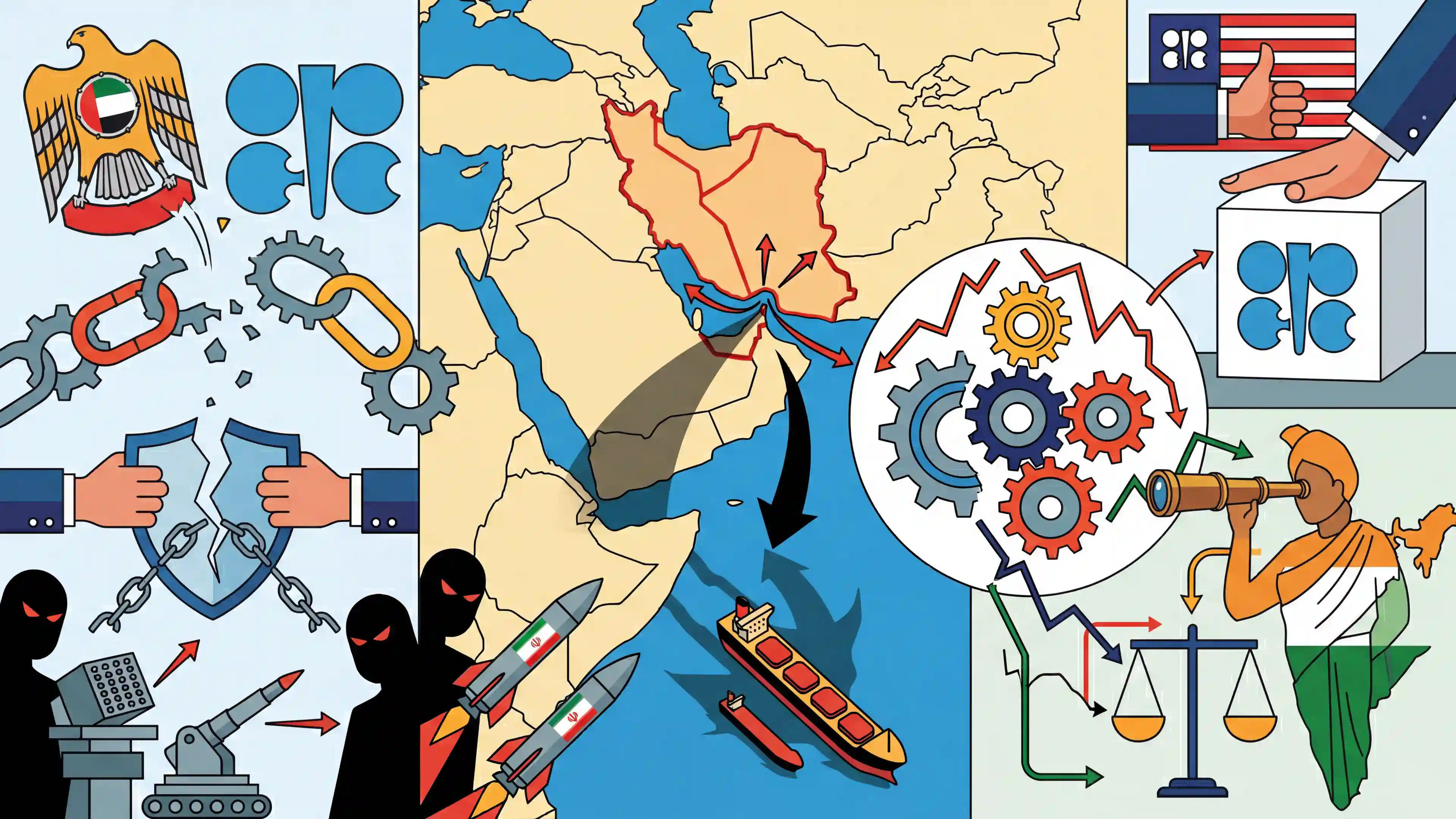
The UAE's exit from OPEC alters the balance of power in the Middle East and directly impacts global energy security. For India, which heavily relies on Gulf oil and remittances, stability in the GCC and secure transit through the Strait of Hormuz are critical to its economic and strategic interests.
Summary
The United Arab Emirates has unexpectedly withdrawn from the OPEC and OPEC+ oil cartels, citing deep dissatisfaction with the lack of defense and solidarity from Saudi Arabia and the broader Gulf Cooperation Council (GCC) amid escalating Iranian attacks. The dramatic exit threatens to severely disrupt global energy markets by dismantling the cartel's production cohesion, potentially leading to volatile crude oil prices. The move exposes widening geopolitical rifts in West Asia, highlights the vulnerability of the Strait of Hormuz as a critical energy chokepoint, and was welcomed by the US as a blow to OPEC's market dominance.
Key Points
- The UAE announced its exit from the OPEC and OPEC+ oil cartels, citing a lack of support from Saudi Arabia and the GCC against Iranian attacks.
- The departure deals a massive blow to the global oil producers' group, threatening to cause significant volatility in international crude oil and energy markets.
- The move underscores deepening geopolitical fractures within the Arab League and the Gulf Cooperation Council over regional security and Iran's influence.
- The US administration welcomed the development as a victory against the cartel's manipulation of global oil prices.
- The conflict highlights the strategic vulnerability of the Strait of Hormuz, a critical maritime chokepoint for crude oil and LNG transit.
Important Terms
OPEC

An intergovernmental organization founded in 1960 by major oil-exporting nations to coordinate petroleum policies, stabilize market prices, and ensure a regular, cost-effective supply of petroleum to consuming nations.
UPSC context
GS II (International Relations) & GS III (Energy Security). Tests knowledge of global energy cartels and their impact on India’s import-dependent economy.
OPEC+
A coalition formed in 2016 between OPEC members and 10 non-OPEC oil producers (notably Russia) to collectively manage global crude oil supply and counter market volatility through production adjustments.
UPSC context
GS II (Global Groupings). Focuses on evolving geopolitical alliances and their role in global commodity price regulation.
Strait of Hormuz
A strategic maritime chokepoint connecting the Persian Gulf and the Gulf of Oman, through which approximately one-fifth of the world’s total oil and liquefied natural gas (LNG) consumption passes.
UPSC context
GS I (Geography) & GS III (Energy Security). Tests understanding of global energy transit vulnerabilities and India’s strategic petroleum interests.
Gulf Cooperation Council (GCC)
A political and economic union of six Arab states in the Persian Gulf (Saudi Arabia, UAE, Qatar, Kuwait, Oman, Bahrain) promoting regional integration, economic coordination, and security cooperation.
UPSC context
GS II (Bilateral/Regional groupings). Critical for India’s energy security, trade, and the welfare of the Indian diaspora in West Asia.
Arab League
A regional organization of 22 Arab nations founded in 1945 to strengthen ties, coordinate political and economic programs, and safeguard the sovereignty and independence of member states.
UPSC context
GS II (International Groupings). Relevant for understanding West Asian geopolitics, Pan-Arabism, and India’s "Look West" policy.
Prelims Trap
"All GCC nations are members of OPEC, and the UAE is the first Gulf state to exit."
Qatar (a GCC member) already left OPEC in 2019. Furthermore, GCC members Oman and Bahrain are not OPEC members (they belong to OPEC+).
Static Concepts Connected
What distinguishes OPEC from the OPEC+ alliance?
- OPEC Core: Founded in 1960 by Iran, Iraq, Kuwait, Saudi Arabia, and Venezuela as a permanent intergovernmental organization to coordinate petroleum policies.
- OPEC+ Expansion: Formed in 2016, this expanded alliance added 10 non-OPEC major oil exporters—including Russia, Oman, and Kazakhstan—to better manage global supply and prices.
What is the geographic significance of the Strait of Hormuz?
- Connecting Waters: A crucial maritime chokepoint linking the Persian Gulf to the Gulf of Oman and the broader Arabian Sea.
- Bordering Nations: Bounded by Iran to the north and the Musandam Peninsula (an exclave of Oman) and the UAE to the south.
- Energy Transit: Facilitates the transit of roughly 20% of global daily oil supply and significant volumes of LNG, making it vulnerable to geopolitical blockades.
Cross-Topic Patterns
Abraham Accords and I2U2 shifts
The UAE's rift with the Saudi-led GCC reflects its distinct strategic autonomy and deepening alignment with the US, India, and Israel under new-age frameworks like I2U2 and IMEC.
India's Strategic Petroleum Reserves
A post-OPEC production free-for-all threatens short-term price volatility, directly testing the adequacy of India's Strategic Petroleum Reserves (SPR) and hastening macroeconomic shifts toward renewables.

Expect a multi-statement Prelims question testing the exact overlaps and exclusions between GCC, OPEC, and OPEC+ memberships in 2026.
Linked PYQs · 3
Linked PYQs · 3
- 2016PrelimsGS1
Which of the following is not a member of 'Gulf Cooperation Council'?
- 2017MainsGS2
The question of India's Energy Security constitutes the most important part of India's economic progress. Analyze India's energy policy cooperation with West Asian countries.
- 2025MainsGS2
"Energy security constitutes the dominant kingpin of India's foreign policy, and is linked with India's overarching influence in Middle Eastern countries.” How would you integrate energy security with India's foreign policy trajectories in the coming years?
