Geopolitical Divergences and BRICS Joint Statement Stalemate
Source:The Hindu ↗
Why It Matters
It provides a real-world example of the challenges inherent in expanding multilateral blocs like BRICS. It also vividly illustrates India's strategic autonomy and its 'de-hyphenated' foreign policy, balancing robust ties with Israel against traditional support for Palestine, a frequent topic in UPSC Mains GS2.
Summary
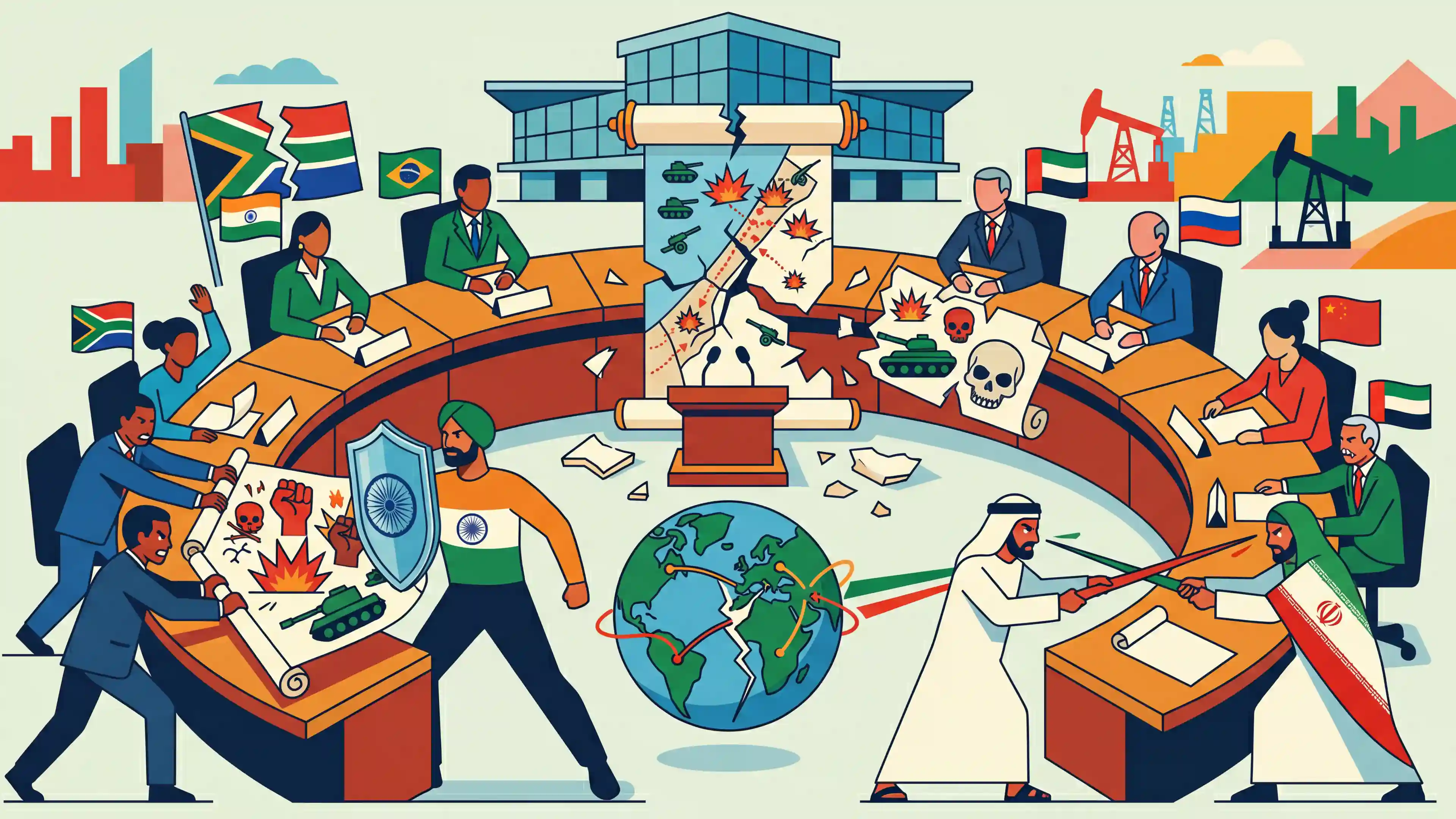
The expanded BRICS grouping failed to issue a joint statement at a recent meeting due to significant internal geopolitical rifts. The breakdown was primarily driven by differences between newly inducted members the UAE and Iran, as well as India's firm stance on the Israel-Palestine conflict. India pushed back against the majority consensus driven by nations like South Africa and Iran, successfully diluting critical language regarding Israel's actions in Gaza (such as the term "genocide") and insisting on the inclusion of the October 7 attacks. This episode underscores the growing challenge of achieving consensus within BRICS amid diverging national interests and regional Middle Eastern rivalries.
Key Points
- A joint statement at a BRICS meeting was derailed due to sharp internal divisions, exposing vulnerabilities in the newly expanded 10-member bloc.
- India actively intervened to dilute the draft's language on the Israel-Palestine conflict, opposing terms like 'genocide' in Gaza and insisting on condemning the October 7 terror attacks.
- Frictions between newly inducted members the UAE and Iran over regional geopolitics further obstructed consensus.
- The incident highlights the operational difficulties of harmonizing divergent national foreign policies—such as India's de-hyphenated approach to Israel and Palestine—within multilateral platforms.
Important Terms
BRICS / BRICS+

An intergovernmental grouping of major emerging economies (initially Brazil, Russia, India, China, South Africa) recently expanded to include Iran, UAE, Egypt, and Ethiopia to foster economic cooperation and global governance reform.
UPSC context
GS-II: International Relations. Crucial for understanding global groupings, South-South cooperation, and India's role in a changing world order.
Consensus-based decision-making
A diplomatic principle requiring unanimous agreement from all member states for any official decision or joint statement, ensuring sovereign equality but often resulting in delays or deadlocked negotiations.
UPSC context
GS-II: Multilateralism. Tests understanding of the structural challenges within informal global groupings compared to treaty-based organizations.
Two-State Solution
India’s long-standing diplomatic stance advocating for an independent, viable Palestinian state existing peacefully alongside Israel, based on negotiated borders and mutual recognition.
UPSC context
GS-II: India's Foreign Policy. Essential for questions on West Asia/Middle East geopolitics and India's balancing act between Israel and Palestine.
Global South
A geopolitical term referring to developing and emerging nations in Africa, Asia, and Latin America; BRICS often positions itself as a representative platform for these countries' interests.
UPSC context
GS-II: Global groupings. Central to India's ambition of being a 'Vishwa Bandhu' or leader of the developing world.
Chair’s Statement
A document issued by the host nation of a summit to summarize discussions when a unanimous 'Joint Statement' or 'Declaration' cannot be reached due to internal disagreements.
UPSC context
GS-II: International Relations. Demonstrates understanding of diplomatic nuances and the outcomes of fragmented multilateral diplomacy.
Multipolarity
A world order characterized by several centers of power rather than a single hegemon, which BRICS aims to promote as an alternative to Western-led global dominance.
UPSC context
GS-II: Important International institutions. Relevant for discussing the shifting balance of global power and India's strategic autonomy.
Prelims Trap
Decisions in the expanded BRICS are taken by a simple or two-thirds majority to overcome bilateral differences.
BRICS operates strictly on consensus. As seen here, a single member's objection can completely derail joint declarations, even in the expanded format.
Static Concepts Connected
What is India's 'de-hyphenated' foreign policy?
- Independent Ties: Treating relationships with two antagonistic countries (e.g., Israel and Palestine) independently, rather than viewing them through a zero-sum lens.
- Strategic Autonomy: Allows India to maintain robust defense ties with Israel while continuing humanitarian aid and political support for a two-state solution in Palestine.
Which disputed islands cause geopolitical friction between the UAE and Iran?
- The Islands: Abu Musa, Greater Tunb, and Lesser Tunb. They are claimed by the UAE but administered by Iran.
- Strategic Location: Located in the eastern Persian Gulf near the critical Strait of Hormuz chokepoint, granting significant maritime control over global oil traffic.
Cross-Topic Patterns
Multilateral Paralysis & Minilateral Rise
The consensus deadlock in expanded BRICS mirrors SAARC's stagnation, further justifying India's recent diplomatic shift towards agile, issue-based minilaterals like I2U2 and the Quad.
Global South Heterogeneity
The Global South is not a monolith; BRICS exposes how regional rivalries (UAE-Iran) and differing strategic alignments prevent a unified anti-Western posture.

Expect a 2026 Prelims question mapping Persian Gulf islands (Abu Musa, Tunbs) or a statement on BRICS' strictly consensus-based voting.
Linked PYQs · 4
Linked PYQs · 4
- 2012MainsGS2
Compare the significance of IBSA and BRICS in the context of India's multilateral diplomacy.
- 2018MainsGS2
“India’s relations with Israel have, of late, acquired a depth and diversity, which cannot be rolled back.” Discuss.
- 2025PrelimsGS1
Consider the following statements with regard to BRICS : I. 16th BRICS Summit was held under the Chairship of Russia in Kazan. II. Indonesia has become a full member of BRICS. III. The theme of the 16th BRICS Summit was Strengthening Multiculturalism for Just Global Development and Security. Which of the statements given above is/are correct?
- 2014PrelimsGS1
With reference to a grouping of countries known as BRICS, consider the following statements: 1. The First Summit of BRICS was held in Rio de Janeiro in 2009. 2. South Africa was the last to join the BRICS grouping. Which of the statements given above is/are correct?
