UAE Bilateral Investment and Semiconductor Sector in Gujarat
Source:bisinfotech ↗
Why It Matters
Highlights the practical outcomes of the India-UAE CEPA, specifically focusing on how foreign direct investment is being channeled into strategic sectors like semiconductors, green hydrogen, and food parks to align with India's self-reliance (Atmanirbhar Bharat) and infrastructure goals.
Summary
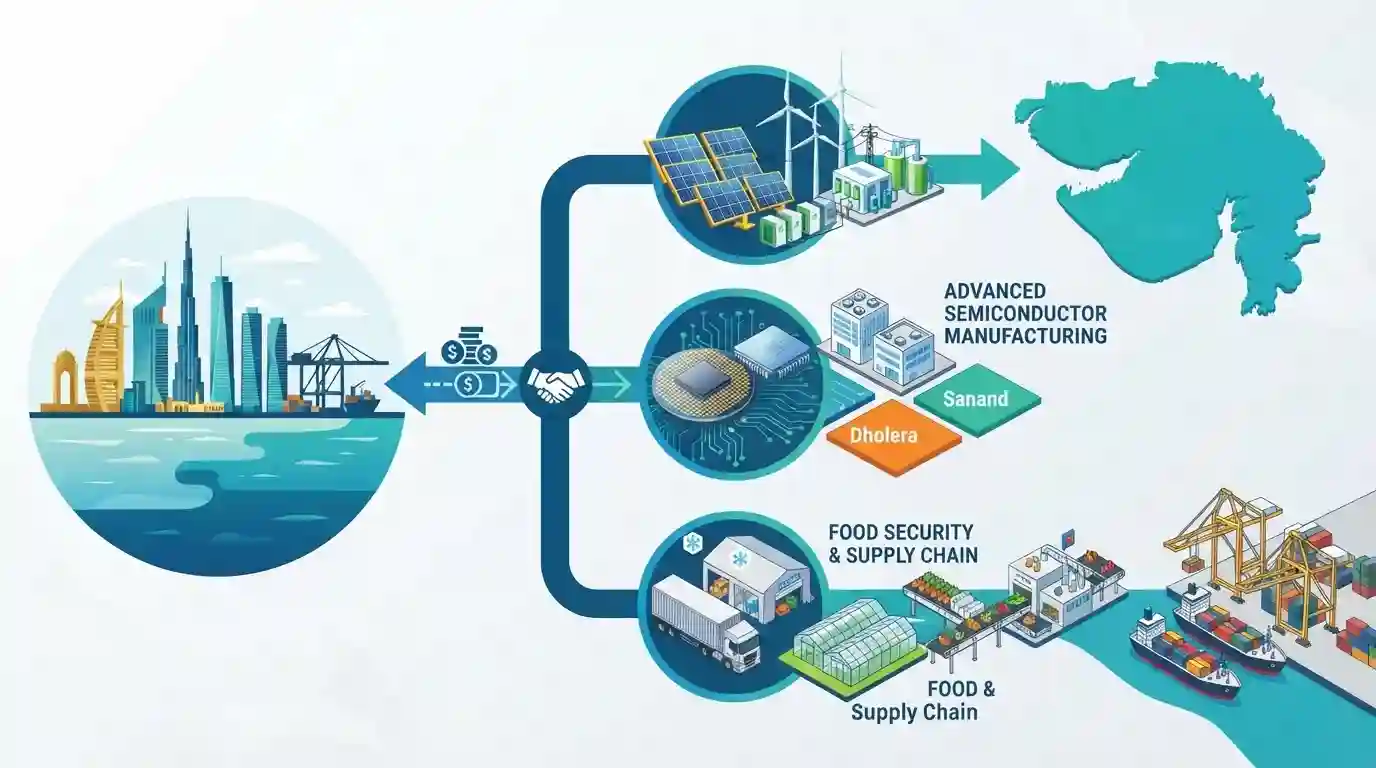
The United Arab Emirates is strategically expanding its investment footprint in Gujarat across critical sectors to bolster bilateral economic ties under the CEPA framework. Key target areas include robust investments in renewable energy infrastructure (solar, wind, and green hydrogen) and advanced semiconductor manufacturing clusters in Dholera and Sanand. Additionally, the UAE aims to enhance regional supply chain resilience through significant capital allocation to food security projects like cold chains and food parks, alongside logistics and maritime port upgrades. This diversified investment strategy underscores a transition towards non-oil trade, sustainable industrialization, and high-tech growth in India.
Key Points
- The UAE is planning to significantly expand its investments in Gujarat, focusing on energy, semiconductors, food security, and logistics.
- Food security investments will target agriculture supply chains, encompassing food parks, cold storage facilities, and export centres to secure regional food supplies.
- Energy sector investments will emphasize renewable resources, specifically solar, wind, and green hydrogen, to support a strategic clean energy transition.
- The UAE plans to invest in advanced manufacturing and semiconductor ecosystems, particularly targeting the emerging industrial clusters in Dholera and Sanand.
- Logistics and maritime port infrastructure will be upgraded through multi-modal logistics parks and freight corridors, leveraging the India-UAE CEPA to boost non-oil bilateral trade.
Important Terms
Comprehensive Economic Partnership Agreement (CEPA)

A comprehensive free-trade pact covering goods, services, and investments. The India-UAE CEPA, signed in 2022, provides duty-free market access and fosters robust bilateral non-oil trade.
UPSC context
Crucial for GS2 (International Relations) and GS3 (Economy), particularly for evaluating India's FTA strategy and West Asia diplomacy.
India Semiconductor Mission (ISM)
A specialized government initiative offering massive fiscal incentives to build a robust domestic semiconductor and display manufacturing ecosystem, reducing reliance on global electronics imports.
UPSC context
Highly relevant for GS3 (Science & Tech, Economy), testing knowledge on indigenization of technology and strategic industrial policy.
India-UAE Food Corridor
A strategic initiative backed by massive UAE capital to develop integrated agricultural supply chains, mega food processing parks, and advanced logistics networks across India.
UPSC context
Important for GS2 (IR) and GS3 (Agriculture, Food Security), highlighting cross-border infrastructure investments and supply chain resilience.
Dholera Special Investment Region
A major greenfield smart city in Gujarat. Supported by state and central policies, it is rapidly emerging as India's premier high-tech hub for large-scale semiconductor fabrication.
UPSC context
Tests knowledge of industrial hubs and smart city infrastructure, relevant to GS3 (Infrastructure) and GS1 (Economic Geography).
Prelims Trap
"The I2U2 food parks in India are jointly funded by all four member nations."
While I2U2 is a joint strategic initiative, the $2 billion funding specifically for integrated climate-smart food parks in India was committed entirely by the UAE.
Static Concepts Connected
How does a CEPA differ from a traditional Free Trade Agreement (FTA)?
- Broader Scope: CEPAs cover services, investments, intellectual property, and regulatory cooperation, whereas traditional FTAs primarily focus on reducing tariffs on goods.
- Deep Integration: They aim for deeper economic integration by addressing non-tariff barriers, mutual recognition agreements, and customs cooperation.
What distinguishes Foreign Direct Investment (FDI) from Foreign Portfolio Investment (FPI)?
- Lasting Interest: FDI involves acquiring a lasting interest (usually 10%+ equity) and management control, while FPI is purely financial capital in stocks or bonds.
- Volatility & Nature: FDI is stable and long-term, often bringing technology transfer, whereas FPI is highly liquid and can quickly exit a country (hot money).
Cross-Topic Patterns
I2U2 synergies with Food Security
The UAE's food park investments directly link to the I2U2 agenda, merging Middle Eastern capital and Israeli agricultural tech with Indian output to secure regional supply chains.
Semiconductors + Strategic Geography
Dholera and Sanand are emerging as twin nodes for the India Semiconductor Mission, merging state-level infrastructure incentives with strategic foreign sovereign wealth investments.

Expect a multi-statement question in 2026 linking UAE's CEPA non-oil trade surge with its I2U2 food security funding in India.
Linked PYQs · 5
Linked PYQs · 5
- 2022GPSC_PRELIMSGS1
Which of the following country emerged as the top trading partner of India in 2022?
- 2025GPSC_PRELIMSGS1
Which of the following would be considered as foreign direct investment in India? 1. Subsidiaries of foreign companies in India 2. Majority foreign equity holding in Indian company 3. Portfolio investment Select the correct answer using the codes given below:
- 2026GPSC_PRELIMSGS1
With reference to the 'India Semiconductor Mission' (ISM), consider the following statements: 1. The India Semiconductor Mission (ISM) is established as an independent business division within the 'Digital India Corporation' to build a semiconductor and display ecosystem. 2. The mission aims to transition India's role from a traditional 'consumer' of semiconductors to a significant 'producer' and an integrated participant in the Global Semiconductor Value Chain. Which of the above statement(s) is/are correct?
- 2025GPSC_PRELIMSGS1
Reliance industries has announced plans to build the world's largest data centre in ______
- 2026GPSC_PRELIMSGS1
Which of the following statement/s is/are correct regarding Renewable Energy Installed Capacity in India? 1. Wind energy is second only to solar energy in the Indian renewable sector. 2. Biomass power capacity accounts for around 30% of India's total renewable energy. 3. India ranks among the top three countries in the world in Hydropower Installed Capacity. Choose the correct option from the following.
