Bombay High Court Tightens Oversight on Mumbai Air Pollution
Source:Indian Express ↗
Why It Matters
This case provides a contemporary, concrete example of the higher judiciary intervening in urban environmental governance due to the chronic failure of municipal bodies to implement pollution control measures, directly relevant to GS2 (Judicial Activism/Executive Accountability) and GS3 (Environmental Pollution).
Summary
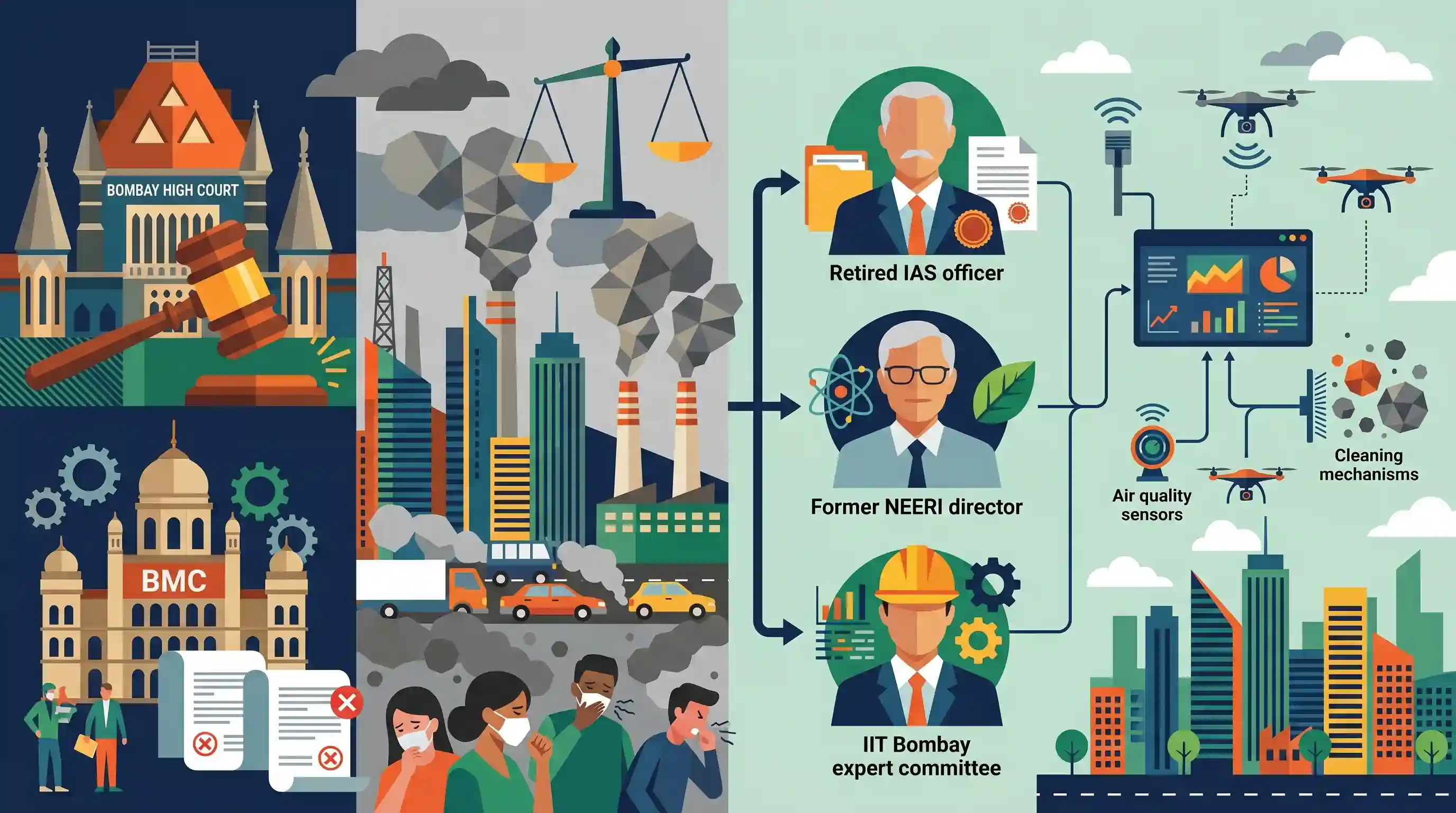
The Bombay High Court has strongly criticized the Brihanmumbai Municipal Corporation (BMC) for its failure to tackle Mumbai's severe air pollution over the past two years, despite previous court interventions. Noting that the civic body's 2023 mitigation guidelines were not implemented on the ground, the court stepped in to tighten its oversight. It formed a high-power committee comprising a retired IAS officer, a former NEERI director, and an IIT Bombay expert to monitor and enforce pollution control measures. This development highlights the growing necessity of judicial intervention and expert committees in addressing urban environmental crises caused by executive inaction.
Key Points
- The Bombay High Court strongly reprimanded the Brihanmumbai Municipal Corporation (BMC) for its failure to curb severe air pollution in Mumbai despite a pending suo motu Public Interest Litigation (PIL) initiated two years ago.
- The court observed that mitigation guidelines proposed by the BMC in 2023 remained largely unimplemented on the ground, reflecting significant executive apathy and governance failure in addressing a critical public health issue.
- To ensure strict compliance and effective implementation of pollution control measures, the High Court constituted a three-member high-power committee to oversee the municipal body's actions.
- The independent panel includes experts such as a retired IAS officer, a former NEERI director, and an environmental science nominee from IIT Bombay, illustrating the role of expert-driven judicial oversight in environmental governance.
Important Terms
Bombay High Court

The constitutional court for Maharashtra and Goa, exercising judicial oversight under Article 226. It plays a pivotal role in environmental jurisprudence by enforcing the right to a clean environment.
UPSC context
GS Paper 2: Judiciary, Judicial Activism; GS Paper 3: Environmental Governance. Tests understanding of judicial intervention in executive failures.
Brihanmumbai Municipal Corporation (BMC)
India's wealthiest municipal body, established under the 1888 Act to manage Mumbai's infrastructure and public health. It is the primary executive agency responsible for urban pollution mitigation.
UPSC context
GS Paper 2: Urban Local Bodies, 74th Amendment Act. Tests knowledge of municipal functions and challenges in urban governance.
National Environmental Engineering Research Institute (NEERI)
A premier CSIR laboratory headquartered in Nagpur, specializing in environmental science and engineering. It provides technical expertise for pollution monitoring and develops innovations like 'green crackers.'
UPSC context
GS Paper 3: Science and Technology, Environmental Pollution. Tests awareness of institutional frameworks for scientific environmental management.
Judicial Activism
The proactive role of the judiciary in ensuring the executive fulfills its constitutional duties, particularly when fundamental rights like the 'Right to Life' (Article 21) are at risk.
UPSC context
GS Paper 2: Indian Constitution, Judiciary. Central theme for questions on the separation of powers and judicial overreach vs. activism.
Urban Governance
The management of urban areas through institutions like Municipalities. In India, it focuses on decentralization, service delivery, and the balance between executive action and judicial oversight.
UPSC context
GS Paper 2: Governance, Local Bodies. Relevant for discussing the efficiency of city administration and public health management.
IIT Bombay
A premier public technical university that provides expert consultancy and scientific research for national sustainability missions and court-mandated environmental committees.
UPSC context
GS Paper 3: Science and Technology, Environment. Highlights the role of academic institutions in solving complex urban and ecological crises.
Prelims Trap
"NEERI is an apex statutory body functioning under the Ministry of Environment, Forest and Climate Change."
NEERI is not a statutory body under MoEFCC. It is a constituent laboratory of the Council of Scientific and Industrial Research (CSIR), under the Ministry of Science and Technology.
Static Concepts Connected
What is the National Environmental Engineering Research Institute (NEERI)?
- Establishment: Established in 1958 and headquartered in Nagpur, Maharashtra.
- Parent Ministry: It functions as a constituent laboratory of CSIR under the Ministry of Science and Technology, not MoEFCC.
- Core Mandate: Conducts research in environmental science, often advising the judiciary and government on pollution mitigation, waste management, and ecological assessments.
How does the judiciary enforce environmental governance against executive apathy?
- Suo Motu PILs: Courts can initiate cases on their own cognizance based on news or reports, linking a clean environment to the Right to Life (Article 21).
- Continuous Mandamus: Courts keep cases pending over long periods to monitor and enforce the implementation of their directives by the executive.
- Expert Committees: When agencies fail, courts create technical panels (e.g., EPCA under the Environment Protection Act 1986) to force multi-agency compliance.
Cross-Topic Patterns
74th Amendment & ULB Capacity Failure
Judicial assumption of municipal functions highlights the chronic financial, technical, and political weakness of Urban Local Bodies (ULBs) in managing core constitutional mandates like public health.
Coastal Topography & Changing Air Quality
Mumbai’s pollution crisis marks a geographical shift; its coastal breeze historically flushed pollutants, but changing wind patterns and massive construction dust have overwhelmed its natural geographic advantage.

Expect a 2026 prelims question testing the parent ministry of NEERI alongside the statutory backing of judiciary-mandated expert panels.
Linked PYQs · 2
Linked PYQs · 2
- 2022MainsGS2
“The most significant achievement of modern law in India is the constitutionalization of environmental problems by the Supreme Court.” Discuss this statement with the help of relevant case laws.
- 2022PrelimsGS1
In the context of WHO Air Quality Guidelines, consider the following statements: 1. The 24-hour mean of PM2.5 should not exceed 15 µg/m³ and annual mean of PM2.5 should not exceed 5 µg/m³. 2. In a year, the highest levels of ozone pollution occur during the periods of inclement weather. 3. PM10 can penetrate the lung barrier and enter the bloodstream. 4. Excessive ozone in the air can trigger asthma. Which of the statements given above are correct?
